Français (France)
  Nederlands (nl-NL)
 00:00 • intro | 00:27 • mysterious stones in the countryside | 01:08 • sad memories of the Vietnam War | 01:56 • the jars scattered on the plain | 05:42 • the cave | 06:59 • mysterious stones in the undergrowth
Personal creation from visual material collected during my trip Laos and Bangkok (2022)
Map of places or practices in Phonsavan on this site
• Use the markers to explore the content •
Phonsavan and the Plain of Jars, between archaeological enigma and recent history
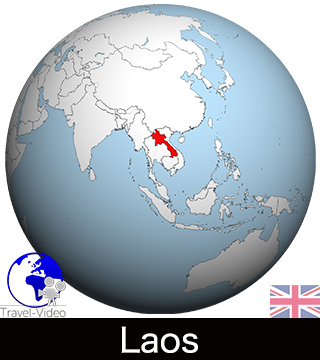
A singular landscape in northeastern Laos
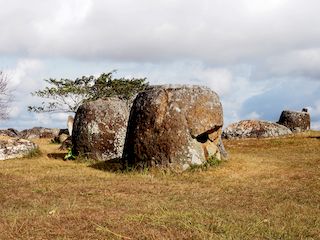
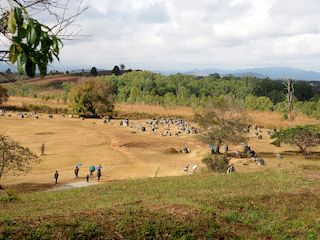
In the region of Phonsavan, in northeastern Laos, lies one of Southeast Asia’s most intriguing archaeological landscapes: the Plain of Jars. Spread across a plateau of grasslands, cultivated fields, and wooded areas, the site is characterized by the presence of hundreds of large stone jars scattered across the terrain. Rather than forming a clearly bounded monument, these elements are integrated into an open landscape, where archaeological remains and natural features coexist.
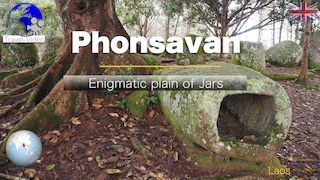
The video offers a gradual exploration of this environment, combining observations of the countryside with a close look at the stone jars and their surroundings. It also introduces a more recent historical layer, revealing how this seemingly remote landscape has been shaped by events that extend well beyond its ancient origins.
Dispersed stone structures across varied settings
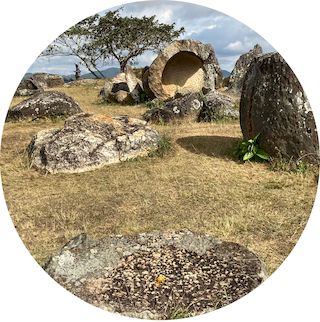
The stone jars themselves form the core of the site. Distributed over multiple locations, they appear in a variety of configurations, sometimes isolated, sometimes grouped in clusters. Their dimensions and shapes differ, but they share a common characteristic: they are placed directly on the ground, without any clearly preserved architectural framework linking them together.
Throughout the video, these jars are observed in contrasting environments. Some stand prominently in open areas of the plain, fully exposed to light and weather, while others are partially hidden in wooded zones, where vegetation alters their visibility and spatial perception. This diversity of contexts reinforces the impression of a fragmented yet coherent site, extending across a wide territory.
A cave also appears as part of the exploration, introducing a different spatial dimension. In contrast to the open plateau, this enclosed environment suggests additional uses of the landscape, whether linked to ancient practices or to more recent periods.
A landscape marked by modern conflict
Beyond its archaeological significance, the region around Phonsavan bears the imprint of more recent history. During the Vietnam War, this part of Laos was heavily bombed, leaving lasting traces on both the land and the local population. The video alludes to these events through elements embedded in the landscape, reminding viewers that the Plain of Jars is not only an ancient site but also a place shaped by twentieth-century conflict.
These remnants introduce a second layer of interpretation. The juxtaposition of prehistoric or protohistoric artifacts with signs of modern warfare creates a complex narrative, where different periods coexist within the same space. This overlap contributes to the distinctive character of the site and deepens its historical significance.
Unresolved questions and archaeological interpretations
The origin and purpose of the stone jars remain uncertain, which is a key factor in the fascination they inspire. Various hypotheses have been proposed, including their possible use in funerary practices, but no single explanation has been universally accepted. This lack of definitive interpretation leaves the site open to ongoing research and debate.
The scale of the jars, the choice of materials, and their distribution suggest a high level of organization and technical capability. Transporting and positioning such heavy stone objects would have required coordinated effort and knowledge of the terrain. These elements indicate that the site reflects a structured society, even if its precise cultural framework is not fully understood.
As a result, the Plain of Jars stands as both an archaeological resource and an unresolved historical puzzle.
What the visual construction makes particularly clear
The video, built largely from carefully selected and animated photographs, offers a clear reading of the site’s complexity. By focusing on specific details in each sequence, it highlights the relationship between the jars, the terrain, and the surrounding vegetation.
The transitions between open plains, wooded areas, and enclosed spaces such as the cave help clarify how these different environments are connected. This approach makes it easier to grasp the spatial organization of the site, which can otherwise be difficult to perceive during a short visit.
The slower visual rhythm allows for close observation of textures, erosion patterns, and the positioning of the jars within the landscape. It also emphasizes subtle variations between different areas, revealing both the diversity and the underlying coherence of the site.
A site between mystery and memory
The Plain of Jars occupies a unique position at the intersection of archaeology, landscape, and recent history. It cannot be understood solely as an ancient monument, nor only as a place marked by modern events. Instead, it represents a layered environment in which different periods and meanings coexist.
The exploration presented in the video highlights this complexity, offering a structured and accessible introduction to the site. For a more detailed understanding, the associated page dedicated to the Plain of Jars provides additional insights into its features and the questions that continue to surround it.
Links to related pages











Audio Commentary Transcript
Somewhere in Laos, between Luang Prabang and Vientiane, stretches a vast grassy expanse. At first glance, it seems ordinary, but it harbors one of the greatest archaeological enigmas of Southeast Asia: the Plain of Jars in Phonsavan. In the distance, a lone dead tree stands at the edge of a crater, a sad remnant of the destructive bombings during the Vietnam War. On the horizon, mysterious silhouettes emerge, appearing to be nothing more than large stones.
But as one approaches these mysterious silhouettes, a startling truth emerges: these are not mere stones, but hand-carved jars scattered across the landscape. The Phonsavan region is home to nearly 2,000 of these stone vessels, spread across about a hundred sites.
The proximity of Phonsavan to the Ho Chi Minh Trail, a key route during the Vietnam War, made this region the most bombed area in the world from 1964 to 1973. Today, while some sites housing the famous ancient jars are open to the public, many others remain closed. The visible craters at these sites bear witness to the massive bombings and remind us of the dangers of unexploded ordnance still scattered across the landscape.
The plains of Phonsavan reveal ancient stone jars, crafted between 500 BC and AD 800. These behemoths, primarily made of sandstone, but also granite and conglomerate, testify to a lost engineering and artistry. Their diverse origins hint at an extensive network of quarries and craftsmanship through the ages.
Perhaps used for funeral rites, as suggested by the human remains and ritual objects found, the true function of these jars remains shrouded in mystery. Each structure may hold untold stories, forgotten rituals, or unknown ceremonies. What ancient secrets do the jars of Phonsavan continue to keep?
Surprisingly, most of these monumental jars bear no inscriptions or depictions, leaving their history to be written solely by the silence of the stone. Scarred by the bombings during the Indochina wars, they stand as guardians of the past. According to local legend, these jars were crafted by a race of giants to brew large quantities of rice wine, celebrating a mythical victory. Today, they continue to captivate the imagination, inviting everyone to ponder the mysteries they hold and the stories they may one day reveal.
Site number 1 also houses a cave that appears to be mysteriously guarded by several wasp nests, urging caution before entering.
Near the mysterious stone jars, this limestone cave, pierced by two man-made openings, has revealed ancient secrets thanks to Madeleine Colani, who explored it in the 1930s. Her excavations uncovered metal fragments, pottery shards, stone tools, and bones, supporting the hypothesis that it served as a crematorium, with the openings acting as chimneys. Local legend adds a layer of mystery, suggesting that these jars were not carved but molded from sand and pebbles, using the cave as a kiln. This site, steeped in history and mythology, continues to captivate and challenge our understanding.
The Plain of Jars site number 1 displays jars in an open space, whereas site number 2 presents these structures within a wooded area. Approximately 10% of the sites, accounting for 1325 jars out of the roughly 2000 catalogued, have been selected for inclusion in the UNESCO World Heritage list. This selection is based on criteria such as archaeological significance, state of preservation, and accessibility. It should be noted that no current archaeological data confirm whether these site configurations reflect the environmental conditions or spatial organization during the Iron Age. Therefore, it would be imprudent to speculate on the original use of these sites based solely on their current state.
Music:
- - YouTube video library - Pachabelli
- - YouTube video library - Waiting - Andrew Langdon
Disclaimer: Despite its appropriateness, copyright issues prevent the use of laotian traditional music in "Phonsavan, Mysterious Plain of Jars • Laos", hence the use of royalty-free music. Despite our careful selection, some might regret this decision, which is necessary to avoid potential lawsuits. Although difficult, this decision is the only viable solution.