

 Français (France)
  Nederlands (nl-NL)
 The Plain of Jars is an extensive archaeological landscape located near Phonsavan in Xieng Khouang Province, Laos. It consists of several scattered sites spread across plateaus and hills where hundreds of large stone jars have been carved from sandstone, granite, or limestone. Their size varies significantly, with some exceeding two meters in height. The origin and purpose of these jars have long attracted archaeological research. Associated discoveries, including burials and funerary objects, suggest a connection with ancient mortuary practices. Today the area is considered one of the most significant prehistoric archaeological complexes in Southeast Asia and provides valuable insight into early societies that once inhabited this region.
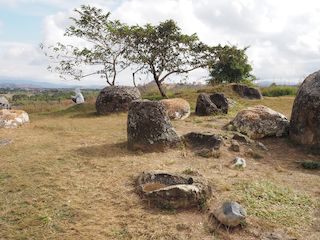
Phonsavan • Plain of Jars: jars on the plain

Phonsavan • Plain of Jars: big jars

Phonsavan • Plain of Jars: jars in the undergrowth
Monument profile
Plain of Jars
Monument category: Archaeological
Monument family: Archaeological
Monument genre: Archaeological site
Geographic location: Phonsavan • Laos
Construction period: 5th century BC
This monument in Phonsavan is inscribed on the UNESCO World Heritage List since 2019 and is part of the serial property "Megalithic Jar Sites in Xiengkhuang – Plain of Jars".See the UNESCO monuments featured on this site
• Links to •
• List of videos about Phonsavan on this site •
Phonsavan, Mysterious Plain of Jars • Laos
Phonsavan, Morning Market & Traditions • Laos
• Sources •
Digital Sources
Books and Publications
- Fitzpatrick, S. (2020). The Archaeology of the Plain of Jars, Laos. Cambridge University Press.
Plain of Jars at Phonsavan: Historical Development of a Megalithic Landscape in Laos
Formation of the Megalithic Jar Sites
The Plain of Jars consists of a large concentration of stone jars distributed across plateaus and hilltops in the region surrounding present-day Phonsavan in Xieng Khouang Province, Laos. Archaeological investigations indicate that these jar sites were created over a long period generally dated between approximately 500 BCE and 500 CE. The jars were carved from large blocks of stone and transported to carefully selected locations across elevated landscapes overlooking surrounding valleys.
The establishment of these jar sites required a considerable degree of organization. Individual jars can weigh several tons and were extracted from quarries located several kilometers from the locations where they now stand. Evidence from quarry sites shows unfinished jars and blocks abandoned during the shaping process, indicating that rough carving took place at the quarry before transport. The installation of these large monolithic containers on exposed plateaus suggests that the placement of the jars formed part of a structured landscape designed for ritual or ceremonial purposes.
Archaeological excavations have revealed that the jars are closely associated with burial activity. Human remains, beads, ceramics, iron objects, and other artifacts have been discovered in pits and burial contexts located near the jars rather than inside them. In several sites, stone discs found near the jars appear to have been used to cover burial pits. These findings suggest that the jar fields functioned as part of a mortuary landscape where funerary practices took place over extended periods. The exact role of the jars within these practices remains debated, but their repeated association with burial features indicates a close connection with ritual treatment of the dead.
Early Documentation and Archaeological Research
The jar sites became known to Western scholars during the late nineteenth century when explorers and colonial administrators traveling through northern Laos recorded the presence of large stone jars scattered across the landscape. The first systematic archaeological study of the Plain of Jars was carried out during the 1930s by the French archaeologist Madeleine Colani.
Colani documented several major jar sites, measured the jars, and analyzed associated artifacts recovered during excavations. Her work established the first comprehensive inventory of the sites and provided the earliest interpretation of the jar fields as part of a funerary complex. She also identified caves in the surrounding limestone hills that contained deposits of cremated human remains and ritual objects, which she interpreted as part of a funerary process involving several stages.
The publication of Colani’s research brought international attention to the site and established the Plain of Jars as one of the most unusual prehistoric landscapes in mainland Southeast Asia. Her work remained the principal reference for several decades, as political instability and limited accessibility prevented extensive further research in the region.
Conflict, Damage, and Restricted Access in the Twentieth Century
The archaeological landscape of the Plain of Jars was profoundly affected by armed conflicts during the twentieth century. During the Indochina conflicts and the Vietnam War era, Xieng Khouang Province became one of the most heavily bombed regions in Laos. Military operations and aerial bombardments targeted areas across the plateau where several jar sites are located.
These campaigns caused direct damage to parts of the archaeological landscape. Some jars were broken or displaced by explosions, and large craters are still visible in several jar fields. Even more significant was the long-term impact of unexploded ordnance scattered across the region. Thousands of unexploded cluster munitions remained embedded in the soil, making many archaeological zones inaccessible for decades.
Because of these hazards, archaeological investigation and conservation efforts were largely suspended for many years. Only a limited number of sites could be safely visited, and systematic study of the full extent of the jar landscape remained impossible throughout much of the late twentieth century.
Renewed Research, Cultural Role, and World Heritage Recognition
From the 1990s onward, international clearance programs gradually began removing unexploded ordnance from key archaeological zones. These efforts allowed archaeologists to return to several major jar sites and conduct new excavations and surveys. Recent investigations have identified more than ninety separate jar sites distributed across the Xieng Khouang plateau, although only a small portion of them are currently accessible.
Modern archaeological projects have expanded knowledge of burial features associated with the jars and have identified quarry locations where the jars were originally carved. The evidence from these excavations confirms that the jar landscape was used repeatedly over extended periods and formed part of a complex ritual system involving burial practices and ceremonial activities.
Today the Plain of Jars holds strong cultural significance for the Lao population and is recognized as one of the country’s most important archaeological landscapes. In 2019 the site was inscribed on the UNESCO World Heritage List under the official name “Megalithic Jar Sites in Xieng Khouang – Plain of Jars.” The designation acknowledges both the archaeological importance of the jar fields and the unique character of the monumental stone landscape created on the plateau.
Current management of the site combines archaeological research, landscape conservation, and continued ordnance clearance. Protection measures focus on preserving the jars in their original positions while allowing controlled public access to several of the safest sites.
Global Historical Context
The main period associated with the creation and use of the jars, between approximately 500 BCE and 500 CE, coincides with major developments in other parts of the world. In South Asia, the Mauryan Empire unified large areas of the Indian subcontinent during the third century BCE. In East Asia, the Han dynasty established a powerful imperial state in China between the second century BCE and the second century CE. In the Mediterranean world, the Roman Republic and later the Roman Empire expanded across Europe, North Africa, and the Near East. These chronological markers place the development of the Plain of Jars within a period of significant cultural and political transformations across the ancient world.
Architectural Structure of the Plain of Jars at Phonsavan
Spatial Organization of the Megalithic Landscape
The Plain of Jars forms a vast architectural landscape composed of numerous stone jar fields distributed across the plateau surrounding present-day Phonsavan in Xieng Khouang Province. Rather than a single monument, the site consists of multiple concentrations of megalithic elements positioned on elevated terrain. The jars occupy hilltops, ridgelines, and gently sloping plateaus overlooking the surrounding valleys. Their placement avoids low or waterlogged ground, indicating deliberate selection of stable surfaces and visually prominent locations.
The size of individual jar fields varies considerably. Some sites contain fewer than ten jars, while others include several hundred distributed across open areas. Within each field the jars usually appear in clusters rather than continuous rows. These clusters are separated by stretches of open ground, creating distinct spatial zones within the same site. The resulting layout produces a dispersed monumental landscape composed of several focal areas rather than a single central structure.
The placement of jars within clusters also suggests a degree of internal organization. Larger jars frequently occupy slightly elevated or central positions, while smaller examples tend to appear around their margins. This distribution creates subtle hierarchies of spatial prominence. Although the jars do not follow a strict directional orientation, clusters often conform to the natural contours of the terrain. In several sites the jars extend along ridges or across gently inclined surfaces, producing arrangements shaped by the underlying topography.
The architectural structure of the site therefore operates at the scale of the landscape rather than at the level of a single building. The visual effect is that of a monumental field of stone elements integrated with the natural relief of the plateau.
Morphology and Proportions of the Stone Jars
The stone jars constitute the primary architectural components of the site. Each jar is carved from a single block of stone and generally displays a cylindrical or slightly tapered form. Exterior walls are usually straight, although some jars widen slightly at mid-height before narrowing toward the base. The top of each jar forms a wide circular opening defined by a carefully shaped rim.
Dimensions vary widely across the different jar fields. Smaller jars measure around one meter in height, while the largest exceed two meters and sometimes approach three meters. The diameter of the opening generally ranges from one to one and a half meters. The walls are thick and massive, while the interior cavities have been carefully hollowed to maintain the structural stability of the monolithic form. The largest examples possess considerable internal volume, functioning as large containers carved entirely from stone.
The bases of the jars are typically flat or slightly rounded so that they can rest directly on the ground surface. In many cases the lower part of the jar is partially embedded in the soil, which improves stability and prevents displacement. Exterior surfaces often preserve visible tool marks produced during carving. These marks appear as shallow grooves or percussion traces running vertically or diagonally along the jar body.
The rim of the opening is usually more finely finished than the exterior surfaces. Many jars show smooth circular edges created through repeated abrasion. In some examples a slight external lip or shoulder appears near the opening, suggesting that a lid or cover may once have been placed on top. Interior surfaces generally show fewer finishing marks, indicating that the main effort was directed toward shaping the exterior form and maintaining structural balance rather than producing a polished interior cavity.
Materials and Quarrying Techniques
The jars were carved from several types of stone available in the surrounding geological formations. Sandstone is the most common material, occurring in large blocks within nearby outcrops. Limestone and granite were also used for certain jars, producing variations in surface texture and weathering resistance. Sandstone jars frequently show stronger erosion patterns, whereas granite examples often retain sharper edges and clearer tool marks.
Archaeological surveys have identified quarry sites located several kilometers from the jar fields. At these locations partially carved jars and abandoned blocks reveal the stages of extraction and shaping. The process began with isolating a large block of stone from the bedrock. Workers then roughly shaped the exterior profile before hollowing the interior cavity. This preliminary shaping probably occurred at the quarry in order to reduce the weight of the block prior to transport.
Hollowing the interior required removing large quantities of stone from the center of the block. Tool marks inside some jars indicate the use of percussion techniques combined with abrasion to smooth the surfaces. The regular thickness of the jar walls demonstrates careful control of the carving process, with the cavity gradually enlarged while preserving structural stability.
Transporting the jars from quarry to installation site required significant technical effort. Some quarry areas lie more than ten kilometers from the jar fields, meaning that multi-ton stone objects had to be moved across uneven terrain. Archaeologists propose that sledges, wooden rollers, and earthen ramps were employed to facilitate this movement. The absence of permanent transport structures suggests that temporary systems were constructed during each transport operation.
Associated Stone Elements and Architectural Composition
Additional stone features appear within the jar fields and contribute to the architectural composition of the sites. The most common associated elements are circular stone discs found near or between the jars. These discs are usually carved from flat slabs and measure roughly one to two meters in diameter. Some remain undecorated, while others display shallow relief carvings or geometric motifs.
In several cases these discs cover archaeological pits located close to the jars. Their diameter often corresponds closely to that of jar openings, leading to the hypothesis that some could have functioned as lids. However, because most discs are currently located on the ground rather than on top of the jars, they may also have served as markers for burial features or ritual deposits associated with the jar fields.
Other stone elements include standing stones and clusters of smaller blocks placed around jar groups. These stones do not form continuous walls or enclosures but appear to mark particular zones within the sites. In some jar fields their arrangement produces circular or semicircular patterns that emphasize the central position of certain jars.
The combined presence of jars, discs, and secondary stones creates a complex spatial composition. Individual clusters function as architectural units defined by the relationships among these elements. Larger jars positioned near the center of clusters reinforce their visual prominence within the wider landscape.
Structural Preservation and Architectural Condition
The architectural condition of the Plain of Jars reflects both natural weathering and damage caused by twentieth-century conflict. During the Vietnam War era the plateau surrounding Phonsavan was subjected to intense aerial bombardment. Several jar fields contain large impact craters, and numerous jars were fractured or displaced by explosions. Broken fragments of jars remain visible at many locations across the sites.
Despite this damage, a substantial number of jars remain standing in their original positions. The thickness of the stone walls and the monolithic construction of the jars contributed to their survival. Granite jars have proven particularly resistant to structural failure, while sandstone jars often display cracks and surface exfoliation caused by long-term weathering.
Current conservation efforts concentrate on stabilizing jars that have become tilted or partially buried through soil erosion. In certain cases archaeologists have carefully repositioned jars to prevent further collapse. Protective management strategies also regulate visitor movement to limit direct contact with fragile stone surfaces.
Today the architectural landscape of the Plain of Jars represents a combination of ancient construction, wartime damage, and modern conservation work. The surviving jars continue to form a monumental stone landscape across the plateau, preserving the spatial structure established during the original installation of the jar fields.