Français (France)
  Nederlands (nl-NL)
 00:00 • intro | 00:23 • on the streets of Bangalore | 01:06 • Lal Bagh, greenhouses and botanical garden | 01:43 • Bangalore Palace
Personal creation from visual material collected during my trip Unknown India • Ladakh, Karnataka, Telangana (2022)
Map of places or practices in Bangalore on this site
• Use the markers to explore the content •
Bangalore, capital of Karnataka between gardens, palace and modern city life
A major metropolis of southern India
Bangalore, officially Bengaluru, occupies a central place in contemporary India. As the capital of the state of Karnataka, it is internationally known for its technology sector, universities, research centres and rapid urban growth. Yet the city cannot be reduced to its modern economic image alone. Bangalore also preserves traces of an older political history, landscaped public spaces and monuments that reflect different phases of its development.
The video offers precisely this broader perspective. It moves through the streets of Bangalore, then explores Lal Bagh with its botanical garden and glasshouse, before focusing on Bangalore Palace. Through these sequences, viewers discover a city where everyday urban movement, royal memory and cultivated green spaces coexist within the same metropolitan setting.
Bangalore therefore appears as a layered city: an administrative capital, a centre of innovation, and a place where historical and environmental heritage remain visible.
The streets of Bangalore and the modern urban landscape
The scenes filmed in the streets provide an immediate sense of Bangalore’s scale and rhythm. It is one of India’s largest cities, marked by intense traffic, constant mobility and a highly active commercial life. Office workers, students, vendors and commuters all contribute to the atmosphere of a city in continuous motion.
The urban fabric also reveals architectural diversity. Modern towers, apartment blocks, older residences, markets, civic buildings and transport infrastructure stand side by side. Like many expanding Indian metropolises, Bangalore displays several generations of development within the same neighbourhoods.
Its position on the Deccan plateau has historically given the city a more moderate climate than many lowland centres, helping explain its long-standing appeal as an administrative and residential hub. During the colonial period, this contributed to the establishment of military and institutional districts, some of which influenced later urban growth.
Seen through its streets, Bangalore is best understood not as a single planned entity, but as a complex city shaped by successive historical layers and contemporary expansion.
Lal Bagh, botanical heritage in the heart of the city
Lal Bagh is one of Bangalore’s most recognisable landmarks. More than a public park, it is a historical garden, botanical collection and civic space deeply connected to the city’s identity. Its origins are linked to eighteenth-century rulers Hyder Ali and Tipu Sultan, who encouraged horticultural development and the introduction of rare plant species.
The garden includes tree-lined avenues, lakes, lawns, rocky outcrops and carefully organised planting zones. In a densely populated metropolis, such an area provides both ecological value and a place of recreation. It also reflects older South Asian traditions in which gardens combined pleasure, prestige and practical cultivation.
Among its most famous structures is the large glasshouse, often associated with flower shows and seasonal exhibitions. Its metal-and-glass design recalls nineteenth-century international trends in greenhouse architecture, adapted here to a tropical botanical setting.
In the video, Lal Bagh reveals a quieter face of Bangalore. It shows that the city’s identity is not built only on traffic and technology, but also on long-established green spaces that continue to shape urban life.
Bangalore Palace and princely memory
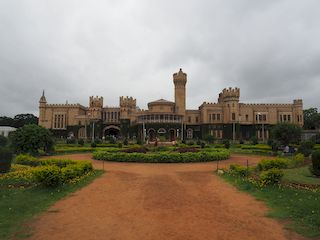
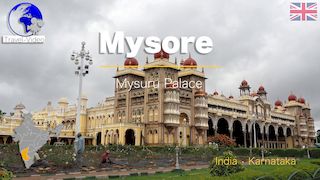
Bangalore Palace is one of the city’s most distinctive monuments. Built in the nineteenth century for the Wadiyar royal family of Mysore, it is notable for an architectural style inspired by European medieval revival forms. Towers, battlements, projecting volumes and decorated interiors create a strong contrast with many traditional South Indian palace models.
This stylistic choice reflects a period when Indian princely courts engaged with British and continental influences while maintaining their own political identity. The palace was therefore both a residence and a statement of prestige, modernity and dynastic continuity.
Its presence in Bangalore also reminds viewers that the city developed within a wider regional history involving Mysore rulers, colonial administration and later state formation in southern India. The palace stands as a visual memory of those transformations.
Architecturally, it remains remarkable for the way imported design references were reinterpreted in an Indian context, producing a building unlike most historic monuments in Karnataka.
What the site’s videos make especially clear
The videos of travel-video.info, often created from carefully selected and animated photographs, are particularly effective for presenting a city such as Bangalore. They allow viewers to move gradually between broad urban scenes and more focused details without the distractions of real-time traffic or hurried sightseeing.
At Lal Bagh, this format helps reveal garden perspectives, vegetation patterns and the scale of the glasshouse. At Bangalore Palace, it makes façades, towers, windows and decorative contrasts easier to observe.
The transitions between sequences also clarify the relationship between the city’s different identities. Modern streets, landscaped gardens and royal architecture do not appear as isolated subjects, but as connected parts of the same urban history.
This slower visual rhythm makes a complex metropolis easier to read and understand.
A capital city with several identities
Bangalore combines metropolitan energy, princely heritage and celebrated green spaces in a way few major cities do. Between its active streets, historic botanical garden and striking palace, the capital of Karnataka reveals a richer character than its technological reputation alone suggests. Those wishing to explore further can continue with the detailed pages devoted to the city’s monuments and historical landmarks.
Links to related pages






Audio Commentary Transcript
Bangalore or Bangaluru in Karnataka in southern India was since its foundation in the 16th century a garrison town.
The city experienced a dazzling expansion after the conquest of the British and even more since independence. This city currently has a population of nearly 11 million and has flourished thanks to the computer industry.
This history, relatively short compared to other Indian cities, probably explains the scarcity of remarkable monuments and buildings, such as those seen elsewhere in the region.
The Bangalore Palace, built at the end of the 19th century in a style strangely reminiscent of Windsor Castle, was intended to serve as a shelter for the young Maharaja Chamarajendra Wadiyar X when he resided in Bangalore, in particular to follow his studies at the university.

Music:
- - YouTube video library - Clouds
Disclaimer: Despite its appropriateness, copyright issues prevent the use of indian traditional music in "Bangalore, capital of Karnataka • India", hence the use of royalty-free music. Despite our careful selection, some might regret this decision, which is necessary to avoid potential lawsuits. Although difficult, this decision is the only viable solution.