

 Français (France)
  Nederlands (nl-NL)
 Of Hindu tradition, (with additional Jain influence), the Western Ganga dynasty ruled for approximately 650 years, ± between 350 and 1000 over all or part of South India, during the Ancient Period and the Classical Period.
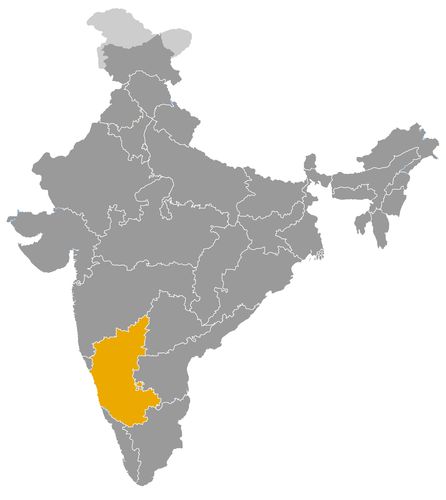
This map illustrates the maximum territory that the Western Ganga Dynasty had reached at its height, covering the current regions of Karnataka in India. Its main purpose is to provide a visual aid to understand the geographical extent of this dynasty. However, it's important to note that the contemporary borders of these regions may not necessarily coincide with the historical territories.
The Western Ganga Dynasty and Its Role in the History of Southern India
A long lasting regional power in ancient Karnataka
The Western Ganga dynasty played an important role in the history of southern India from about the fourth century to the early eleventh century. Its main territory was Gangavadi, a region corresponding broadly to southern Karnataka. Talakad, on the banks of the Kaveri River, was one of its principal political centres, although the dynasty’s authority shifted over time according to war, alliance and dependence on larger powers.
The Western Gangas were not an imperial dynasty on the scale of the Chalukyas, Rashtrakutas or Cholas. Their historical importance lies instead in their exceptional longevity and their ability to preserve a regional political identity over several centuries. They ruled a strategic zone between the Deccan plateau, the Kaveri basin and the Tamil regions. This location made them important intermediaries in the political history of southern India.
A political role shaped by autonomy and subordination
The political history of the Western Gangas was marked by alternating phases of regional autonomy and subordination to stronger dynasties. In their early period, they consolidated control over Gangavadi, a region of agricultural lands, forests, hill zones, routes and religious centres. Their power was based on local authority rather than large scale imperial conquest.
From the sixth and seventh centuries onward, the Western Gangas often operated within the sphere of the Chalukyas of Badami. They retained their dynastic identity and local kingship while accepting the superiority of a larger Deccan power. This relationship allowed them to survive without losing their regional base. Later, under the Rashtrakutas, the Gangas again became important allies and subordinate rulers. Some Ganga kings, such as Butuga II and Marasimha II, played notable military roles in Rashtrakuta campaigns.
This political flexibility was one of the dynasty’s strengths. The Western Gangas could act as local sovereigns, military allies or vassal rulers depending on the balance of power. Their final decline came with the expansion of the Cholas into Gangavadi in the early eleventh century, when the region was incorporated into a wider imperial structure.
Cultural patronage connected with Jainism and local traditions
The cultural role of the Western Gangas is especially associated with Jainism. Although the dynasty and its elites also supported Brahmanical and Hindu traditions, Jain institutions received significant patronage in Gangavadi. Monks, temples, basadis, scholars and religious communities benefited from grants and protection by kings, ministers and military commanders.
The most famous monument connected with this cultural environment is the colossal statue of Gomateshwara at Shravanabelagola, commissioned by the general Chavundaraya in the late tenth century. Chavundaraya was not himself a king, but his work belongs directly to the political and cultural world of the Western Gangas. The monument remains one of the most important achievements of Jain art in southern India.
This patronage shows how regional dynasties could shape religious landscapes without enforcing a single tradition. The Western Ganga period was marked by coexistence and interaction among Jain, Shaiva, Vaishnava and Brahmanical institutions. Royal support for different religious groups helped strengthen legitimacy, reward elites and integrate local communities into the political order.
Contributions to Kannada culture, inscriptions and architecture
The Western Gangas contributed to the development of Kannada culture and regional forms of written expression. Their inscriptions, composed in Sanskrit and Kannada, are important for understanding administration, land grants, social structure and religious patronage in early medieval Karnataka. They also show the growing role of Kannada as a language of regional identity and political communication.
The artistic production associated with the dynasty includes Jain basadis, temples, sculptures, memorial stones and inscriptions. Ganga architecture was not always monumental in the manner of later Hoysala buildings, but it helped form the artistic background from which later Karnataka traditions developed. Their patronage contributed to the continuity of regional styles in stone construction, iconography and sacred geography.
Shravanabelagola became a major centre of Jain devotion, learning and artistic expression. Through such sites, the Western Gangas helped establish southern Karnataka as a distinct cultural zone. Their cultural legacy therefore lies not only in individual monuments, but also in the creation of a regional religious and artistic environment.
Economic foundations in agriculture and land grants
The economy of the Western Ganga kingdom was based primarily on agriculture. Gangavadi included fertile river valleys, cultivated plains, forested areas and upland zones. These varied landscapes supported crop production, cattle rearing, forest resources and local trade. Agricultural revenue sustained the court, the army, religious institutions and administrative structures.
Land grants were central to the economic organization of the kingdom. The rulers granted villages, tax rights or revenues to Brahmins, temples and Jain establishments. Such grants were not merely religious donations. They helped stabilize territorial control, reward supporters, integrate local elites and strengthen the connection between royal authority and rural society.
The location of Gangavadi also gave the dynasty access to regional trade routes. These routes linked the Deccan plateau with the Kaveri valley and the Tamil regions. Goods such as grain, livestock, timber, metals, textiles and ritual objects circulated through these networks. The Western Ganga economy was therefore regional in scale, but connected to wider patterns of exchange in southern India.
A dynasty central to the history of Karnataka
The Western Gangas occupy an important place in Indian history because they represent the strength of regional dynasties in the making of medieval South India. They did not dominate the entire peninsula, but they preserved political continuity in southern Karnataka for several centuries. Their ability to adapt to the Chalukyas, Rashtrakutas and Cholas shows how local rulers could survive within changing imperial systems.
Their legacy is visible in the political history of Gangavadi, the growth of Jainism in Karnataka, the artistic importance of Shravanabelagola, the development of epigraphic culture and the formation of a regional identity in southern Karnataka. The Western Ganga dynasty therefore stands as a key intermediary between the early historic polities of the Deccan and the later medieval powers of South India.
The Geographic Extent of the Western Ganga Dynasty in Southern Karnataka
A regional kingdom centred on Gangavadi
The Western Ganga dynasty ruled mainly in southern Karnataka from about the fourth century to the early eleventh century. Its principal territory was known as Gangavadi, a historical region that included areas around Talakad, Mysore, Shravanabelagola and the upper Kaveri basin. This location gave the dynasty a strategic position between the Deccan plateau and the Tamil regions of southern India.
The territorial history of the Western Gangas was not that of a large empire with fixed and continuously expanding borders. It was instead the history of a durable regional kingdom whose extent changed according to wars, alliances and subordination to larger powers. At different times, the Western Gangas ruled as independent kings, as allies of stronger dynasties or as subordinate rulers under the Chalukyas, Rashtrakutas and eventually the Cholas. Their importance came from the stability of their core region and from their ability to survive in a highly competitive political environment.
The territorial core around Talakad and the Kaveri basin
Talakad, on the banks of the Kaveri River, was one of the main political centres of the Western Ganga kingdom. Its position was important because it lay near fertile agricultural lands, internal routes and access points toward both the Deccan and the Tamil country. The Kaveri basin provided the dynasty with agricultural revenue, settlement density and a practical basis for administration.
The core of Gangavadi included plains, river valleys, forested zones, hill regions and upland areas. This diversity gave the kingdom access to grain, cattle, timber, forest products and manpower. The region also contained religious centres, especially Jain sites such as Shravanabelagola, which became closely associated with Ganga patronage and elite culture.
Within this central area, Ganga authority was relatively strong. Royal power was expressed through land grants, local chiefs, temple patronage, military service and control of important settlements. However, like many early medieval Indian kingdoms, their rule was not uniform in a modern administrative sense. Authority was strongest near political and religious centres and more flexible in frontier zones.
A strategic position between the Deccan and the Tamil regions
The Western Ganga kingdom stood between two major geographical and political worlds. To the north and northwest lay the Deccan plateau, where powers such as the Chalukyas and Rashtrakutas dominated large territories. To the south and southeast lay the Tamil regions, where the Pallavas, Pandyas and later Cholas competed for influence. Gangavadi therefore formed a frontier zone, a buffer and a corridor between these regions.
This position gave the Western Gangas an importance greater than the size of their kingdom. Control over Gangavadi meant access to routes connecting the Deccan with the Kaveri valley and the southern peninsula. For larger dynasties, the Ganga territory was useful as a military base, a defensive zone and a route of expansion. For the Gangas themselves, this geography created both opportunity and danger.
The dynasty could use its position to negotiate alliances and preserve autonomy. At the same time, its lands were repeatedly exposed to external intervention. The history of Western Ganga territory is therefore closely linked to the changing balance of power in southern India.
Relations with the Chalukyas of Badami
From the sixth and seventh centuries, the Western Gangas were often drawn into the political sphere of the Chalukyas of Badami. The Chalukyas were a major Deccan power, and Gangavadi lay near the southern edge of their strategic interests. For the Chalukyas, Ganga territory helped protect access toward the south and contain rivals such as the Pallavas.
The relationship was not simply one of conquest and disappearance. The Western Gangas retained their dynastic identity, their kings and much of their local authority while recognizing Chalukya superiority in certain periods. This arrangement allowed the Chalukyas to secure a loyal regional partner, while the Gangas preserved their territorial base and royal status.
Their geographic position made such an arrangement practical. Gangavadi was close enough to matter to the Chalukyas, but distinct enough to remain under local rulers. This pattern of regional autonomy under imperial influence became a recurring feature of Ganga history.
The Western Gangas within the Rashtrakuta sphere
After the rise of the Rashtrakutas, the Western Gangas became connected to another major Deccan power. Their territory remained valuable because it provided access to the southern peninsula and to the routes linking the Deccan with the Kaveri region. Several Ganga rulers became important allies of the Rashtrakutas, especially in military campaigns.
Under rulers such as Butuga II and Marasimha II, the Western Gangas gained prestige through their service to the Rashtrakuta political order. This did not eliminate their regional importance. On the contrary, the Gangas often used their alliance with stronger powers to reinforce their own local authority. Their territorial position allowed them to act as intermediaries between the imperial centre and the southern frontier.
The Rashtrakuta period shows that Ganga power was not measured only by the size of its territory. It was also based on the strategic value of Gangavadi and the military usefulness of its ruling house.
Pressure from the Pallavas, Pandyas and Cholas
To the south and southeast, the Western Gangas faced pressure from the powers of the Tamil region. The Pallavas and Pandyas were important neighbours in earlier phases, while the Cholas became the decisive force at the end of Ganga rule. These dynasties were interested in the routes and frontier zones connecting the Kaveri basin with southern Karnataka.
The Chola expansion from the late tenth century changed the political balance. The Cholas sought to control Gangavadi as part of their wider imperial strategy in southern India. The region’s location made it essential for access between the Tamil country and the Karnataka interior. By the early eleventh century, Gangavadi was incorporated into the Chola sphere, ending the effective sovereignty of the Western Ganga dynasty.
A limited but durable territorial presence
The geographic extent of the Western Ganga dynasty was not vast compared with the great empires of the Deccan and South India. Yet it was historically significant because of its durability and strategic location. For several centuries, the dynasty maintained a coherent territorial base in southern Karnataka, centred on Gangavadi, Talakad and the upper Kaveri region.
Their position shaped all their relations with neighbouring dynasties. It made them valuable allies of the Chalukyas and Rashtrakutas, rivals or targets of southern powers, and eventual subjects of Chola expansion. The Western Gangas show how a regional kingdom could remain politically important for centuries by controlling a key corridor between larger cultural and military zones.
The Western Gangas ruled mainly over Gangavadi, in the south of present-day Karnataka, with Talakad as a major centre. The early reigns are approximate and dates may vary according to reconstructions; the dynasty exercised at times regional sovereignty and at times subordinate power under the Chalukyas, Rashtrakutas or Cholas.
- Konganivarman Madhava (c. 350–370) • Traditional founder of the dynasty, he established Ganga authority in southern Karnataka.
- Madhava I (c. 370–390) • He consolidated the early territorial foundations of the line in the Gangavadi region.
- Harivarman (c. 390–410) • He continued the organization of the kingdom and strengthened the dynastic position around Talakad.
- Vishnugopa (c. 410–430) • His reign belongs to the early phase of the formation of Ganga power.
- Madhava II (c. 430–469) • He maintained dynastic continuity and contributed to the regional consolidation of the kingdom.
- Avinita (c. 469–529) • An important ruler of the early period, he strengthened the political stability and prestige of the dynasty.
- Durvinita (c. 529–579) • A king remembered for his authority and cultural patronage, he consolidated the kingdom against neighbouring powers.
- Mushkara (c. 579–604) • He ruled during a period of transition marked by the rise of major Deccan kingdoms.
- Polavira (c. 604–629) • His reign is less well documented, but it belongs to the continuity of Ganga power.
- Srivikrama (c. 629–654) • He maintained the dynasty within the political context dominated by the Chalukyas of Badami.
- Bhuvikarma (c. 654–679) • He preserved Ganga authority over Gangavadi during a phase of regional dependencies and alliances.
- Shivamara I (c. 679–725) • He strengthened the dynasty’s position in southern Karnataka.
- Sripurusha (c. 725–788) • One of the most powerful Ganga rulers, he led important campaigns and asserted the kingdom’s regional autonomy.
- Shivamara II (c. 788–816) • He ruled during a troubled period marked by conflict with the Rashtrakutas and shifting political balances.
- Rachamalla I (c. 816–843) • He restored a degree of stability after tensions caused by Rashtrakuta intervention.
- Ereganga Neetimarga I (c. 843–870) • He ruled as a regional king within the political orbit of the Rashtrakutas.
- Rachamalla II (c. 870–907) • He maintained Ganga authority in Gangavadi while accommodating Rashtrakuta supremacy.
- Ereganga Neetimarga II (c. 907–921) • His reign belongs to the later phase of the dynasty, marked by increased dependence on major Deccan powers.
- Narasimha (c. 921–933) • He maintained dynastic continuity in a context of regional competition.
- Rachamalla III (c. 933–938) • His brief reign preceded the rise of Butuga II.
- Butuga II (c. 938–961) • An important ally of the Rashtrakutas, he temporarily strengthened the military prestige of the Western Gangas.
- Marulaganga Neetimarga (c. 961–963) • He ruled briefly during an unstable succession period.
- Marasimha II (c. 963–975) • A notable late ruler of the dynasty, he served Rashtrakuta interests and still asserted the military role of the Gangas.
- Rachamalla IV (c. 975–986) • He ruled as the political order of the Deccan was rapidly changing.
- Rakkasa Ganga (c. 985–1024) • The last major ruler of the line, he retained reduced authority before Gangavadi was incorporated into the Chola sphere.