Français (France)
  Nederlands (nl-NL)
 Of Hindu tradition, (with additional Buddhist influence), the Kalachuris of Mahishmati dynasty ruled for approximately 175 years, ± between 450 and 625 over all or part of Central India and West India, during the Ancient Period and the Classical Period.
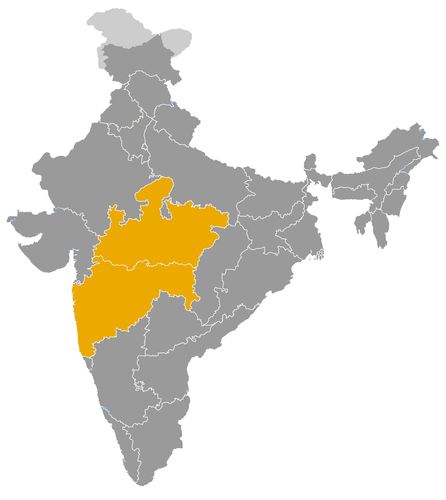
This map illustrates the maximum territory that the Kalachuris of Mahishmati Dynasty had reached at its height, covering the current regions of Madhya Pradesh and Maharashtra in India. Its main purpose is to provide a visual aid to understand the geographical extent of this dynasty. However, it's important to note that the contemporary borders of these regions may not necessarily coincide with the historical territories.
The Kalachuris of Mahishmati and Their Role in Early Medieval India
An early regional dynasty in central western India
The Kalachuris of Mahishmati, often described as the Early Kalachuris, occupied an important place in the political history of India during the sixth and early seventh centuries. Their centre was Mahishmati, usually identified with Maheshwar on the Narmada River in present-day Madhya Pradesh. This location placed them in a strategic zone between central India, Malwa, western India and the routes leading toward the Deccan.
The dynasty is less extensively documented than the later Kalachuris of Tripuri or the Kalachuris of Kalyani. Only a small number of rulers are securely known, notably Krishnaraja, Shankaragana and Buddharaja. Yet their historical significance is clear. They belonged to a period in which regional powers emerged after the decline of earlier imperial structures, particularly those connected with the Gupta age and its successors.
Political authority in a fragmented post Gupta landscape
The rise of the Kalachuris of Mahishmati took place in a political environment marked by regional competition. After the weakening of large imperial formations in northern and central India, several dynasties sought to control strategic territories, routes and revenue producing regions. The Narmada valley was one of these crucial spaces, and the Kalachuris were able to establish themselves there as a significant regional power.
Krishnaraja, the first known ruler of the dynasty, appears to have built or consolidated a kingdom with enough authority to issue widely circulated silver coins. This indicates an organized political structure with economic and administrative capacity. Shankaragana, probably his son, is more clearly attested through inscriptions and represents a further stage in the dynasty’s consolidation. Buddharaja, the last known ruler of the early line, faced pressure from the expanding Chalukyas of Vatapi.
The Kalachuris of Mahishmati did not create a large pan Indian empire. Their role was that of an intermediate regional power controlling a strategic corridor. They helped shape the balance of power between central India, western India and the Deccan at a moment when political authority was being reorganized around regional kingdoms.
Mahishmati and the Narmada valley as a strategic base
The geographical position of Mahishmati was central to Kalachuri power. The Narmada valley formed one of the great natural routes across the Indian subcontinent. It connected the interior of central India with western regions and opened access toward the Deccan. Control over this corridor gave the Kalachuris military, fiscal and commercial advantages.
The river valley provided fertile lands, settlements, markets and routes for the movement of armies and goods. For a regional dynasty, such an axis was a major asset. It allowed the rulers of Mahishmati to maintain contact with neighbouring regions and to project authority beyond their immediate capital.
This same location also made the kingdom vulnerable. A territory placed on important routes attracted rivals. The Chalukyas of Vatapi, rising in the Deccan during the sixth and seventh centuries, had a clear interest in controlling the northern approaches to their sphere of power. Their expansion eventually reduced Kalachuri independence and ended the dynasty’s effective sovereignty.
Cultural legitimacy through Sanskritic kingship
The cultural impact of the Kalachuris of Mahishmati is harder to measure than their political role, but it was nevertheless significant. Their inscriptions and royal self presentation show that they participated in the Sanskritic culture of early medieval Indian kingship. Like other ruling houses of the period, they used royal titles, genealogical claims and religious language to present themselves as legitimate protectors of order.
Their political culture was connected with Hindu religious traditions and with the broader world of Brahmanical patronage. Although the surviving evidence does not allow a detailed reconstruction of all their temple foundations or religious donations, the dynasty belonged to a period in which kingship was closely associated with ritual authority, land grants and support for religious institutions.
In this sense, the Kalachuris helped integrate the Narmada region into the wider political and cultural patterns of early medieval India. Their use of inscriptions, titulature and religious legitimacy reflects the growing importance of Sanskrit as a language of power across regional kingdoms.
Economic strength expressed through coinage and routes
One of the most notable features of the Kalachuris of Mahishmati is their coinage, especially that associated with Krishnaraja. The circulation of silver coins suggests a functioning economy and a state capable of issuing recognized monetary instruments. Coinage also indicates that Kalachuri authority reached beyond the immediate royal court and participated in wider systems of exchange.
The economic foundation of the dynasty was probably based on agriculture, local taxation and control over routes. The Narmada valley linked productive rural areas with markets and trade paths connecting central India, Malwa, western India and the Deccan. This gave the Kalachuris access to resources needed to support military forces, administration and royal prestige.
Their economy was therefore not purely local. It depended on movement, circulation and the ability to control a corridor between important regions. This explains why their territory became attractive to neighbouring dynasties and why the Chalukyas eventually challenged their position.
Relations with neighbouring powers and the Chalukya advance
The political role of the Kalachuris was strongly shaped by their relations with neighbouring dynasties. To the north and west, they were connected with the political world of Malwa and western India. To the south, they confronted the expanding powers of the Deccan. The most important of these were the Chalukyas of Vatapi, whose rise transformed the balance of power.
Under Buddharaja, Kalachuri sovereignty appears to have weakened under Chalukya pressure. The Chalukyas were building a broader Deccan based power and sought influence over the routes leading northward. The defeat or subordination of the Kalachuris allowed them to extend their reach into central western India.
A limited dynasty with lasting historical importance
The Kalachuris of Mahishmati did not leave a long lasting empire, but they remain important in the history of India. They represent an early example of regional state formation in central India after the decline of older imperial systems. Their control of Mahishmati, their coinage and their role in the struggle for the Narmada valley show that they were more than a minor local lineage.
Their legacy also lies in the later use of the Kalachuri name by other dynastic branches, especially those of Tripuri and Kalyani. Whether the exact genealogical connections were direct or partly constructed, the name retained prestige. The Kalachuris of Mahishmati therefore stand at the beginning of a broader historical tradition associated with regional power, strategic geography and the political transformation of early medieval India.
The Geographical Expansion of the Kalachuris of Mahishmati in Early Medieval India
A kingdom centred on Mahishmati and the Narmada valley
The Kalachuris of Mahishmati, often called the Early Kalachuris, were a regional dynasty active mainly during the sixth and early seventh centuries. Their political centre was Mahishmati, generally identified with Maheshwar on the Narmada River in present-day Madhya Pradesh. This position placed them in a strategic zone between central India, Malwa, western India and the routes leading toward the Deccan.
The exact territorial extent of their kingdom is difficult to define with precision, because the surviving evidence is limited. The best-attested rulers, Krishnaraja, Shankaragana and Buddharaja, appear to have controlled a territory centred on the middle Narmada valley, with influence extending toward Malwa, northern Maharashtra and parts of central western India. Their realm should not be imagined as a state with fixed and clearly drawn frontiers. It was more likely a regional sphere of authority based on control of routes, river crossings, agricultural lands, market centres and fortified positions.
The Narmada corridor as the foundation of Kalachuri power
The Narmada valley was the main territorial axis of the Kalachuris of Mahishmati. The river forms one of the most important natural corridors across central India, linking the interior of the subcontinent with western regions. It also provides access toward the Deccan through routes connecting the Narmada basin with the Tapti valley and the northern plateau.
Control of this corridor gave the Kalachuris several advantages. It provided agricultural resources, fiscal income, communication routes and military mobility. Armies could move along the valley, merchants could circulate between regions, and royal authority could be projected from Mahishmati into neighbouring zones. For a dynasty of limited but strategic territorial reach, mastery of such a corridor was essential.
The same geography also created vulnerability. The Narmada valley was not an isolated heartland but an open route between competing political spheres. Any dynasty seeking to dominate central western India or to expand from the Deccan toward the north had an interest in controlling or neutralizing Mahishmati. This made the Kalachuri kingdom both influential and exposed.
Influence toward Malwa and western India
To the north and north-west of Mahishmati lay Malwa, one of the most important regions of early medieval central India. Its plateau, urban centres and links with western trade routes made it a desirable zone for any regional power. The Kalachuris of Mahishmati likely exercised influence over areas bordering Malwa, although direct and lasting control over the whole region cannot be firmly established.
Their connection with Malwa shaped their political importance. By controlling the southern approaches to that region and the Narmada route below it, the Kalachuris participated in the balance of power between central India and the west. The circulation of coins attributed to Krishnaraja suggests that Kalachuri authority, or at least their economic reach, extended beyond the immediate vicinity of Mahishmati. Coin circulation does not prove direct rule in every area where coins were found, but it indicates participation in wider commercial and political networks.
This western orientation brought the dynasty into contact with other regional powers whose names are less consistently documented for this period. The Kalachuris were part of a competitive environment in which authority over routes and revenue-producing territories could shift rapidly according to military success and dynastic strength.
Southern routes toward the Deccan and northern Maharashtra
The southern extension of Kalachuri influence was closely connected with the routes leading from the Narmada valley toward northern Maharashtra and the Deccan. These areas formed a transition zone between central India and the rising powers of the southern plateau. Control or influence in this direction allowed Mahishmati to function as a gateway between the north-western and central regions of India and the Deccan.
Northern Maharashtra may have formed part of the Kalachuri sphere of influence, especially in areas linked to the Tapti valley and the approaches to the Deccan. These territories were valuable because they controlled movement between river systems and plateau routes. They also exposed the Kalachuris to southern expansion.
The most important neighbouring power in this context was the Chalukya dynasty of Vatapi. As the Chalukyas expanded in the Deccan during the sixth and seventh centuries, they increasingly challenged Kalachuri authority. Their northern ambitions brought them into conflict with the rulers of Mahishmati, especially during the reign of Buddharaja.
Relations with the Chalukyas of Vatapi
The confrontation with the Chalukyas was the decisive factor in the later territorial history of the Kalachuris of Mahishmati. The Chalukyas of Vatapi were building a major Deccan-based kingdom and sought to extend their influence toward central western India. The routes linking the Deccan with the Narmada valley were therefore of major strategic value.
Buddharaja, the last known ruler of the Early Kalachuris, appears to have retained some authority after initial Chalukya pressure, but the dynasty gradually lost its independent position. The Chalukya advance reduced Kalachuri control over the southern approaches and eventually weakened their hold over the broader Narmada region.
This shift altered the balance of power in early medieval India. The decline of the Kalachuris allowed the Chalukyas to project influence farther north and strengthened the Deccan’s role in the politics of central western India. Mahishmati, once the centre of Kalachuri power, lost its position as the capital of an independent regional dynasty.
A strategic but fragile territorial formation
The geographical extension of the Kalachuris of Mahishmati was significant because of location rather than imperial scale. Their kingdom controlled or influenced a key zone around Mahishmati, the middle Narmada valley, parts of central western India and routes toward Malwa and the Deccan. This territory placed them at the meeting point of several political and economic regions.
Their relations with neighbouring dynasties were shaped by this geography. Their proximity to Malwa connected them to western and northern politics, while their southern routes brought them into rivalry with the Chalukyas of Vatapi. Their power depended on the ability to hold strategic corridors rather than on the possession of a vast empire.
The Kalachuris of Mahishmati therefore played an important role in the territorial organization of early medieval India. Their rise shows how control of a river valley and regional routes could sustain a significant kingdom. Their decline shows the same strategic geography becoming a source of vulnerability when stronger neighbouring powers expanded into the same space.
The Kalachuris of Mahishmati, often called the Early Kalachuris, are securely known only through a small number of rulers attested by coins and inscriptions. The dates are approximate, and the end of Buddharaja’s reign probably corresponds to a gradual loss of sovereignty to the Chalukyas of Vatapi.
- Krishnaraja (c. 550–575 CE) • The first known king of the dynasty, he probably established his authority at Mahishmati and issued widely circulated silver coinage.
- Shankaragana (c. 575–600 CE) • Son of Krishnaraja, he is the first Kalachuri ruler clearly attested by inscriptions from his own reign.
- Buddharaja (c. 600–625 CE) • The last known king of the Early Kalachuris, he retained part of his authority after initial Chalukya pressure before the gradual disappearance of dynastic sovereignty.
 Links to the main sections of the site