Français (France)
  Nederlands (nl-NL)
 Of Hindu tradition, the Kadamba of Triparvata dynasty ruled for approximately 85 years, ± between 455 and 540 over all or part of South India, during the Medieval Period.
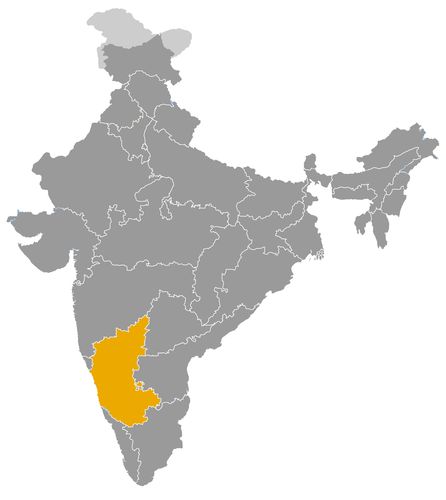
This map illustrates the maximum territory that the Kadamba of Triparvata Dynasty had reached at its height, covering the current regions of Karnataka in India. Its main purpose is to provide a visual aid to understand the geographical extent of this dynasty. However, it's important to note that the contemporary borders of these regions may not necessarily coincide with the historical territories.
The Kadambas of Triparvata and Their Regional Role in Indian History
A Kadamba branch within the political landscape of early medieval Karnataka
The Kadambas of Triparvata formed one of the regional branches of the wider Kadamba tradition, a dynasty whose origins are closely associated with the early historic and early medieval development of Karnataka. While the better known Kadambas of Banavasi had already established a strong political identity in western Deccan history, the Triparvata line illustrates how Kadamba authority continued through collateral branches, local power centres and shifting alliances with stronger imperial powers.
Triparvata, generally associated with a strategic zone in the Deccan rather than a vast imperial capital, became the centre of a Kadamba branch that operated in a political environment dominated by larger dynasties such as the Chalukyas. The significance of this dynasty therefore lies less in the creation of a large empire than in its role as a regional authority, mediating between local elites, agrarian communities, religious institutions and the ambitions of greater powers.
Political authority shaped by regional autonomy and imperial pressure
The Kadambas of Triparvata emerged in a period when the Deccan was marked by competition between regional dynasties and expanding imperial formations. Their political role was largely defined by their ability to preserve a measure of autonomy while acknowledging, opposing or negotiating with stronger neighbours. Like many regional ruling houses of early medieval India, they combined hereditary legitimacy with practical diplomacy.
Their power depended on the control of fortified centres, productive lands and routes linking different parts of Karnataka and the western Deccan. This made them valuable allies and sometimes potential rivals to larger states. The Kadambas of Triparvata could function as subordinate rulers, frontier guardians or regional competitors depending on the balance of power around them.
Their political importance also came from the continuity of the Kadamba name. By claiming connection with an established dynastic tradition, they inherited a form of legitimacy that was meaningful in the Deccan. This helped them present their rule not as a temporary local arrangement, but as part of a recognized lineage of kingship.
A cultural role rooted in Kannada identity and Sanskritic kingship
The broader Kadamba tradition is especially important in the history of Kannada language and regional identity. The early Kadambas are often associated with the rise of Kannada as a language of administration and political expression, alongside Sanskrit. The Kadambas of Triparvata inherited this cultural environment and contributed to the continuation of a regional courtly culture in which local language, Brahmanical learning and royal patronage interacted.
Their inscriptions and patronage practices reflected the dual cultural world of the Deccan. Sanskrit remained the prestigious language of royal genealogy, religious merit and political proclamation, while Kannada increasingly expressed local authority and social rootedness. This combination was not accidental. It allowed rulers to participate in the wider Sanskritic model of Indian kingship while also addressing regional audiences, landed groups and temple communities.
The cultural impact of the Triparvata Kadambas should therefore be understood as part of a wider process: the consolidation of regional political cultures in early medieval India. Their rule helped sustain a Deccan environment where kingship was expressed through genealogy, land grants, religious donations and the public recording of authority in inscriptions.
Religious patronage as a means of legitimacy and social organization
Like many dynasties of the Deccan, the Kadambas of Triparvata used religious patronage as a political and social instrument. Temples, Brahmanical settlements and religious beneficiaries played a central role in the organization of land, authority and prestige. Grants to Brahmins or religious institutions were not merely acts of devotion. They helped create durable networks of loyalty, agricultural management and cultural influence.
This pattern linked the dynasty to the broader Brahmanical order, while also embedding its authority in local society. Religious patronage gave rulers moral legitimacy and placed them within the traditional framework of dharmic kingship. At the same time, it strengthened the economic base of temple centred communities, which often became important nodes of settlement, redistribution and record keeping.
The Kadambas of Triparvata were therefore part of a wider transformation in which temples and land grants became central to regional state formation. Their cultural legacy cannot be separated from these institutions, which connected political authority with ritual prestige and rural expansion.
Economic foundations based on land, routes and local production
The economy of the Kadambas of Triparvata was primarily agrarian. Control over cultivated land, irrigation resources and village revenues formed the material basis of their power. Their authority depended on the ability to collect revenue, assign land rights and regulate the relationship between rulers, local chiefs, cultivators and religious beneficiaries.
The region under their influence was also connected to movement across the Deccan. Even if the dynasty did not command a maritime trading empire, its position within inland networks gave it access to routes used by merchants, officials, soldiers and religious specialists. Political stability in such areas encouraged local production, market exchange and the growth of temple economies.
Their economic role was therefore regional but meaningful. By maintaining authority over land and settlements, they contributed to the gradual integration of local economies into larger Deccan political systems. When subordinated to greater powers, they could also serve as intermediaries through whom tribute, military service and revenue were organized.
A dynasty whose importance lies in continuity and regional mediation
The Kadambas of Triparvata occupy a modest but significant place in Indian history. They were not among the largest imperial powers of the subcontinent, yet their importance lies precisely in showing how early medieval India was built through layered political structures. Large empires depended on regional dynasties, local rulers and inherited lineages that managed territory, upheld social order and transmitted cultural models.
Their role was political through the preservation of regional authority, cultural through the continuation of Kadamba and Kannada associated traditions, religious through patronage networks, and economic through the control of agrarian resources. The dynasty demonstrates that the history of India was shaped not only by major empires, but also by regional houses whose authority connected local society with wider political worlds.
The Geographic Reach of the Kadambas of Triparvata in Early Medieval India
A regional Kadamba power centred in the western Deccan
The Kadambas of Triparvata belonged to the wider Kadamba political tradition of Karnataka, but their historical role must be distinguished from that of the main Banavasi line. After the consolidation of Kadamba authority in the western Deccan, dynastic divisions produced more than one centre of power. Banavasi remained the best known nucleus, while Triparvata became the seat of a collateral branch that operated within the same broad political zone.
The territorial extension of the Triparvata Kadambas was therefore not that of a vast independent empire, but of a regional kingdom or sub kingdom embedded in the political geography of early medieval Karnataka. Its importance lay in the control of inland areas connected to the Kadamba heartland, in its ability to challenge or reunite with the Banavasi line, and in the way it participated in the wider balance of power between the Deccan and southern India.
Triparvata as a secondary centre of Kadamba authority
Triparvata appears to have functioned as a distinct dynastic centre after the Kadamba royal house divided into branches. While the exact location and boundaries of its authority are less clearly documented than those of Banavasi, it is generally understood as lying within the western Deccan sphere, connected to the political landscape of present day Karnataka.
Its territory should be imagined as a zone of authority rather than as a sharply demarcated state with fixed borders. Early medieval Indian polities often controlled fortified centres, agricultural districts, temple settlements, trade routes and clusters of villages, while influence weakened toward frontier areas. The Kadambas of Triparvata probably exercised direct control over their core region and looser influence over surrounding districts through local chiefs, landed elites and religious beneficiaries.
This structure made Triparvata both a political refuge and a rival centre within the Kadamba world. It could support an alternative claimant, preserve dynastic continuity during internal conflict, or serve as a base for reunification when one ruler managed to impose authority over both branches.
The relationship between Triparvata and Banavasi
The most important territorial relationship of the Triparvata branch was with Banavasi, the original Kadamba capital and the symbolic heart of the dynasty. Banavasi controlled a strategic region in northern Karnataka and the western coastal hinterland, linking inland routes with the Konkan and the Arabian Sea corridor. Triparvata, by contrast, represented a secondary but significant inland centre.
The division between Banavasi and Triparvata reflects the fragmentation typical of early medieval dynastic politics. A royal family could split into branches without abandoning a shared dynastic identity. The existence of two centres did not necessarily mean a complete rupture, but it created competition over legitimacy, territory and access to revenue.
At times, the Triparvata line could act as a rival to the Banavasi rulers. At other moments, it could contribute to the restoration of wider Kadamba unity. This flexible relationship shaped the political geography of the dynasty: power was not concentrated in a single capital alone, but distributed between several centres that could cooperate or compete according to circumstance.
Control over inland Karnataka and the western Deccan routes
The Kadambas of Triparvata were situated in a region where inland Karnataka connected with the broader western Deccan. This position mattered because political authority depended not only on fertile land, but also on access to routes linking royal courts, military movements, religious centres and commercial exchange.
The territories associated with the Kadamba world included parts of northern and western Karnataka, with influence extending at times toward the Konkan and neighbouring Deccan zones. The Triparvata branch was probably more closely tied to the inland component of this system. Control over such areas allowed the dynasty to draw revenue from agriculture, supervise local chiefs and maintain military resources.
This geographic position also made Triparvata vulnerable. It stood within a zone contested by larger powers, especially the rising Chalukyas of Badami. Once the Chalukyas expanded, smaller Kadamba branches had to adapt to a new political order in which autonomy became increasingly limited.
Relations with the Chalukyas of Badami
The rise of the Chalukyas transformed the geopolitical environment of the Kadambas of Triparvata. The Chalukyas expanded from the northern Karnataka region and gradually imposed their dominance over older regional powers. For the Kadambas, this meant that their territory became part of a contested frontier between inherited Kadamba authority and emerging Chalukya imperial ambition.
The Triparvata branch, like the wider Kadamba house, had to face the pressure of Chalukya expansion. Defeat or subordination did not necessarily eliminate Kadamba power immediately, but it changed its character. Formerly autonomous rulers could become feudatories, regional chiefs or subordinate allies within the Chalukya sphere.
This relationship illustrates a common pattern in early medieval India. Larger dynasties often absorbed older regional houses without fully destroying them. The Kadambas retained prestige, local roots and administrative usefulness, while the Chalukyas gained access to established networks of authority.
Contacts and tensions with other neighbouring dynasties
The geographic position of Triparvata also placed the Kadambas in relation to other southern and Deccan powers. The Western Gangas, active in southern Karnataka, formed another important regional dynasty. Relations between Kadambas and Gangas could involve rivalry, frontier tension and shifting alignments depending on the wider political situation.
The Pallavas to the southeast and the Vakatakas to the north were also part of the larger diplomatic and military horizon of the Kadambas. Although the Triparvata branch was not always directly engaged with all these powers, its existence must be understood within a network of competing dynasties. Marriage alliances, military campaigns, tributary relations and claims of prestige linked even regional branches to the broader politics of peninsular India.
A limited territory with wider historical significance
The Kadambas of Triparvata did not control a vast or long lasting empire. Their geographic importance lies in their role as a secondary Kadamba centre within the western Deccan, a region where dynastic authority was divided, negotiated and repeatedly reconfigured.
Their territories probably included inland districts tied to the Kadamba political sphere, with influence shaped by local chiefs, agrarian settlements and strategic routes. Their position affected relations with Banavasi, the Chalukyas, the Gangas and other neighbouring powers. Through this role, the Triparvata branch shows how regional dynasties helped structure the political map of early medieval India, even when their territorial reach remained modest compared with the great imperial formations around them.
Les Kadamba de Triparvata furent une branche parallèle des Kadamba de Banavasi, active dans le Karnataka ancien. Les dates sont approximatives et varient selon les reconstructions historiques; le centre de Triparvata est généralement situé soit vers Devagiri dans l’actuel district de Dharwad, soit vers Halebidu.
- Krishnavarma I (vers 455–475) • Fondateur probable de la branche de Triparvata, il gouverna la partie méridionale du domaine kadamba face à la pression des Pallava.
- Vishnuvarma (vers 475–485) • Il succéda à Krishnavarma I et dut probablement composer avec la suzeraineté ou l’influence des Pallava.
- Simhavarma (vers 485–516) • Il maintint la branche de Triparvata dans une position régionale, avec des relations prudentes envers Banavasi et les puissances voisines.
- Krishnavarma II (vers 516–540) • Il affronta la branche de Banavasi et contribua à une réunification partielle du pouvoir kadamba avant l’ascension des Chalukya de Badami.
 Links to the main sections of the site