

 Français (France)
  Nederlands (nl-NL)
 Lal Bagh Botanical Garden is one of the best-known public sites in Bangalore, the capital of Karnataka. Established in the modern period, this large botanical garden plays an important role in the city’s urban, cultural and scientific life. It combines landscaped grounds, plant collections, walking areas and facilities linked to horticulture. Popular with residents as well as visitors, Lal Bagh remains a major landmark in Bangalore’s identity. The site also hosts flower shows and seasonal events. It reflects the lasting importance of major public gardens in the structure and image of Indian metropolitan centres.
Bangalore • Lal Bagh Botanical Garden
Bangalore • Lal Bagh Botanical Garden
Bangalore • Lal Bagh Botanical Garden
Monument profile
Lal Bagh Botanical Garden
Monument category: Designed Sites
Monument family: Museum, remarkable architecture or group of buildings
Monument genre: Cultural or scientific
Geographic location: Bangalore • Karnataka • India
Construction period: 18th century AD
• Links to •
• List of videos about Bangalore on this site •
Bangalore • Capital of Karnataka, gardens and palace • India
Lal Bagh Botanical Garden: Historical Development of a Major Garden in Bangalore
Foundation under Hyder Ali and Expansion under Tipu Sultan
Lal Bagh Botanical Garden originated in the eighteenth century during the rise of the Kingdom of Mysore. Its creation is generally attributed to Hyder Ali, who established the garden in Bangalore as a planned horticultural enclosure intended for cultivation, experimentation and royal prestige. The site was laid out on the southern side of the historic town, where land was available for a large enclosed garden.
After Hyder Ali’s death in 1782, Tipu Sultan continued and expanded the project. He is associated with the introduction of new plant species, including fruit trees and ornamental varieties obtained through diplomatic and commercial contacts. Under his rule, Lal Bagh developed beyond a pleasure garden into a productive botanical space linked to agriculture and court administration.
Reorganisation in the Colonial Period
Following the defeat of Tipu Sultan in 1799, Mysore entered a new political order shaped by British power. Lal Bagh was retained and gradually reorganised during the nineteenth century. Its functions became more scientific and administrative, reflecting the model of colonial botanical gardens used for plant exchange, crop trials and horticultural research.
Botanists and officials expanded collections, improved pathways and systematised planting zones. The garden became an important centre for the testing and diffusion of economically useful species within southern India. It also increasingly served Bangalore’s growing urban population as a public landscaped space.
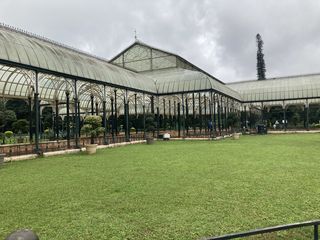
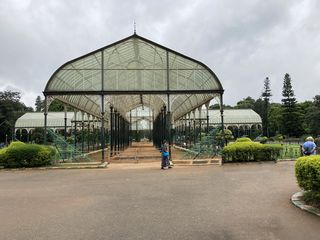
The most visible architectural addition of this period was the Glass House, completed in the late nineteenth century. Built as an exhibition pavilion inspired by iron-and-glass structures of Europe, it strengthened the garden’s civic and ceremonial role.
From Scientific Garden to Urban Public Landmark
During the twentieth century, Bangalore expanded rapidly as an administrative, military and later industrial city. Lal Bagh adapted to this urban transformation. While preserving botanical functions, it became one of the city’s principal recreational landscapes. Walking paths, open lawns and organised horticultural displays increased its public use.
Flower shows held in the Glass House became especially significant, linking the garden with regional celebrations and civic identity. Lal Bagh also preserved mature tree collections and historic landscape features at a time when much of Bangalore was urbanising.
The garden’s role therefore evolved from princely enclosure to colonial botanical institution and finally to metropolitan public park.
Present Role, Preservation and Historical Value
Today Lal Bagh remains one of Bangalore’s most important historic sites. It combines botanical collections, nineteenth-century structures, water features and long-established tree avenues within a dense modern city. Preservation efforts focus on maintaining the Glass House, conserving plant heritage, repairing circulation networks and protecting historic rock formations and lakeside areas.
Its historical value lies in the continuity of use across different political eras: Mysore rule, colonial administration and post-independence Karnataka. Few urban sites in Bangalore preserve such a long institutional history while remaining actively used by the public.
Global Historical Context
When Lal Bagh was founded in the eighteenth century, the Qing dynasty ruled China, the Ottoman Empire remained a major power, and European trading companies were expanding across Asia. In the late eighteenth century, the American Revolution and later the French Revolution reshaped Atlantic politics. In India, regional states such as Mysore were confronting growing British influence.
Spatial Design and Built Structures of Lal Bagh Botanical Garden in Bangalore
Site Layout and Overall Composition
Lal Bagh Botanical Garden occupies a large enclosed tract in southern Bangalore, forming a distinct landscaped precinct within a dense urban environment. The site is organised as a planned botanical park rather than a single monument. Its design combines lawns, tree-lined avenues, lakeside zones, plant collections and built structures distributed across irregular terrain. Slight changes in ground level create shifting viewpoints and help separate open spaces from more intimate planted sectors.
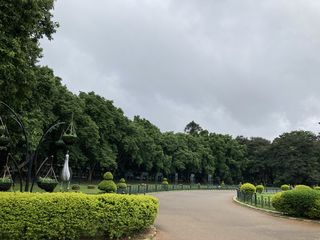
The circulation system is one of the defining architectural features of the garden. Main drives and wide pedestrian avenues connect the principal gates with landmarks such as the Glass House, the central lake and specialised horticultural areas. Secondary paths branch into quieter sectors, creating a hierarchy of movement. This network gives the garden internal order while preserving visual variety.
Boundary walls, gateways and controlled entrances establish the garden as a protected institutional landscape rather than an ordinary municipal park. The contrast between the vegetated interior and the surrounding city remains central to its spatial identity.
The Glass House as Architectural Focus
The most prominent built structure within Lal Bagh is the Glass House, erected in the late nineteenth century as an exhibition pavilion. It is based on an iron-and-glass structural system composed of repetitive metal columns, roof trusses and glazed panels. Its transparent envelope allows the building to remain visually light despite its size.
The plan is elongated and symmetrical, with a central hall flanked by side bays. Repetition of identical structural frames produces rhythm and clarity. The roof rises in measured sections, allowing natural light to penetrate deep into the interior. Ventilation is supported through the height of the central volume and the permeability of the glazing system.
Architecturally, the Glass House differs sharply from the surrounding vegetation through its geometric precision. It functions as a ceremonial centre, flower exhibition hall and visual anchor. During public events, the building acts as both container and monument.
Water Systems, Rock Features and Landscape Engineering
The architecture of Lal Bagh also includes engineered landscape elements. Water bodies, drainage channels, embankments and retaining edges shape both appearance and function. The central lake is among the principal compositional features. Its irregular shoreline contrasts with the straighter geometry of roads and pathways, producing an interplay between formal planning and naturalistic scenery.
Stone steps, platforms, parapets and small bridges around the water edges create access points and controlled viewpoints. These details transform the lake from a reservoir into a designed landscape component integrated with movement and visual sequence.
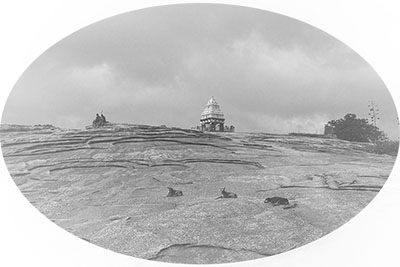
Another key feature is the granite outcrop known as Lal Bagh Rock. Though geological in origin, it has been architecturally adapted through stairs, railings and lookout points. This intervention converts the rock into an elevated belvedere. Because most of the garden is horizontal, the outcrop introduces rare vertical emphasis and long views across the site.
Secondary Buildings and Functional Structures
Scattered through the garden are secondary pavilions, nurseries, service buildings, administrative blocks and smaller greenhouses. These structures are generally modest in scale and intentionally subordinate to the Glass House. Their forms favour practicality: simple volumes, shaded verandas, sloped roofs or deep eaves, and openings that assist cross-ventilation in Bangalore’s climate.
Benches, shelters, signage bases, boundary edges and planting enclosures also contribute to the architectural vocabulary. Though individually minor, these repeated elements create coherence and support public use of the garden.
The relationship between built form and vegetation is carefully balanced. Structures are placed as markers, destinations or service points rather than continuous frontage. This preserves the perception of Lal Bagh as an open designed landscape rather than a building complex.
Alterations, Maintenance and Conservation
Continued urban growth and heavy visitation have required repeated intervention. Pathways have been resurfaced, drainage systems upgraded and public facilities modernised. The Glass House has undergone restoration campaigns involving glazing replacement, repainting and structural maintenance of metal components exposed to moisture and corrosion.
Conservation challenges differ from those of masonry monuments. Glass panels, iron members, paving surfaces and lakeside edges all require ongoing technical care. Repairs must preserve historic proportions and the established relationship between architecture and planting.
Lal Bagh remains a hybrid work in which architecture, engineering and botanical planning operate together as a coherent urban landscape.