Français (France)
  Nederlands (nl-NL)
 00:00 • intro | 00:53 • Cave 1, a temple dedicated to Shiva | 02:17 • Cave 2, a temple dedicated to Vishnu | 03:24 • Cave 3, another temple dedicated to Vishnu | 05:47 • Cave 4, a Jain temple dedicated to Mahavira | 06:59 • Lake Agastya | 07:28 • The other temples of Badami
Personal creation from visual material collected during my trip Unknown India • Ladakh, Karnataka, Telangana (2022)
• Use the markers to explore the content •
Badami, Rock-Cut Sanctuaries and Former Capital of the Chalukyas
A Major Historical Site of Karnataka
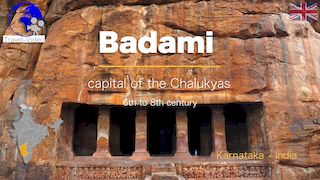
Badami is one of the most significant archaeological and historical sites in Karnataka and in the wider Deccan region of India. Known in early sources as Vatapi, it served as the capital of the Early Chalukya dynasty between the sixth and eighth centuries. From this city, the Chalukyas shaped political power, artistic patronage, and architectural development across large parts of peninsular India.
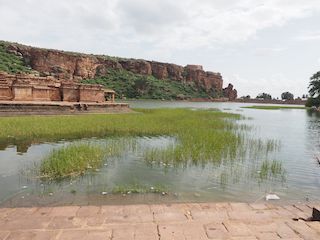
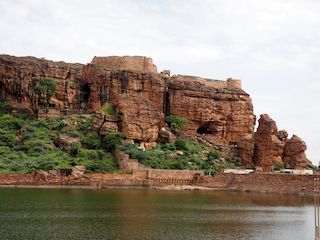
The site is set within a striking landscape of red sandstone cliffs surrounding Agastya Lake. Against this dramatic natural backdrop stand rock-cut temples, freestanding shrines, stairways, ancient pathways, and traces of an earlier urban settlement. The video therefore presents more than a group of monuments: it reveals a place where geology, religion, and royal history are closely connected.
Badami remains especially valuable because it combines dynastic memory, sacred architecture, and an exceptional natural setting in one coherent ensemble.
The Cave Temples and Principal Monuments
The best-known monuments of Badami are the four cave temples carved into the cliff face. These sanctuaries belong to the earliest and most influential phases of Indian rock-cut architecture and illustrate the artistic ambition of the Chalukya court.
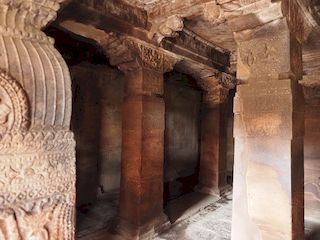
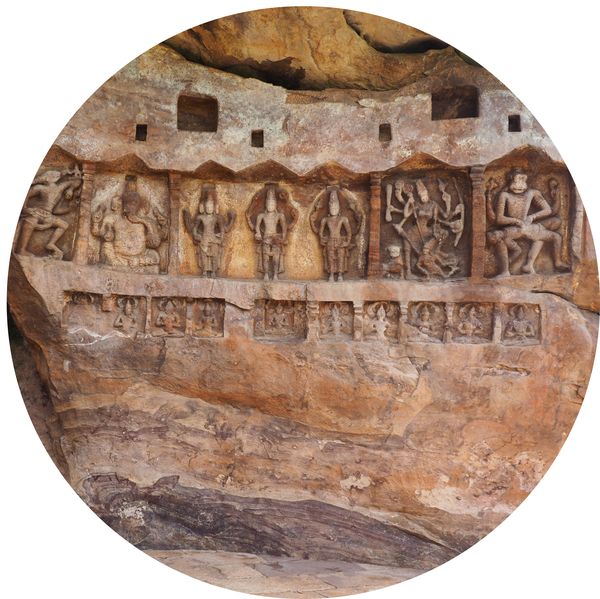
The first cave is dedicated to Shiva. Its sculptural program includes dynamic images of the deity in various forms, including the cosmic dancer. Pillars, relief carvings, and the organization of interior space already show a sophisticated understanding of sacred architecture.
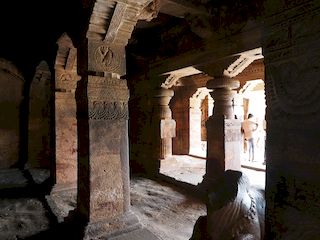
The second and third caves are primarily associated with Vishnu. Their walls display divine incarnations, celestial imagery, and refined narrative compositions. The third cave, larger and more elaborate than the others, is often regarded as the artistic high point of the group because of its scale and sculptural quality.
The fourth cave belongs to the Jain tradition and is dedicated to Mahavira. Its presence demonstrates that Badami was not exclusively Hindu, but a centre where multiple religious communities were active.
Below the cliffs lies Agastya Lake, one of the defining elements of the site. Along its shores stand several temples, including the Bhutanatha group, among the most recognizable views of Badami. Their silhouettes reflected in the water create one of the most memorable architectural scenes in Karnataka.
Additional shrines and smaller monuments around the lake complete the picture of Badami as a former royal and sacred city rather than a single isolated monument.
Historical, Architectural, and Urban Context
Badami was developed in the sixth century under the early Chalukya rulers, especially Pulakeshin I and his successors. From this capital, the dynasty expanded its authority across much of present-day Karnataka and neighbouring regions. The city therefore functioned as an administrative, military, and ceremonial centre.
Its ancient name, Vatapi, appears frequently in inscriptions and historical records. The location between sandstone ridges offered natural defence while also controlling regional routes. This strategic geography helped explain its selection as a capital.
The Chalukyas played a decisive role in the evolution of temple architecture. In Badami, architects experimented with forms, columned halls, sculptural programs, and spatial planning that would later develop further at Aihole and Pattadakal. The site reflects an important moment when northern and southern Indian artistic traditions interacted creatively.
Agastya Lake was not merely scenic. It supported water supply, ritual activity, and the practical life of the settlement. Badami must therefore be understood as a planned historical landscape shaped by rock, water, and royal authority.
Although the political centre later moved elsewhere, Badami retained religious prestige and lasting cultural importance.
What the Video Makes Especially Clear
The videos of travel-video.info, often created from carefully selected and animated photographs, are particularly well suited to a complex site such as Badami. They allow viewers to observe carvings, pillars, façades, and excavated interiors more calmly than during a rapid physical visit.
Transitions between images also clarify the logic of the place. The viewer can understand how the cave temples dominate the cliffs, how the lake forms the centre of the composition, and how freestanding shrines relate to the surrounding terrain.
For rock-cut monuments, this slower visual rhythm is especially valuable. It reveals details that can easily be missed on site: the depth of porticos, the refinement of capitals, the arrangement of sacred chambers, and the sculptural treatment of walls and ceilings.
The progression of viewpoints also shows that Badami is not simply a set of caves, but a complete historical environment where architecture and landscape were conceived together.
An Essential Site of the Ancient Deccan
Badami brings together royal history, rock-cut sanctuaries, religious diversity, and a memorable natural setting. For anyone interested in the history of South India, it is one of the key places to understand the cultural achievements of the early Deccan world. Visitors wishing to go further can explore the detailed pages dedicated to the individual caves and associated temples for deeper insight into their history, iconography, and architecture.









Audio Commentary Transcript
Dug into these red cliffs towards the end of the 6th century, these astonishing temples overlooking an artificial lake dating from the same period remind us that Badami was once the capital of one of the greatest empires of South India, that of the Chalukyas, even if nowadays it is a small town of nearly 30,000 inhabitants.
The caves carved into the cliff are four in number, each located at a different height connected to each other by a staircase, and named after their place in relation to the entrance to the sanctuary. Thus, the first cave encountered is called cave number 1. It is dedicated to Shiva. There are several bas-reliefs representing Shiva, including a dancing shiva.
Temple nr2 is dedicated to Vishnu. In addition to several bas-reliefs representing avatars of Vishnu, this temple offers us interesting sculptures on the ceiling. One of them represents a fish wheel (Chakra Matsya) and the other a maze of swatikas patterns.
Temple No. 3 is also dedicated to Vishnu. It is the only one bearing a clear indication of the date of the end of the work, namely in 578. It is also the largest of the 3 Hindu temples of Badami and the one whose sculptures are the most refined. Here again several avatars of Vishnu are represented. The ceilings of this third temple are also splendid.
Evidence of religious tolerance in those ancient times, probably the beginning of the 7th century, the fourth temple carved into the cliff of Badami is not a Hindu temple. It is a Jain temple, which is dedicated to Mahavira, the 24th Tirthankara. The bas-reliefs in this cave represent different Tirthankara. A brief explanation of what the Jain Tirthankaras are is given in the commentary of this video on the site
But the creative Chalukyas architects didn't just dig temples into the cliff. They also built other important temples, although more classic, whether in Badami or in the surrounding area. Their reign is hailed to this day to be a significant turning point in the history and architecture of South India.
Music :
- - YouTube video library - AchillesIn Memory of Jean Talon - The Mini Vandals, (© Alchemists Tower - Strings by Kevin MacLeod is licensed under a Creative Commons Attribution 4.0 license. https://creativecommons.org/licenses/by/4.0/
- Source: http://incompetech.com/music/royalty-free/index.html?isrc=USUAN1100632
- Artist: http://incompetech.com/)
- - YouTube video library - Action+Strike
- - YouTube video library - Exciting Trailer, (© Exciting Trailer by Kevin MacLeod is licensed under a Creative Commons Attribution 4.0 license. https://creativecommons.org/licenses/by/4.0/
- Source: http://incompetech.com/music/royalty-free/index.html?isrc=USUAN1100494
- Artist: http://incompetech.com/)
- - YouTube video library - From Russia with love
Disclaimer: Despite its appropriateness, copyright issues prevent the use of indian traditional music in "Badami, former capital of the Chalukyas, Karnataka • India", hence the use of royalty-free music. Despite our careful selection, some might regret this decision, which is necessary to avoid potential lawsuits. Although difficult, this decision is the only viable solution.