

 Français (France)
  Nederlands (nl-NL)
 Cave No. 3 of Badami is one of the principal rock-cut sanctuaries within the Badami cave complex in the Indian state of Karnataka. Carved into the sandstone cliffs overlooking the former Chalukya capital, the monument forms part of a group of temples excavated during the early Chalukya period. Today it represents an important archaeological and cultural landmark of the Deccan region. The site attracts historians, archaeologists and visitors interested in Indian heritage. Cave No. 3 illustrates a significant phase in the development of Hindu rock-cut temples and reflects the historical importance of Badami as a political, religious and artistic center during early medieval South India.
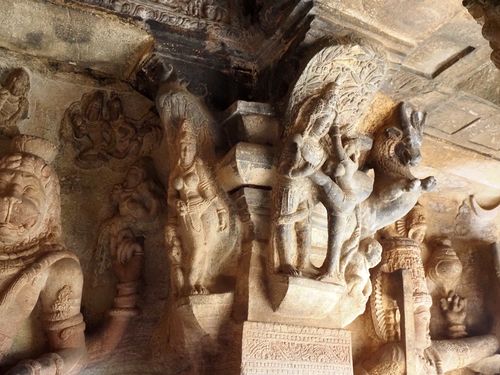
Badami • Cave No.3: ceiling and column
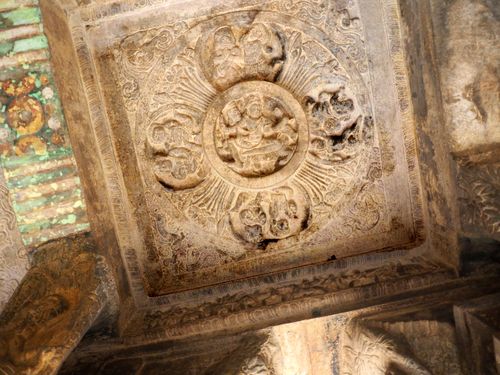
Badami • Cave No.3: ceiling
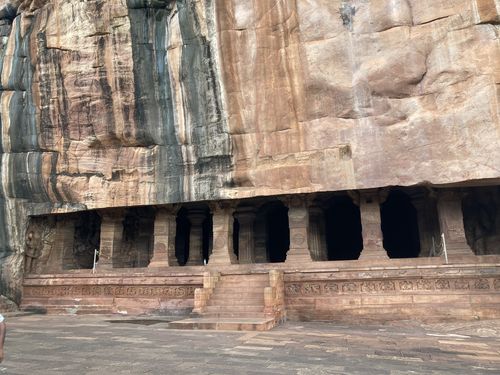
Badami • Cave No.3: facade
Monument profile
Cave No.3
Monument category: Rock Sanctuary
Monument family: Rock Sanctuary and Monumental Bas-reliefs
Monument genre: Religious
Cultural heritage: Hindu
Geographic location: Badami • Karnataka • India
Construction period: 6th century AD
• Links to •
• Dynasties that contributed to the construction of the monument •

• This monument illustrates the following theme •
Architecture • Rock-cut monuments : Rock-cut temples and caves in India
• List of videos about Badami on this site •
Badami, former capital of the Chalukyas, Karnataka • India
• References •
UNESCO: Evolution of Temple Architecture – Aihole-Badami- Pattadakal
Bagalkote District: Badami Caves
Wikipedia EN: Badami cave temples
• Sources •
Digital Sources
Books and Publications
- Michell, G. (1977). "The Chalukyas of Kalyana and the Kalachuris of Kalyana." University of Michigan.
- Reddy, P. Chenna. (2001). "Temples of Karnataka." Bharatiya Kala Prakashan.
History of Cave No. 3 in Badami
Political and Social Context of the Construction
Cave No. 3 of Badami forms part of the celebrated rock-cut cave complex located in the historic town of Badami in the Indian state of Karnataka. Carved into the red sandstone cliffs overlooking the former capital of Vatapi, the monument belongs to the early phase of the Western Chalukya dynasty, which dominated large parts of the Deccan between the sixth and eighth centuries. Among the caves of Badami, Cave No. 3 stands out as the largest and most elaborate Hindu sanctuary, reflecting both the political ambitions and the religious patronage of the Chalukya rulers.
The cave was excavated during the reign of Mangalesha in the late sixth century. An inscription within the cave dated to 578 CE confirms royal involvement in its creation and links the monument directly to the Chalukya court. At that time, Vatapi had emerged as the administrative and symbolic center of a growing kingdom. Monumental architecture served as a key instrument for legitimizing royal authority, and the sponsorship of temples allowed rulers to present themselves as protectors of religious order and cosmic balance.
The Chalukya dynasty expanded rapidly during this period, consolidating control over the Deccan plateau and establishing diplomatic and military relations with neighboring powers. The construction of large religious monuments therefore had both spiritual and political significance. Temples demonstrated prosperity, stability, and the cultural sophistication of the ruling elite. Cave No. 3, dedicated primarily to Vishnu, reflects the religious orientation favored by segments of the Chalukya court while simultaneously reinforcing the prestige of the capital.
The excavation of monumental caves also had symbolic implications. Rock-cut sanctuaries were frequently associated with sacred mountains in Indian religious traditions. By carving temples directly into the cliffs surrounding Vatapi, the Chalukya rulers transformed the natural landscape into a sacred environment linked to royal power. The caves thus contributed to shaping a ceremonial and religious landscape that elevated the capital’s status within the region.
Major Historical Events Affecting the Site
During the sixth and early seventh centuries, Vatapi experienced a period of political strength and economic vitality. The Chalukya rulers developed a sophisticated administrative structure and maintained active contacts with other regions of the subcontinent. The cave temples, including Cave No. 3, were created during this era of expansion and stability.
However, the Chalukya kingdom soon faced intense rivalry with the Pallava dynasty of southern India. The Pallavas controlled important territories in present-day Tamil Nadu and competed with the Chalukyas for dominance over the southern Deccan. These tensions resulted in a series of military campaigns that shaped the political landscape of the region.
One of the most significant events occurred in 642 CE when the Pallava king Narasimhavarman I launched a major offensive against Vatapi. After prolonged conflict with the Chalukya ruler Pulakeshin II, Pallava forces succeeded in capturing the capital. Historical accounts suggest that the city suffered considerable damage during the invasion. The fall of Vatapi marked a temporary but dramatic setback for the Chalukya dynasty.
Despite the turmoil, the cave temples appear to have survived relatively intact. Their location within the sandstone cliffs may have contributed to their preservation, as they were less vulnerable to destruction than freestanding buildings. In the decades following the Pallava invasion, the Chalukyas gradually regained political influence, although the capital itself never fully recovered its earlier prominence.
Over the following centuries, the region came under the authority of several successive dynasties, including the Rashtrakutas and later the Western Chalukyas. Each transition in power altered the political significance of the area, yet the caves remained visible remnants of the early Chalukya period. While their original ritual functions may have diminished, the monuments continued to attract local reverence and periodic religious use.
Global Context During the Period of Construction
The excavation of Cave No. 3 took place during a time of major cultural developments across Eurasia. The sixth century was marked by the consolidation of regional states and the construction of monumental religious architecture in many parts of the world.
In the Byzantine Empire, large Christian basilicas and monumental churches symbolized imperial authority and religious unity. The architectural program initiated under Emperor Justinian reflected the role of monumental construction in expressing political and spiritual legitimacy.
In East Asia, Buddhist cave complexes such as those at Longmen and Yungang in China continued to expand during this period. These sites demonstrate a parallel tradition of carving religious sanctuaries into cliffs and rock faces. Although they belong to different religious contexts, they share a common approach to integrating architecture with natural landscapes.
Across the Indian subcontinent, the post-Gupta era witnessed the emergence of powerful regional dynasties that promoted distinctive artistic traditions. Temple architecture began to evolve into increasingly complex forms, both in rock-cut sanctuaries and in structural stone temples. The Badami caves represent a transitional phase in this architectural evolution, where techniques inherited from earlier Buddhist rock-cut traditions were adapted to Hindu devotional practices.
Transformations Over the Centuries
Following the decline of Vatapi as a political center, the cave temples gradually lost their direct connection with royal patronage. Nevertheless, they continued to exist as sacred spaces associated with regional religious traditions. Local communities maintained a degree of ritual engagement with the site, even as its broader political significance faded.
Unlike many freestanding monuments, the rock-cut nature of Cave No. 3 helped preserve much of its original structure. The absence of large-scale rebuilding or expansion allowed the monument to retain the essential features of its early medieval design.
During the early modern period, the caves attracted the attention of travelers and scholars who recognized their historical importance. By the nineteenth century, systematic archaeological interest in Indian heritage led to more detailed documentation of the Badami complex. Researchers began to analyze the inscriptions, sculptures, and architectural features of the caves, situating them within the broader development of Indian temple architecture.
As the surrounding town evolved over time, the caves became integrated into the cultural identity of Badami. Although the city itself underwent many transformations, the sandstone cliffs containing the caves remained a constant visual presence within the landscape.
Cultural Role in the Modern Era
Today Cave No. 3 is regarded as one of the most significant monuments of the Badami cave complex and a major example of early Hindu rock-cut architecture. The site attracts visitors, historians, and archaeologists interested in the artistic and political achievements of the Chalukya period.
The cave contributes to the understanding of religious developments in early medieval India, particularly the spread of Vaishnavism in the Deccan. The sculptures and inscriptions preserved within the monument offer valuable evidence for reconstructing the political and cultural environment of the sixth century.
For the people of Karnataka, the Badami caves symbolize an important phase in regional history. They recall the period when the Chalukya rulers transformed Vatapi into a major cultural center whose influence extended across much of southern India.
The caves also play a role in contemporary cultural tourism. Visitors come not only to observe the architectural and sculptural features of the site but also to experience a landscape shaped by centuries of religious and historical activity.
Conservation and Modern Preservation Challenges
The preservation of Cave No. 3 presents ongoing challenges due to the natural characteristics of the sandstone in which the monument is carved. Sandstone is susceptible to gradual erosion, especially under conditions of fluctuating temperature, humidity, and seasonal rainfall. Over long periods, these environmental factors can affect the stability of carved surfaces and architectural details.
Increasing tourism has also introduced new pressures. Large numbers of visitors can accelerate the wear of stone surfaces and contribute to minor structural damage if protective measures are not maintained. Authorities responsible for heritage management have therefore implemented conservation policies designed to regulate visitor access and protect fragile areas of the cave.
Archaeological monitoring programs continue to study the structural condition of the monument and its surrounding cliffs. These initiatives aim to ensure that the sculptures, inscriptions, and architectural elements remain preserved for future generations.
Cave No. 3 of Badami thus remains both an archaeological treasure and a symbol of early medieval artistic achievement. Its history reflects the political ambitions of the Chalukya dynasty, the religious traditions of the Deccan, and the enduring cultural importance of rock-cut architecture in the Indian subcontinent.
Architecture of Cave No. 3 at Badami
Architectural innovations and technical mastery
Cave No. 3 at Badami represents one of the most sophisticated examples of early Hindu rock-cut architecture in the Deccan region. Excavated during the late sixth century under the patronage of the Chalukya dynasty, the monument reflects a high level of technical planning and architectural experimentation. Unlike structural temples assembled from stone blocks, the cave was carved directly into the red sandstone cliff overlooking the ancient capital of Vatapi. This process required a precise understanding of the geological properties of the rock and a carefully coordinated method of excavation.
Rock-cut architecture operates through a subtractive technique in which interior volumes are progressively removed from a natural rock mass. In the case of Cave No. 3, artisans began by outlining the façade and entrance terrace before excavating the deeper interior spaces. Structural elements such as columns, beams and ceiling sections were left in place during the excavation and later sculpted into their final forms. This method demanded an advanced level of planning because any miscalculation could weaken the surrounding rock and compromise the integrity of the monument.
The cave also demonstrates a sophisticated approach to spatial engineering. The placement of pillars is not purely decorative but serves to distribute the weight of the cliff above the sanctuary. The regular alignment of columns creates a balanced structural grid that stabilizes the excavated chamber. At the same time, the arrangement organizes the internal space and guides movement toward the inner shrine.
Natural lighting and ventilation were also integrated into the design. The wide opening of the façade allows daylight to penetrate deeply into the mandapa, illuminating sculptural panels and architectural details. The orientation of the cave ensures that sunlight enters the hall during large parts of the day while still protecting the interior from excessive heat. This careful balance between exposure and protection contributes to the preservation of the sculptural surfaces and enhances the visual experience of the monument.
Materials and construction methods
The principal material used in the excavation of Cave No. 3 is the reddish sandstone characteristic of the Badami cliffs. This stone, while relatively soft compared with granite, possesses a consistent texture that allows detailed carving while maintaining structural stability. Its workability made it particularly suitable for the creation of complex architectural forms and sculptural reliefs.
The excavation process involved several phases. Craftsmen first removed large sections of rock to define the main hall, after which they refined the structural elements and decorative surfaces. The columns, beams and ceilings were carved out of the same rock mass rather than being added separately. As a result, the architectural structure and the sculptural program form a unified composition.
Metal tools such as chisels and hammers were used to cut and smooth the sandstone. The precision visible in the carved surfaces suggests the presence of highly trained artisans working in organized teams. Specialists responsible for structural carving likely collaborated with sculptors who executed the elaborate iconographic panels.
The sandstone itself contributes significantly to the aesthetic character of the monument. Its warm red tones change subtly with variations in daylight, producing different visual effects throughout the day. The color of the rock enhances the sculptural forms and reinforces the visual unity between architecture and landscape.
Artistic and architectural influences
The architectural design of Cave No. 3 reflects a transitional stage in the evolution of temple architecture in southern India. The monument belongs to a tradition of rock-cut sanctuaries that had developed earlier in Buddhist and Jain contexts across the Indian subcontinent. Chalukya artisans adapted these earlier techniques to create a Hindu temple environment carved directly into the cliff.
Many architectural features within the cave imitate the forms of structural temples built with masonry. The entrance façade resembles a pillared pavilion, suggesting the presence of a mandapa that would normally precede a freestanding shrine. By reproducing such elements in rock, the builders created a spatial arrangement that mirrored contemporary temple design.
The decorative program demonstrates a synthesis of regional artistic traditions. Sculptural panels depicting Vishnu and his manifestations dominate the interior walls. These reliefs combine stylistic influences from the post-Gupta artistic tradition with local Deccan interpretations of divine imagery. The figures display balanced proportions, controlled movement and detailed ornamentation typical of early medieval Indian sculpture.
Motifs such as lotus medallions, geometric patterns and decorative bands appear throughout the cave, reinforcing the connection between architecture and sculpture. The integration of these elements illustrates the Chalukya approach to temple design, in which structural form and iconography function together to create a coherent sacred environment.
Spatial organization and structural layout
Cave No. 3 is the largest of the Hindu caves at Badami and demonstrates a carefully organized spatial sequence typical of early temple architecture. The monument begins with a broad terrace cut into the cliff face, which provides an open platform before the entrance. This space functions as a transitional zone between the exterior landscape and the sacred interior.
Beyond the terrace lies the entrance portico supported by a series of carved pillars. This portico forms the first architectural layer of the cave and marks the threshold of the sanctuary. The columns here display varied shapes, including square bases, octagonal shafts and elaborately carved capitals. These forms not only provide structural support but also introduce decorative complexity at the entrance.
The portico leads into the principal hall, or mandapa, which constitutes the central architectural space of the monument. This hall is supported by multiple rows of pillars arranged in symmetrical alignment. The columns divide the interior into aisles, creating a rhythmic spatial pattern that directs attention toward the deeper parts of the cave.
The rear section of the monument contains the most sacred area of the sanctuary. This zone likely served as the focal point of ritual activity and housed the principal icon of the temple. The hierarchical arrangement of spaces—from open terrace to portico, hall and inner shrine—reflects the symbolic progression commonly found in Hindu temple architecture.
Ceilings within the cave are carefully carved and decorated with geometric and floral motifs. These decorative ceilings contribute to the visual richness of the interior while maintaining the structural continuity of the rock mass above.
Dimensions and notable features
Among the caves of the Badami complex, Cave No. 3 is distinguished by its considerable scale and the refinement of its sculptural program. The hall extends significantly into the sandstone cliff, creating one of the most spacious rock-cut interiors in the region. The carefully aligned pillars enhance the sense of depth and architectural order.
Large sculptural panels dominate several walls of the cave. These panels depict major forms of Vishnu, including monumental representations that occupy entire wall sections. The scale of these sculptures demonstrates both the technical ability of the artisans and the importance of Vaishnavite worship within the Chalukya court.
An inscription found within the cave provides valuable information about its construction and links it to the reign of the Chalukya ruler Mangalesha. Such inscriptions are rare within rock-cut monuments and offer important historical evidence regarding the patronage of early temple architecture in the Deccan.
Local traditions occasionally associate the caves of Badami with legendary events from regional mythology. Although these stories belong more to cultural memory than historical documentation, they illustrate the enduring symbolic presence of the caves within the surrounding community.
Architectural significance and conservation challenges
The architectural importance of Cave No. 3 lies in its role as a key example of early medieval temple design in southern India. The monument illustrates the experimentation that took place during the Chalukya period, when rock-cut techniques were combined with emerging forms of structural temple architecture. The cave therefore represents an important stage in the transition from excavated sanctuaries to fully constructed stone temples.
Today the Badami caves are recognized as a major archaeological and cultural site. Cave No. 3 in particular attracts scholars studying the evolution of Hindu iconography and early temple planning in the Deccan region. Its architectural layout, sculptural program and inscriptions provide crucial evidence for understanding the artistic achievements of the Chalukya dynasty.
The preservation of the monument presents several challenges. Sandstone, although workable for carving, is vulnerable to gradual erosion caused by wind, water infiltration and seasonal temperature changes. Over time these natural processes can soften sculptural details and weaken exposed surfaces.
Tourism also introduces pressures on the site. Continuous visitor traffic may accelerate wear on steps, floors and carved surfaces. Conservation authorities therefore monitor the monument closely and regulate access to certain areas in order to minimize physical damage.
Ongoing conservation initiatives aim to stabilize the sandstone surfaces and maintain the structural integrity of the cave. Through these efforts, Cave No. 3 continues to stand as one of the most significant architectural achievements of the early Chalukya period and a major testimony to the development of rock-cut temple architecture in the Indian subcontinent.