

 Français (France)
  Nederlands (nl-NL)
 Cave No. 2 in Badami, located in the state of Cave No. 2 forms part of the rock-cut cave complex of Badami, an important archaeological site located in the town of Badami in the state of Karnataka in southern India. This group of sanctuaries carved into sandstone cliffs overlooks the historic urban area and represents a significant stage in the cultural and religious development of the Deccan region during the early medieval period. Cave No. 2 belongs to this monumental ensemble that reflects the artistic traditions and religious life of the time. Today the site is visited by scholars, historians, and travellers interested in Indian heritage and the historical monuments of South Asia.
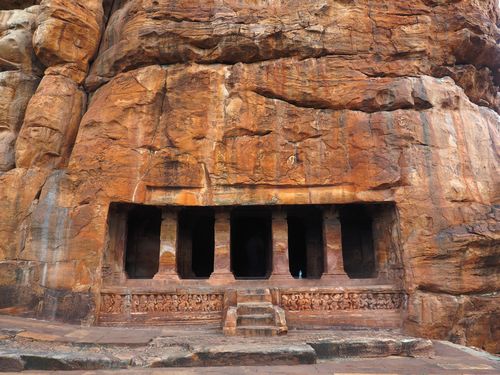
Badami • Cave No.2: view from the outside
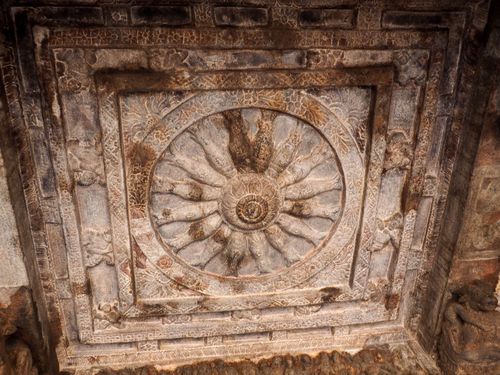
Badami • Cave No.2: one of the cave ceilings
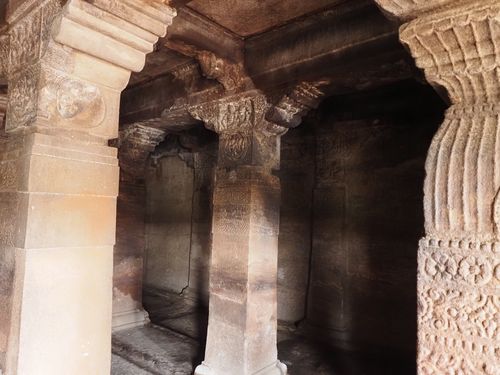
Badami • Cave No.2: kolommen in de grot
Monument profile
Cave No.2
Monument category: Rock Sanctuary
Monument family: Rock Sanctuary and Monumental Bas-reliefs
Monument genre: Religious
Cultural heritage: Hindu
Geographic location: Badami • Karnataka • India
Construction period: 1st century BC
• Links to •
• Dynasties that contributed to the construction of the monument •

• This monument illustrates the following theme •
Architecture • Rock-cut monuments : Rock-cut temples and caves in India
• List of videos about Badami on this site •
Badami, former capital of the Chalukyas, Karnataka • India
• References •
Bagalkote DIstrict: Badami Caves
Wikipedia EN: Badami Cave temples
UNESCO: Evolution of Temple Architecture – Aihole-Badami- Pattadakal
• Sources •
Digital Sources
Books and Publications
History of Cave No. 2, Badami
Political and Social Context of the Construction
Cave No. 2 at Badami belongs to a remarkable group of rock-cut sanctuaries carved into the sandstone cliffs overlooking the ancient city of Vatapi, the early capital of the Chalukya dynasty in present-day Karnataka. The monument was created during the sixth century, a period marked by the consolidation of Chalukya power in the Deccan plateau and the emergence of a distinctive regional artistic identity.
The Chalukya rulers sought to transform Vatapi into a political, cultural, and religious center capable of rivaling other emerging capitals across the Indian subcontinent. Monumental architecture played a central role in this ambition. By commissioning temples and sacred spaces, the ruling elite could demonstrate both their political authority and their commitment to religious patronage, an essential component of royal legitimacy in early medieval India.
Cave No. 2 was most likely excavated during the reign of one of the early Chalukya rulers in the later sixth century, possibly under the patronage of Pulakeshin I or his successors. The construction of the Badami cave temples coincided with the consolidation of the dynasty’s control over large portions of the Deccan. These monuments served not only as religious sanctuaries but also as statements of dynastic prestige.
The Chalukya kingdom existed within a competitive political environment. Powerful neighboring dynasties, including the Pallavas to the southeast and the Kadambas to the west, were also investing in temple construction as a visible expression of their authority. Monumental religious architecture became a means of cultural rivalry, allowing rulers to assert ideological superiority and divine sanction for their rule.
The religious orientation of Cave No. 2 reflects the broader religious landscape of the Chalukya court. While multiple religious traditions coexisted within the kingdom, the patronage of Brahmanical Hinduism played a central role in royal ideology. The cave’s iconographic program, dedicated primarily to Vishnu and his manifestations, reflects the prominence of Vaishnavite traditions within the royal sphere.
Major Historical Events Affecting the Site
The history of Vatapi was shaped by periods of both prosperity and conflict. During the sixth and early seventh centuries, the city flourished as the political and cultural heart of the Chalukya realm. The cave temples, including Cave No. 2, formed part of an ambitious architectural program that transformed the natural sandstone cliffs surrounding the city into a monumental religious landscape.
This period of stability ended dramatically in the mid-seventh century. In 642 CE, the Pallava king Narasimhavarman I launched a major military campaign against the Chalukya capital. The Pallava forces successfully captured Vatapi after a series of confrontations with the Chalukya ruler Pulakeshin II. The fall of the city was a significant political event that marked the temporary collapse of Chalukya authority in the region.
Although the city was sacked during the invasion, the rock-cut sanctuaries appear to have survived largely intact. Their location within the cliffs may have protected them from extensive destruction. Nevertheless, the conquest disrupted the political and religious life of the city and temporarily diminished its status as a royal center.
In the centuries that followed, control of the region passed through several dynasties. The Rashtrakutas, who rose to power in the eighth century, incorporated the region into their expanding empire. Later, the Western Chalukyas reasserted influence over parts of the Deccan. Throughout these political transformations, the cave temples remained visible reminders of the earlier Chalukya legacy.
Over time, the role of Badami shifted from a political capital to a regional settlement. As new religious and administrative centers emerged elsewhere, the caves gradually lost their central role in royal patronage. However, they continued to be respected as sacred spaces and historical monuments within the local cultural landscape.
Global Context During the Period of Construction
The creation of Cave No. 2 occurred during a period of significant architectural and cultural development across much of the world. The sixth century witnessed the construction of monumental religious structures in several civilizations, reflecting broader patterns of political consolidation and religious expression.
In the Mediterranean world, the Byzantine Empire was engaged in major architectural projects, including the continuation of grand Christian basilicas that symbolized imperial authority. In East Asia, China was undergoing a period of political transformation that would eventually lead to the reunification of the empire under the Sui dynasty. Buddhist cave complexes such as those at Dunhuang and Longmen continued to expand, demonstrating the persistence of large-scale rock-cut architecture.
Within the Indian subcontinent, the centuries following the decline of the Gupta Empire saw the rise of powerful regional dynasties that invested heavily in temple construction. Monumental architecture became a key medium through which rulers expressed political legitimacy and religious devotion. The rock-cut temples of Badami belong to this broader historical movement, in which sacred architecture served both spiritual and political purposes.
The Badami caves also illustrate a transitional moment in Indian architectural history. Earlier traditions of rock-cut architecture, developed in Buddhist sites such as Ajanta, had demonstrated the technical possibilities of carving monumental spaces directly into living rock. The Chalukya artisans adapted these techniques to Hindu temple architecture, creating sanctuaries that would influence later structural temples throughout the Deccan.
Transformations and Historical Evolution of the Monument
Over the centuries, Cave No. 2 experienced gradual changes in its function and significance. Initially conceived as an active temple associated with royal patronage, the site likely hosted ritual activities and religious ceremonies during the height of Chalukya power.
As the political importance of Vatapi declined, the intensity of religious activity within the caves diminished. Nevertheless, the sanctuaries continued to attract local devotion. Their sculptural imagery and sacred associations ensured that they remained part of the region’s religious landscape even after the city ceased to function as a royal capital.
During the medieval period, the caves appear to have undergone limited structural alteration. Because they were carved directly into the sandstone cliffs, their architectural form remained relatively stable. The most significant transformations involved patterns of use rather than physical modifications to the structure itself.
Interest in the historical significance of the Badami caves increased during the nineteenth century, when scholars and administrators began documenting India’s architectural heritage. These early studies helped establish the caves as important examples of early medieval Indian art and architecture.
In the twentieth century, archaeological surveys and conservation programs further reinforced the recognition of Badami as a major historical site. The caves became an important focus for research on the development of temple architecture in the Deccan region.
Cultural Role and Contemporary Significance
Today, Cave No. 2 forms part of one of the most significant archaeological landscapes in southern India. The Badami cave complex is widely regarded as a key monument illustrating the artistic achievements of the Early Chalukya period.
The site attracts historians, archaeologists, and visitors interested in the evolution of Indian temple architecture. The cave temples provide valuable insight into the early development of sculptural programs associated with Hindu religious traditions.
For the local population, the caves remain a symbol of regional identity and historical continuity. The memory of the Chalukya dynasty continues to occupy an important place in the cultural heritage of Karnataka. Festivals, tourism activities, and educational programs frequently highlight the historical importance of the Badami monuments.
Although the caves are primarily visited as archaeological monuments today, their sacred associations have not entirely disappeared. Some visitors continue to treat the spaces as sites of spiritual significance, reflecting the enduring religious traditions connected to the imagery carved into the rock.
Conservation and Modern Preservation Challenges
The preservation of Cave No. 2 presents several challenges. The sandstone cliffs in which the caves were excavated are vulnerable to natural weathering processes. Exposure to wind, rain, and temperature fluctuations can gradually erode the carved surfaces.
Tourism also represents a potential source of stress for the monument. Increased visitor numbers can accelerate wear on the rock surfaces and create pressures on the surrounding landscape. Managing visitor access while maintaining the integrity of the monument remains an ongoing concern.
Conservation authorities have implemented a range of protective measures aimed at preserving the sculptures and architectural features of the caves. These include monitoring structural stability, limiting physical contact with vulnerable surfaces, and conducting periodic maintenance of the site.
Today, the Badami caves are recognized as one of the most important early medieval temple complexes in India. Cave No. 2 stands as a lasting testament to the political ambitions, artistic creativity, and religious traditions of the Chalukya dynasty. Through careful preservation and continued research, the monument continues to contribute to a deeper understanding of the cultural history of the Deccan region.
Architecture of Cave No. 2, Badami
Architectural Context and Technical Innovation
Cave No. 2 at Badami forms part of a remarkable ensemble of rock-cut sanctuaries excavated into the sandstone cliffs overlooking the former Chalukya capital of Vatapi. Created during the sixth century, the monument illustrates an important phase in the evolution of Hindu temple architecture in the Deccan. At this time, architects and sculptors were experimenting with the adaptation of earlier rock-cut traditions—previously associated largely with Buddhist sites—to Brahmanical religious architecture.
The construction of the cave required a precise understanding of geological conditions, spatial geometry, and structural balance. Unlike masonry temples, which can be assembled gradually, a rock-cut sanctuary must be planned in its entirety before excavation begins. Builders had to determine the exact dimensions of halls, pillars, ceilings, and sculptural surfaces while working from a single mass of rock. Any miscalculation could compromise the structural stability of the entire monument.
The architectural planning of Cave No. 2 demonstrates careful consideration of these constraints. The excavation progressed from the façade inward, leaving structural supports in place while removing the surrounding rock. Columns were carved directly from the cliff to support the ceiling, distributing the weight of the sandstone above. These pillars function simultaneously as structural elements and aesthetic components, establishing rhythm and symmetry within the interior space.
Lighting and ventilation were also integrated into the architectural design. The cave opens toward the exterior landscape through a broad verandah, allowing daylight to penetrate the interior hall. This natural illumination enhances the visibility of the sculptures while maintaining a gradual transition from bright exterior space to the darker, more intimate sanctum. Such spatial modulation reflects a deliberate architectural approach that combines ritual symbolism with practical environmental considerations.
Materials and Construction Techniques
The entire monument is carved into the reddish sandstone characteristic of the Badami cliffs. This geological material played a decisive role in shaping both the techniques and visual qualities of the architecture. Sandstone is relatively soft when first cut, allowing sculptors to carve intricate details and smooth surfaces with iron tools such as chisels, hammers, and pointed picks. Over time, exposure to air causes the stone to harden, helping preserve the sculptural details.
The construction process involved several stages. Workers initially removed large sections of rock to establish the general outline of the façade and verandah. Once the basic spatial framework had been defined, the interior hall was excavated, leaving columns and wall surfaces intact. These structural elements were then refined through careful carving. Finally, sculptors executed the decorative reliefs and iconographic panels that give the monument its distinctive artistic character.
This method of excavation allowed builders to reproduce forms normally associated with structural temples. Pillars, bases, capitals, mouldings, and ceiling panels were all carved from the living rock, creating the impression of an assembled architectural structure despite the fact that the entire monument is monolithic. The ability to translate the vocabulary of constructed temples into a rock-cut environment represents one of the most significant technological achievements of early Chalukya architecture.
Artistic and Architectural Influences
The architectural style of Cave No. 2 reflects the cultural position of the Deccan as a crossroads between northern and southern India. The Chalukya dynasty controlled territories that connected several artistic regions, and this geographic situation encouraged the development of a hybrid architectural language.
Elements associated with northern Indian temple traditions appear alongside features characteristic of southern architectural forms. The pillars exhibit a progression from square bases to more rounded shafts, a structural solution that anticipates the column types later used in Dravidian temple architecture. Decorative mouldings and sculptural frames surrounding the niches also display stylistic affinities with both northern and southern traditions.
The cave’s sculptural program, dedicated primarily to Vishnu, is integrated into the architecture rather than applied as separate decoration. Large reliefs occupy carefully planned niches in the walls, transforming the architectural surfaces into narrative and symbolic compositions. This integration of sculpture and architecture reflects the Chalukya approach to sacred space, in which visual imagery reinforces the religious meaning of the architectural setting.
Earlier rock-cut traditions, particularly those developed in Buddhist cave complexes such as Ajanta, provided technical precedents for the excavation of large interior spaces. However, the Badami caves differ significantly in iconography and spatial organization. The focus on Brahmanical deities and the arrangement of spaces oriented toward Hindu ritual practices mark an important adaptation of earlier techniques to new religious contexts.
Spatial Organization and Structural Layout
Cave No. 2 follows a spatial sequence typical of early Hindu rock-cut temples. The monument begins with an open verandah overlooking the surrounding landscape. This elevated terrace creates a visual connection between the sanctuary and the natural environment while emphasizing the monumental character of the cliff façade.
The verandah is supported by a row of pillars that frame the entrance to the interior hall. These columns establish the architectural rhythm of the façade and provide a transitional zone between the exterior and the sacred interior space. The arrangement also allows air and light to circulate freely, moderating the interior climate.
Beyond the verandah lies the main hall, which forms the central space of the sanctuary. The hall is supported by carved pillars arranged symmetrically to maintain structural stability while preserving an open interior volume. The ceiling surfaces are decorated with carved patterns that emphasize the geometric order of the space.
At the rear of the hall lies the sacred zone associated with the principal deity. This area is slightly darker and more enclosed, reinforcing its ritual importance. The architectural progression from open terrace to interior hall and finally to the sanctified inner space mirrors the symbolic journey of worshippers approaching the divine presence.
One notable structural feature of the cave is the careful integration of architectural elements within the natural rock mass. Rather than imposing an artificial layout onto the cliff, the builders adapted their design to the geological conditions of the site. The resulting architecture appears both monumental and organically connected to the surrounding landscape.
Dimensions and Architectural Particularities
Although Cave No. 2 is not the largest sanctuary within the Badami complex, it demonstrates a refined architectural balance between scale and detail. The proportions of the pillars and the height of the interior hall create an impression of spaciousness despite the cave’s relatively moderate dimensions.
The sculptural niches along the walls contain some of the most distinctive artistic elements of the monument. These reliefs represent different manifestations of Vishnu and are framed by architectural elements that integrate them seamlessly into the surrounding structure. The framing devices, mouldings, and carved panels emphasize the hierarchical organization of the sacred imagery.
Another remarkable feature is the ceiling decoration, which introduces geometric patterns and ornamental motifs that enrich the visual complexity of the interior. These carved ceilings demonstrate the technical mastery of the sculptors, who were able to maintain symmetry and precision while working overhead within a confined space.
Local traditions and later accounts have occasionally associated the caves with legends regarding their construction, suggesting that the monuments were believed to have been created through extraordinary skill or divine inspiration. While such narratives belong to the realm of cultural memory rather than historical documentation, they reflect the lasting impression created by the architectural achievement of the site.
Architectural Significance and Conservation
The architecture of Cave No. 2 plays a crucial role in understanding the development of temple architecture in southern India. The monument represents a transitional stage in which rock-cut techniques were combined with architectural forms that would later appear in fully structural temples built of stone blocks.
This architectural experimentation had lasting influence throughout the Deccan region. The Chalukya builders who worked at Badami later contributed to the development of structural temple complexes at sites such as Aihole and Pattadakal, where many architectural ideas first explored in rock-cut form were translated into freestanding buildings.
Today the cave forms part of a major archaeological landscape that is recognized for its historical and artistic importance. The preservation of the monument remains a significant challenge due to the vulnerability of sandstone to natural weathering. Exposure to wind, rain, and temperature variations can gradually erode the carved surfaces.
Visitor activity also requires careful management in order to prevent damage to the sculptures and architectural details. Conservation programs aim to stabilize the rock surfaces, monitor structural conditions, and regulate visitor access to sensitive areas.
Despite these challenges, Cave No. 2 continues to stand as an important example of early medieval Indian architecture. Its design demonstrates the technical ingenuity of Chalukya artisans and the cultural ambitions of the dynasty that commissioned the monument. Through its integration of architecture, sculpture, and landscape, the cave illustrates a formative moment in the history of Hindu temple architecture in the Deccan.