Français (France)
  Nederlands (nl-NL)
 00:00 • intro | 01:05 • the Sikh gurus | 03:20 • the Golden Temple • Guru Ganth Sahib | 05:15 • the bedtime of Guru Granth Sahib | 07:28 • a farm in the city | 08:19 • in the kitchens of the gurdwara | 17:40 • the Golden Temple | 19:41 • the old city bazaar
Personal creation from visual material collected during my trip India • Hola Mohalla • Punjab • Himachal Pradesh (2018)
Map of places or practices in Amritsar on this site
• Use the markers to explore the content •
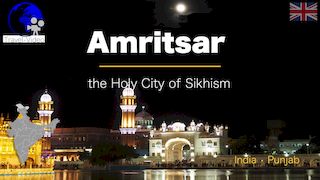
Amritsar, Holy City of Sikhism and Spiritual Heart of Punjab
A major religious city in northern India
Located in the state of Punjab in northwestern India, Amritsar holds a central place in the history and spiritual life of Sikhism. The city is internationally known for the Golden Temple, the most revered sanctuary of a religion founded in the late fifteenth century in the Punjab region. Yet Amritsar is far more than a single monument. It combines intense religious life, community traditions, commercial energy and a strong regional identity.
Founded in the late sixteenth century around a sacred pool, the city developed as a pilgrimage centre, a place of learning and an urban space deeply shaped by Sikh institutions. It continues to attract worshippers, travellers and visitors who come not only to admire architecture, but to experience a living spiritual centre.
This video reflects that diversity through sacred monuments, ceremonies, communal kitchens, street scenes and everyday life. It presents a city where religion, hospitality and urban activity remain closely connected.
The Golden Temple and the places highlighted in the video
The Golden Temple, or Harmandir Sahib, forms the symbolic heart of Amritsar. Built at the centre of a vast sacred tank, it is reached by a causeway leading pilgrims toward the shrine. Its gilded surfaces, domes and reflections in the water have made it one of the most recognisable landmarks in India.
The presence of the Guru Granth Sahib, the holy scripture of Sikhism regarded as the eternal spiritual guide, gives the sanctuary its essential religious meaning. Ceremonies linked to its daily installation and its evening transfer are among the most significant moments in the rhythm of the shrine.
The gurdwara kitchens and the Langar Hall reveal another fundamental dimension of Amritsar. The langar is a free communal meal served to all, regardless of religion, background or social status. This long-standing practice gives concrete expression to Sikh values of equality, humility and service.
The video also evokes other aspects of the city, including an urban farm and traditions linked to the care of animals, reminders that older ways of life still survive within the modern city. The old bazaar, with its dense streets and constant movement, shows the commercial vitality surrounding the sacred centre.
Historical, religious and urban context
Amritsar was founded under the guidance of the early Sikh Gurus, especially Guru Ram Das and Guru Arjan. The sacred pool, known as the Amrit Sarovar, gave the city its name. From the beginning, the site was conceived as an open spiritual centre, welcoming people from different backgrounds.
Over the centuries, the city experienced prosperity as well as destruction and rebuilding linked to regional conflicts. In the nineteenth century, under the Sikh Empire of Maharaja Ranjit Singh, the sanctuary received major embellishments, including gilded copper plating that helped create its present appearance.
The urban fabric of Amritsar developed around the sacred complex, with markets, pilgrim accommodation, religious institutions and specialised commercial streets. Unlike some planned imperial capitals, the city grew organically as a pilgrimage centre whose influence steadily expanded.
Architecturally, the Golden Temple combines Punjabi, Mughal and regional influences. Marble surfaces, decorative inlay, domes, arcades and balanced proportions create a synthesis characteristic of northern India. The monument is admired not only for ornament, but for the harmony between architecture, water and ritual movement.
What the videos on this site make especially clear
The videos presented on this site, often created from carefully selected and animated photographs, are particularly well suited to a place like Amritsar, where atmosphere matters as much as architecture.
Successive views of the Golden Temple help the viewer understand the relationship between the central shrine, the sacred pool and the surrounding galleries. Seen from different angles, the overall symmetry of the complex becomes clearer, as does the central role of water in the spiritual experience.
Images linked to the Guru Granth Sahib make the importance of ritual life easier to grasp. Even without attending a full ceremony, the visual sequence conveys the respect shown to the sacred scripture and its central place in Sikh tradition.
Scenes filmed in the kitchens and Langar Hall reveal the communal dimension of the site in practical terms. Collective work, food preparation and the welcome offered to all become immediately understandable through the progression of images.
The bazaar and the older streets show that the holy city is not separated from ordinary life. Trade, movement and daily activity continue around the sanctuary at all hours.
Finally, changing light, especially in the evening, enhances the contemplative quality of the site and highlights the beauty of reflections across the water.
A city where spirituality and daily life meet
Amritsar is not only one of the great religious centres of Sikhism. It is also a living city where faith, hospitality, historical memory and urban energy meet. The Golden Temple stands at its heart, but the identity of the city extends far beyond a single monument.
The detailed pages linked to this video offer an opportunity to explore the sanctuary, the langar tradition and the other places that make Amritsar one of the most memorable destinations in northern India.




Audio Commentary Transcript
At the origin of Sikhism, Guru Nanak and his 9 successors.
They all contributed to the writing of the holy book of Sikhism, and the book became the “11th guru” under the name of Guru Granth Sahib.
He is considered a full man and it is for this reason that he sleeps in a bed but also that he can die, in which case he will be replaced by a new copy printed in Amritsar.
Amritsar is the Mecca of Sikkhism. The most sacred temple of this religion is the Harmandir Sahib, also called the Golden Temple because it is covered with fine gold.
The temple was built in 1601 by the 5th guru, Guru Arjan at the very spot where Guru Nanak, the founder of Sikkhism, came to meditate.
Every day, at sunset, Guru Granth Sahib is carried in procession to his bed, where he spends the night.
Gurdwara are places of prayer and meeting for Sikhs. That of Amritsar is located just in front of the Golden Temple and is one of the 5 main gurdwaras of Sikkhism, called Takhts, which means "throne" in Persian.
In Sikkhism, sharing is an important value. In all gurdwaras, vegetarian meals are offered to anyone, Sikh or not, who wishes to participate in the common meal. The logistics of delivering these thousands of meals a day are impressive.
Here are some pictures of the kitchens of Gurdwara Akal Takht at mealtime.
Harmandir Sahib, or Golden Temple, a holy high place of Sikhism was destroyed and rebuilt several times. Its most recent destruction took place in 1984 when Indian Prime Minister Indira Gandhi ordered a major military operation to dislodge Sikhs separatists who had taken refuge there, as well as in the Gurdwara near the temple. The toll from this operation officially stands at 493 dead and 86 Sikh wounded and 84 killed and 248 wounded among the attacking troops.
It was also this attack that led to the assassination of Indira Gandhi a few months later.

Music:
- - YouTube video library - Evil March, (© Evil March by Kevin MacLeod is licensed under a Creative Commons Attribution 4.0 license. https://creativecommons.org/licenses/by/4.0/
- Source: http://incompetech.com/music/royalty-free/index.html?isrc=USUAN1100727
- Artist: http://incompetech.com/)
- - YouTube video library - Exciting Trailer, (© Exciting Trailer by Kevin MacLeod is licensed under a Creative Commons Attribution 4.0 license. https://creativecommons.org/licenses/by/4.0/
- Source: http://incompetech.com/music/royalty-free/index.html?isrc=USUAN1100494
- Artist: http://incompetech.com/)
- - YouTube video library - Fall of the Solar King, (© Fall of the Solar King by Twin Musicom is licensed under a Creative Commons Attribution 4.0 license. https://creativecommons.org/licenses/by/4.0/
- Artist: http://www.twinmusicom.org/)
- - YouTube video library - Familiar Things
- - YouTube video library - Flowers in the Rain
- - YouTube video library - For Originz, (© For Originz by Kevin MacLeod is licensed under a Creative Commons Attribution 4.0 license. https://creativecommons.org/licenses/by/4.0/
- Source: http://incompetech.com/music/royalty-free/index.html?isrc=USUAN1100700
- Artist: http://incompetech.com/)
- - YouTube video library - Her Owl Ring
- - YouTube video library - Ignosi, (© Ignosi by Kevin MacLeod is licensed under a Creative Commons Attribution 4.0 license. https://creativecommons.org/licenses/by/4.0/
- Source: http://incompetech.com/music/royalty-free/index.html?isrc=USUAN1100450
- Artist: http://incompetech.com/)
- (Inde) - Hola Mohalla at Guru Nanak Dwara - Kar Kirpa Tere Gun Gavan Golden Temple - Shahab Kirtan Popular Punjabi Devotional Songs
Disclaimer: Despite its appropriateness, copyright issues prevent the use of indian traditional music in "Amritsar, Holy City of Sikhism • Punjab, India ", hence the use of royalty-free music. Despite our careful selection, some might regret this decision, which is necessary to avoid potential lawsuits. Although difficult, this decision is the only viable solution.