Français (France)
  Nederlands (nl-NL)
 Of the British Raj ruled for approximately 89 years, ± between 1858 and 1947 over all or part of East India, North India, South India, the Himalayan region and West India, during the Colonial Period.
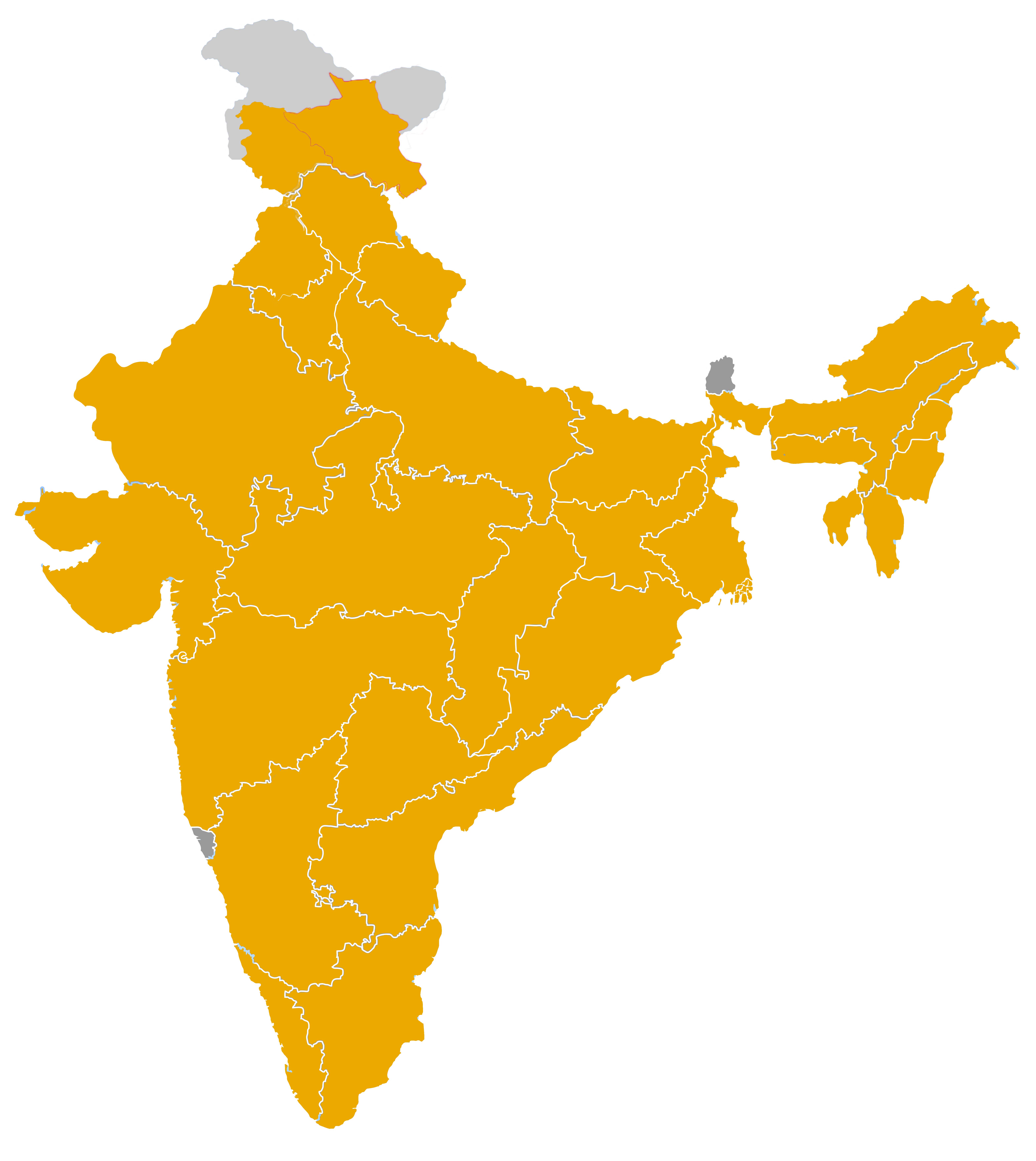
This map illustrates the maximum territory that the British Raj Dynasty had reached at its height, covering the current regions of Delhi (NTC), Ladakh, Maharashtra, Meghalaya, Mizoram, Nagaland, Odisha, Punjab, Rajasthan, Sikkim, Tamil Nadu, Telangana, Tripura, Uttar Pradesh and Uttarakhand in India. Its main purpose is to provide a visual aid to understand the geographical extent of this dynasty. However, it's important to note that the contemporary borders of these regions may not necessarily coincide with the historical territories.
The British Raj and the Colonial Transformation of Modern India
An imperial regime rather than an Indian dynasty
The British Raj refers to the period of direct rule by the British Crown over India from 1858 to 1947. It was not an Indian dynasty in the usual sense, but a colonial imperial regime governed in the name of the British monarch. After the uprising of 1857, the authority of the British East India Company was abolished, and the administration of India passed formally to the Crown. From 1876, Queen Victoria held the title Empress of India, while her successors were styled Emperors of India until the end of British rule.
The Raj occupied a central place in the history of modern India because it reshaped political authority, economic structures, cultural life and regional identities across the subcontinent. Its legacy is complex. It introduced institutions and infrastructures that survived into independent India, but it did so within a system of foreign domination, racial hierarchy and economic subordination.
Centralised administration and imperial control
Politically, the British Raj created a highly centralised colonial state. British India included directly administered provinces such as Bengal, Bombay, Madras, Punjab, the United Provinces, Assam and the Central Provinces. Alongside these territories, hundreds of princely states remained under local rulers, but their sovereignty was limited by British paramountcy. Their external relations, succession disputes and strategic policies were controlled or supervised by the colonial power.
The viceroy and governor general represented the Crown in India and exercised executive authority. Beneath him stood a hierarchy of governors, commissioners, district officers, magistrates and revenue officials. The Indian Civil Service became the administrative backbone of the Raj. It was designed to preserve order, collect revenue and protect British interests, but it also shaped the future administrative culture of India.
The Raj also contributed indirectly to the rise of Indian nationalism. By governing vast regions through common institutions, laws, censuses, railways and education systems, it helped create a wider political arena in which Indian leaders could imagine the subcontinent as a shared public space. The Indian National Congress, founded in 1885, emerged from this environment and gradually became a major vehicle of anti colonial politics.
Economic integration into the British imperial system
The economic impact of the British Raj was profound and deeply contested. India was integrated into the British imperial economy as a supplier of raw materials, a market for manufactured goods and a source of taxation. Cotton, jute, tea, indigo, opium, wheat and other commodities were linked to global trade networks controlled or influenced by British interests.
The colonial government built railways, ports, roads, telegraph lines and irrigation works. These infrastructures transformed mobility, communication and commerce. They connected distant regions, facilitated troop movements and made it easier to transport agricultural produce and raw materials to ports. Although these developments contributed to the later integration of the Indian economy, their primary purpose was imperial administration, military control and commercial extraction.
Industrial development remained uneven. Bombay became an important textile centre, Bengal developed a major jute industry, and mining expanded in several regions. Yet many traditional crafts declined under pressure from imported industrial goods and changing market structures. Rural India remained heavily dependent on land revenue, cash crops and monsoon conditions. Famines during the colonial period exposed the vulnerability of this economic order and remain one of the most controversial aspects of British rule.
Cultural change through education, language and law
The cultural role of the British Raj was significant, though never one sided. English became a major language of administration, law, education and public debate. Universities in Calcutta, Bombay and Madras, founded in 1857, helped produce a new educated elite. This class included lawyers, journalists, teachers, civil servants, reformers and political leaders who used colonial institutions while also challenging colonial authority.
Western style education encouraged new forms of historical writing, social reform and political argument. Indian intellectuals debated questions of caste, religion, gender, law, representation and national identity. Reform movements developed within Hindu, Muslim, Sikh and other communities, often combining indigenous traditions with new intellectual frameworks.
At the same time, British cultural policies were shaped by assumptions of imperial superiority. Colonial knowledge systems classified Indian society through censuses, legal categories, ethnography and administrative reports. These classifications sometimes hardened social and religious identities that had previously been more fluid. The cultural legacy of the Raj therefore includes both intellectual renewal and the distortions produced by colonial rule.
Urban landscapes and imperial symbolism
The Raj transformed many Indian cities. Calcutta, Bombay and Madras expanded as colonial port cities and administrative centres. Delhi acquired renewed imperial significance after the capital was transferred from Calcutta in 1911. New Delhi was designed as a monumental capital expressing British imperial authority through architecture, ceremonial avenues and government buildings.
Hill stations such as Simla also played an important role in colonial governance and social life. They served as seasonal administrative centres and as spaces of separation between British officials and the Indian population. Railways, cantonments, courts, clubs, universities and civil lines altered the physical and social geography of many cities.
National resistance and the end of colonial rule
The Raj faced increasing opposition from the late nineteenth century onward. Early demands for greater Indian participation in government developed into broader claims for self government and independence. Mahatma Gandhi transformed the nationalist movement through non cooperation, civil disobedience and mass mobilisation. Other leaders and currents, including constitutionalists, revolutionaries, social reformers and regional movements, also shaped the struggle.
The Second World War weakened Britain’s capacity to maintain imperial rule. Political negotiations, mass protests and communal tensions led to the end of the Raj in 1947. Independence came with partition, creating India and Pakistan and causing immense violence and displacement.
A lasting but ambivalent place in Indian history
The British Raj left a powerful institutional and historical legacy. It shaped administration, law, railways, education, political organisation and territorial integration. Yet these changes were inseparable from colonial domination, economic exploitation and unequal power. In Indian history, the Raj stands as a period of profound transformation, marked both by imposed imperial structures and by the emergence of the modern movements that brought colonial rule to an end.
The Geographical Reach of the British Raj in the Indian Subcontinent
A colonial empire extending across most of South Asia
The British Raj was the system of direct rule established by the British Crown over India after 1858. It was not a dynasty in the Indian sense, but an imperial regime headed nominally by the British monarch and administered in India by the viceroy. Its geographical extent was vast. At its height, it covered most of the Indian subcontinent, including present day India, Pakistan and Bangladesh, while Burma was also administered as part of British India until its separation in 1937.
The Raj inherited much of its territorial structure from the British East India Company. Before 1858, the Company had already expanded through conquest, treaties, annexations and subsidiary alliances. The Crown therefore took control of a complex political map composed of directly ruled provinces, princely states under British paramountcy, frontier zones and strategically controlled dependencies. This structure made the Raj one of the largest and most diverse colonial formations of the modern world.
Directly governed provinces under British administration
The core of British authority lay in the provinces directly administered by colonial officials. These included major territories such as Bengal, Bombay, Madras, Punjab, the United Provinces, the Central Provinces, Assam, Bihar and Orissa, Sind and the North West Frontier Province. These regions varied greatly in language, economy, religion, population density and political importance.
Bengal was a major administrative, intellectual and commercial region. Bombay and Madras were coastal presidencies with strong maritime connections. Punjab was strategically important for military recruitment and for defence on the north western frontier. Assam and Burma linked British India to the eastern borderlands and to Southeast Asia. The United Provinces and the Central Provinces formed important inland administrative zones.
Direct rule allowed the colonial state to control taxation, law, policing, land revenue, public works and military logistics. Railways, roads, ports and telegraph lines tied these provinces more closely together. This integration made movement across the subcontinent faster and more systematic, but it primarily served imperial needs: troop deployment, extraction of raw materials, commercial transport and administrative supervision.
Princely states within the imperial system
A large part of the territory associated with the Raj was not administered directly. Hundreds of princely states continued to be ruled by Indian dynasties, but under British paramountcy. States such as Hyderabad, Mysore, Kashmir, Baroda, Gwalior, Jaipur, Jodhpur, Travancore and Bhopal retained internal courts, rulers and administrative traditions. Their autonomy, however, was limited.
The British controlled or supervised their external relations, defence, succession issues and strategic decisions. Political residents were often stationed at princely courts to monitor and influence local rulers. This system allowed the Raj to dominate a very large area without absorbing every territory into the provincial administration.
The princely states gave the colonial order a layered geography. Some regions were governed directly by British officials, while others were ruled indirectly through subordinate dynasties. For neighbouring Indian powers, this meant that relations with the Raj were rarely relations between equals. Formerly sovereign dynasties became protected allies, dependent rulers or ceremonial partners within an imperial hierarchy.
The north western frontier and the Afghan buffer
The north western frontier was one of the most strategically sensitive zones of the Raj. After the annexation of Punjab, British India bordered tribal regions and Afghanistan. This frontier became central to imperial defence policy because British officials feared Russian expansion in Central Asia. Afghanistan was treated as a buffer between British India and possible northern threats.
The British did not generally seek to incorporate Afghanistan fully into India. Instead, they tried to control its external orientation through wars, treaties and diplomatic pressure. The frontier itself remained militarised and unstable. Mountain passes, tribal territories and border settlements required constant negotiation and military readiness.
This geography shaped the Raj’s relations with neighbouring powers. Afghanistan was not simply an independent neighbour, but a strategic shield. The Punjab and the North West Frontier Province became crucial to the defence of the empire, and military recruitment from these regions gained special importance in colonial policy.
Himalayan borderlands and relations with Nepal, Bhutan and Tibet
The northern edge of the Raj brought British India into contact with the Himalayan world. Nepal remained independent, but its relationship with the British was shaped by diplomacy, military agreements and recruitment. Gurkha soldiers became an important part of the colonial army, making Nepal a strategic partner without being absorbed into the Raj.
Bhutan also preserved its internal autonomy, though treaties limited aspects of its external position. Tibet became a diplomatic concern because of its location between British India, China and Central Asia. British interest in Tibet was driven by trade, frontier security and anxiety over rival imperial influence.
These Himalayan relationships show that the geographical reach of the Raj extended beyond formal borders. British India exercised influence through diplomacy, treaties, military pressure and buffer arrangements. The frontier was therefore both a boundary and a zone of indirect power.
Burma and the eastern expansion of British India
To the east, Burma was progressively conquered during the Anglo Burmese wars and became part of British India. Its inclusion gave the Raj a wider connection to Southeast Asia and the Bay of Bengal. Rangoon became an important port, and Burmese rice exports became central to the colonial economy.
However, Burma differed significantly from India in language, religion, social structure and political history. Its administration as part of British India created tensions and practical difficulties. In 1937, Burma was separated from British India and made a distinct British colony. This separation shows that the geographical reach of the Raj was not fixed, but changed according to imperial priorities and administrative convenience.
A territorial order that reshaped South Asian politics
The geographical extension of the British Raj transformed relations across South Asia. Indian princely states were drawn into a subordinate imperial network. Border powers such as Afghanistan, Nepal, Bhutan and Tibet were treated as strategic buffers. Burma linked the Raj to Southeast Asia before being administratively separated.
When British rule ended in 1947, the colonial territory did not become a single successor state. Partition created India and Pakistan, while Burma had already been separated and Bangladesh emerged later from eastern Pakistan. Yet the territorial legacy of the Raj remained decisive. Provincial boundaries, railways, military frontiers, administrative centres and relations with former princely states continued to shape the political geography of modern South Asia.
The British Raj was not an Indian dynasty, but a colonial regime administered in the name of the British Crown. The nominal sovereigns were the British monarchs, first queen and later empress or emperors of India; the viceroys and governors-general exercised imperial executive authority in India.
Victoria, Queen of the United Kingdom and later Empress of India
- Charles Canning (1858–1862) • The first Viceroy of India after power was transferred from the British East India Company to the Crown.
- Lord Elgin (1862–1863) • His short term continued the administrative reorganisation of the Raj after Crown rule began.
- John Lawrence (1864–1869) • A former administrator of Punjab, he favoured internal consolidation and caution on the north-western frontier.
- Lord Mayo (1869–1872) • He developed provincial finance and encouraged statistical surveys before his assassination in the Andaman Islands.
- Lord Northbrook (1872–1876) • He governed during frontier tensions and debates over imperial policy toward Afghanistan.
- Lord Lytton (1876–1880) • He organised the Delhi Durbar of 1877 proclaiming Victoria Empress of India, but his term was also marked by famine and repressive measures.
- Lord Ripon (1880–1884) • He promoted several liberal reforms, especially in local administration, and became associated with the Ilbert Bill controversy.
- Lord Dufferin (1884–1888) • His term saw the foundation of the Indian National Congress and the annexation of Upper Burma.
- Lord Lansdowne (1888–1894) • He strengthened the military and frontier organisation of the Raj amid imperial rivalries in Asia.
- Lord Elgin (1894–1899) • His government faced famines, epidemics and unrest in several regions.
- Lord Curzon (1899–1901 under Victoria) • He launched a broad programme of administrative and imperial reforms, continued under Edward VII.
Edward VII, Emperor of India
- Lord Curzon (1901–1905 under Edward VII) • He continued his centralising policy and ordered the partition of Bengal in 1905.
- Lord Minto (1905–1910) • He governed during the rise of the swadeshi movement and supported the Morley-Minto reforms of 1909.
George V, Emperor of India
- Lord Hardinge (1910–1916) • He oversaw the transfer of the capital from Calcutta to Delhi and governed during the early years of the First World War.
- Lord Chelmsford (1916–1921) • His term was marked by the Montagu-Chelmsford reforms, the Rowlatt Act and the Amritsar massacre.
- Lord Reading (1921–1926) • He administered India during the decline of the Non-Cooperation Movement and renewed constitutional debate.
- Lord Irwin (1926–1931) • He faced Gandhi’s Civil Disobedience Movement and concluded the Gandhi-Irwin Pact in 1931.
- Lord Willingdon (1931–1936 under George V) • He adopted a firm policy toward the nationalist movement and governed during the constitutional discussions leading to the 1935 Act.
Edward VIII, Emperor of India
- Lord Willingdon (1936 under Edward VIII) • He completed his term at the beginning of Edward VIII’s brief reign.
- Lord Linlithgow (1936 under Edward VIII) • He took office shortly before the monarch’s abdication.
George VI, Emperor of India
- Lord Linlithgow (1936–1943 under George VI) • He was viceroy at the outbreak of the Second World War and governed during the Quit India Movement.
- Lord Wavell (1943–1947) • He tried to manage the political crisis, the Bengal famine and the constitutional negotiations at the end of the Raj.
- Lord Mountbatten (1947) • The last Viceroy of India, he oversaw the transfer of power and the partition between India and Pakistan.
 Links to the main sections of the site