

 Français (France)
  Nederlands (nl-NL)
 The Victoria Memorial in Kolkata is a major commemorative monument located in the state of West Bengal, India. Built during the period of the British Raj, it was dedicated to the memory of Queen Victoria and stands as one of the most visible symbols of the colonial era in the city. The building now houses a museum presenting collections related to the political, cultural and artistic history of India and the British Empire. Surrounded by extensive public gardens, the monument is also a popular place for residents and visitors. It forms an important part of Kolkata’s historical and cultural heritage.
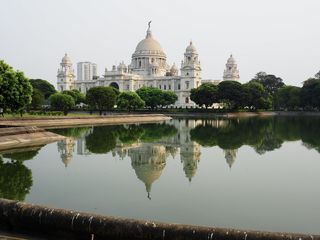
Kolkata • Victoria Memorial
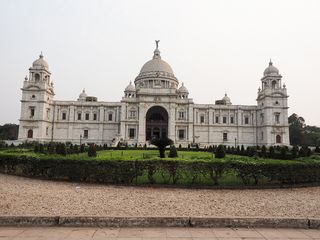
Kolkata • Victoria Memorial
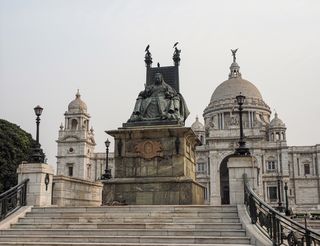
Kolkata • Victoria Memorial
Monument profile
Victoria Memorial
Monument categories: Museum, Memorial monument
Monument families: Monument for cultural purposes • Museum, remarkable architecture or group of buildings
Monument genres: Cultural or scientific
Geographic location: Kolkata • West Bengal •
Construction period: 20th century AD
• Links to •
• Dynasties that contributed to the construction of the monument •

• List of videos about Kolkata on this site •
Kolkata • Urban Life and Trading Traditions
Kolkata • Colonial Heritage and Legacy of the Raj
Kolkata • Religious Diversity and Urban Traditions
History of the Victoria Memorial, Kolkata
Political and Social Context of Construction
The Victoria Memorial in Kolkata was conceived in the early twentieth century during the final phase of the British Raj in India, a period marked by both imperial confidence and growing political unrest. The death of Queen Victoria in 1901 prompted a wave of commemorative initiatives across the British Empire. In India, where Victoria had been proclaimed Empress in 1876, colonial authorities sought to construct a monument that would embody imperial authority while honoring the monarch whose reign had coincided with the consolidation of British rule on the subcontinent.
The project was strongly promoted by Lord Curzon, Viceroy of India from 1899 to 1905. Curzon believed that a monumental memorial dedicated to Queen Victoria should be erected in Calcutta, then the capital of British India and the administrative center of imperial governance in Asia. His ambition was not only commemorative but political. By creating a grand architectural landmark, the colonial administration aimed to reaffirm the prestige and legitimacy of British rule at a time when nationalist movements were beginning to challenge imperial authority.
The Victoria Memorial was therefore conceived as both a monument and a museum. Curzon envisioned a building that would preserve historical documents, artworks, and relics associated with the British Empire in India while simultaneously serving as a symbolic representation of imperial stability and continuity. The memorial was intended to demonstrate the cultural and administrative achievements of British governance in India.
Financing the project involved a complex network of political relationships. Although the British colonial administration coordinated the initiative, much of the funding was raised through public subscription across India. Indian princes, landowners, and wealthy elites were encouraged to contribute to the project. Their participation reflected both political pragmatism and the intricate alliances between the colonial state and regional ruling elites. By involving Indian donors, the memorial could be presented as a collaborative imperial project rather than a purely British imposition.
Construction and Imperial Symbolism
The foundation stone of the Victoria Memorial was laid in 1906 by the Prince of Wales, who would later become King George V. Construction proceeded over several years and the monument was officially opened to the public in 1921.
The memorial was designed not only as a commemorative structure but also as an institutional center dedicated to the interpretation of imperial history. Its galleries were intended to display paintings, manuscripts, sculptures, and artifacts related to the expansion of British influence in India. Through these collections, visitors were encouraged to perceive the British Empire as a civilizing and stabilizing force in the region.
The location of the memorial also carried symbolic meaning. Situated near the Maidan, one of Kolkata’s largest open spaces, the monument occupied a prominent position within the urban landscape. This placement ensured that the structure would remain visible across the city and would function as a focal point within the colonial capital.
The memorial was inaugurated during a period of significant political transformation. By the time the building opened in 1921, the capital of British India had already been transferred from Calcutta to New Delhi in 1911. Despite this administrative shift, the Victoria Memorial continued to represent the historical importance of Kolkata as a center of imperial governance.
Global Context of Monumental Construction
The creation of the Victoria Memorial must also be understood within a broader global trend toward monumental architecture in imperial capitals and colonial cities during the nineteenth and early twentieth centuries. Across Europe and its overseas territories, governments commissioned large memorials and museums dedicated to national leaders, imperial achievements, and historical narratives.
In London, Paris, and other European capitals, monumental buildings served to reinforce national identity and commemorate political power. Similar architectural strategies were employed in colonial contexts, where large public buildings were used to symbolize the authority and permanence of imperial rule.
The Victoria Memorial fits within this international tradition. Like many contemporary monuments, it combined commemorative and educational functions. Museums established during this period often served as repositories for artifacts collected across imperial territories, presenting them within narratives that emphasized imperial expansion and cultural exchange.
The memorial also reflects the broader intellectual climate of the time. Historical museums were increasingly viewed as institutions capable of shaping public understanding of the past. By displaying objects connected with imperial governance and exploration, the Victoria Memorial contributed to a global movement that used museums as instruments of cultural interpretation and political messaging.
Historical Transformations and Institutional Evolution
The political transformation of India during the twentieth century significantly altered the meaning of the Victoria Memorial. When India achieved independence in 1947, the monument lost its original function as a symbol of imperial authority. However, rather than dismantling or abandoning the structure, the newly independent Indian government chose to preserve it as a historical institution.
This decision reflected a broader approach to colonial-era architecture across India. Many buildings constructed during the British period were retained and integrated into the cultural and administrative framework of the new nation. The Victoria Memorial was gradually reinterpreted as a museum dedicated not only to the colonial era but also to the broader history of India.
The collections and exhibitions within the building evolved accordingly. Displays increasingly addressed themes such as the emergence of Indian nationalism, the cultural diversity of the subcontinent, and the political transformations that led to independence. In this way, the memorial shifted from being a symbol of imperial power to becoming a site for historical reflection and interpretation.
Urban development also influenced the context of the monument. During the colonial period, the Victoria Memorial stood within a relatively open landscape near military parade grounds and administrative buildings. Over the course of the twentieth century, Kolkata expanded dramatically. New neighborhoods, transportation networks, and commercial districts transformed the surrounding urban environment. Despite these changes, the memorial and its gardens remained one of the city’s most prominent public spaces.
Contemporary Role and Cultural Significance
Today the Victoria Memorial functions primarily as a museum and cultural institution. Its galleries contain paintings, sculptures, manuscripts, maps, and artifacts that illustrate the political and cultural history of India from the eighteenth century through the colonial period.
The monument holds a complex position within the cultural identity of Kolkata. For many residents it represents an architectural landmark and a major historical institution. At the same time, it serves as a reminder of the colonial past and the political structures that once governed the subcontinent.
The surrounding gardens have become a popular recreational area for residents and visitors. The site hosts cultural events, educational programs, and temporary exhibitions that contribute to the city’s public cultural life. As one of the most recognizable buildings in Kolkata, the Victoria Memorial also plays an important role in tourism and in the visual identity of the city.
Conservation and Modern Preservation Challenges
Preserving the Victoria Memorial presents several challenges associated with environmental conditions and urban development. Kolkata’s climate is characterized by high humidity, seasonal monsoon rains, and significant temperature variations. These factors can affect building materials and the conservation of artworks housed within the museum.
Air pollution is another concern. As Kolkata has grown into a densely populated metropolis, increased traffic and industrial activity have introduced pollutants that may gradually affect the monument’s exterior surfaces. Conservation programs have therefore focused on maintaining the structure while protecting the collections stored inside the building.
Restoration efforts have included periodic cleaning of the exterior stone, improvements to climate control systems within the museum galleries, and modernization of exhibition facilities. These initiatives aim to ensure that the building remains structurally sound while meeting contemporary standards for museum conservation.
Although the Victoria Memorial is not listed as a UNESCO World Heritage Site, it is widely recognized as one of the most significant historical monuments in eastern India. Its preservation is regarded as an important component of safeguarding Kolkata’s architectural heritage.
Through its transformation from imperial memorial to historical museum, the Victoria Memorial reflects the broader evolution of India’s relationship with its colonial past. The monument now stands not only as a symbol of the British Empire but also as a site where multiple layers of history—imperial, national, and urban—intersect.
Architecture of the Victoria Memorial, Kolkata
Architectural conception and monumental program
The Victoria Memorial in Kolkata represents one of the most significant examples of monumental architecture constructed in India during the final decades of the British Raj. Conceived as a commemorative monument dedicated to Queen Victoria and simultaneously as a museum devoted to the history of British rule in India, the building was intended to express imperial authority through architectural scale, material quality, and symbolic composition. The structure was designed by the British architect William Emerson, whose work in India frequently combined European classical principles with elements derived from local architectural traditions.
The architectural conception of the Victoria Memorial reflects the ambition to produce a building that would visually rival the great imperial monuments of Europe while remaining legible within the cultural and architectural context of the Indian subcontinent. The design therefore merges classical European symmetry with forms associated with Mughal and Indo-Islamic architecture. This synthesis produces a monumental structure that is neither purely European nor entirely derived from indigenous traditions, but rather an architectural hybrid representing the imperial ideology of cultural synthesis promoted by the British administration.
The building occupies a dominant position within a large landscaped park near the Maidan, one of Kolkata’s major open spaces. This placement was deliberate. By situating the memorial within expansive gardens and broad visual axes, the designers ensured that the building would be visible from multiple approaches and would function as a focal point within the urban landscape.
Materials and construction techniques
One of the most striking architectural characteristics of the Victoria Memorial is the extensive use of white Makrana marble. This stone, quarried in Rajasthan, had previously been used in some of the most celebrated monuments of Indian architecture. Its selection for the memorial was both aesthetic and symbolic. The bright white surface provided visual distinction within the dense urban environment of Kolkata while also establishing a visual connection with the tradition of monumental marble architecture in the Indian subcontinent.
Beneath the marble exterior lies a structural system composed primarily of masonry and reinforced construction techniques common in late nineteenth- and early twentieth-century public buildings. The structure required substantial foundations due to the alluvial soil conditions of the Kolkata region. Engineers had to design a stable base capable of supporting the enormous mass of the central dome and the extensive marble cladding.
The construction process involved the collaboration of British engineers, architects, and Indian craftsmen. While structural planning followed European engineering principles, the detailed stone carving and decorative elements were executed by skilled Indian artisans. This collaboration allowed the building to combine structural precision with highly refined ornamental detail.
Marble panels were carefully fitted over the masonry structure, creating a unified architectural surface while maintaining the stability of the load-bearing walls. The durability of marble also offered advantages in the humid climate of Bengal, where prolonged monsoon seasons and high moisture levels could damage less resilient materials.
Architectural innovations and climatic adaptation
Although the Victoria Memorial draws heavily on European monumental traditions, its design incorporates several adaptations to the tropical climate of eastern India. Large openings, high ceilings, and wide internal corridors facilitate natural air circulation throughout the building. These features were particularly important before the widespread use of mechanical climate control.
The internal spatial arrangement promotes ventilation by allowing air to move between galleries and across central halls. The building’s elevated plinth also contributes to structural protection against flooding and seasonal rainfall, which are common features of the regional climate.
The surrounding gardens and open spaces also play a role in the architectural functioning of the monument. The landscaped environment allows air to circulate freely around the building while preventing the structure from being immediately surrounded by dense urban development. This spatial buffer was an important consideration during the design phase, ensuring both visual prominence and environmental protection.
From an urban planning perspective, the monument demonstrates the British colonial approach to monumental architecture in administrative capitals. By integrating large public gardens with monumental structures, planners created civic landscapes that combined symbolic power with functional public space.
Architectural influences and stylistic synthesis
The Victoria Memorial illustrates a deliberate fusion of architectural traditions. The building’s general symmetry and axial planning derive from European neoclassical architecture. The central dome, colonnaded porticos, and balanced wings evoke the design principles commonly used in major civic buildings across Europe during the nineteenth century.
At the same time, the structure incorporates elements associated with Mughal architecture. The central dome echoes the proportions and spatial prominence seen in imperial Mughal mausoleums. Smaller domed pavilions placed at the corners of the structure resemble chhatris, architectural features frequently used in North Indian palaces and tombs.
The combination of classical colonnades with Mughal-inspired domes creates a distinctive architectural language that came to characterize many late colonial buildings in India. This style, often described as Indo-Saracenic or Indo-European monumental architecture, was intended to visually reconcile imperial authority with local architectural traditions.
Decorative elements further reinforce this synthesis. Sculptures and reliefs on the exterior depict figures associated with British imperial history, while certain ornamental details reflect Indian decorative motifs. The result is an architectural narrative that simultaneously celebrates imperial leadership and acknowledges the cultural context of the monument’s location.
Spatial organization and internal structure
The Victoria Memorial follows a strongly axial plan centered on a monumental dome. The central chamber forms the architectural and symbolic heart of the building. From this core space extend galleries arranged symmetrically along longitudinal and transverse axes.
This layout reflects the building’s dual function as memorial and museum. The central hall provides a ceremonial space suitable for commemorative displays, while the surrounding galleries accommodate exhibitions dedicated to historical artifacts, paintings, manuscripts, and sculptures.
The interior circulation system was designed to handle large numbers of visitors while maintaining clear spatial orientation. Wide corridors connect the various exhibition rooms, allowing visitors to move gradually through the museum’s collections. Staircases and secondary halls provide vertical and lateral movement throughout the structure.
High ceilings and large windows allow natural light to illuminate the interior galleries. This design feature was particularly important during the early years of the museum when artificial lighting systems were less advanced than those available today.
Dimensions and notable architectural features
The Victoria Memorial is one of the most imposing structures in Kolkata. The building’s central dome rises to approximately fifty meters above ground level, making it visible across large parts of the surrounding landscape. The dome is topped by a bronze statue representing Victory, mounted on a mechanical bearing that allows it to rotate with the wind.
The overall building extends across a substantial footprint within the surrounding gardens. Long marble façades and colonnaded entrances contribute to the visual rhythm of the structure, while sculptural groups placed around the building enhance its commemorative character.
One of the most distinctive aspects of the monument is the integration of sculpture into the architectural program. Numerous statues representing historical figures associated with the British Empire are placed around the building and along the surrounding pathways. These sculptures form part of the narrative framework through which the memorial communicates its historical message.
The gardens surrounding the memorial also contribute to the architectural composition. Carefully planned pathways, water features, and lawns create sightlines that emphasize the monument’s symmetry and monumental scale.
Structural characteristics and distinguishing features
Compared with many other colonial monuments constructed during the same period, the Victoria Memorial stands out for the scale of its marble construction and the complexity of its stylistic synthesis. The building does not replicate a single architectural tradition but instead integrates multiple visual references within a unified composition.
The central dome serves as both a structural and symbolic focal point. Its massive base distributes weight evenly through the surrounding walls, while its elevated position ensures the monument’s dominance within the skyline of the surrounding parkland.
Another distinctive feature is the careful balance between vertical emphasis and horizontal expansion. While the dome draws attention upward, the extended wings and terraces create a horizontal spread that anchors the building within the landscape.
Conservation and architectural significance today
Today the Victoria Memorial remains one of the most recognizable architectural landmarks in eastern India. Its monumental design, extensive use of marble, and synthesis of architectural traditions make it a key example of late colonial architecture in South Asia.
Preservation of the monument presents several challenges. Kolkata’s humid climate and seasonal monsoon rains can affect the marble surfaces and structural elements. Urban pollution also poses long-term risks to the stone façade. Conservation programs therefore focus on cleaning, repairing, and protecting the marble while maintaining the original architectural integrity of the building.
Despite these challenges, the Victoria Memorial continues to function both as a museum and as a major cultural landmark. Its architecture embodies the intersection of imperial ambition, local craftsmanship, and architectural experimentation during the final phase of British rule in India. Through its scale, materials, and stylistic synthesis, the monument remains an enduring example of how architecture was used to express political power, cultural dialogue, and historical memory within the urban landscape of Kolkata.