Français (France)
  Nederlands (nl-NL)
 00:00 • intro | 00:23 • in the streets of Kolkata | 01:03 • rickshaws from another time | 02:13 • street scenes and small shops | 04:19 • the flower market
Personal creation from visual material collected during my trip India • Amazing East India: Assam, Odisha, West Bengal (2023)
Map of places or practices in Kolkata on this site
• Use the markers to explore the content •
Kolkata: Everyday Life, Historic Streets and Commercial Traditions
A city shaped by movement and daily activity
Kolkata is one of India’s most distinctive urban centres, combining colonial-era heritage, dense commercial districts and long-established local traditions. While the city is known for its historic buildings, cultural institutions and political history, much of its character is found in the streets themselves. This video explores the everyday life of the metropolis through its traffic, traditional means of transport, neighbourhood businesses and one of its most remarkable commercial institutions: the flower market of Mullick Ghat.
Rather than focusing on major monuments, the journey highlights the urban atmosphere that defines Kolkata. Busy streets, small businesses and traditional occupations reveal how commerce and daily activity continue to shape the city’s identity.
Street life, traditional transport and local commerce
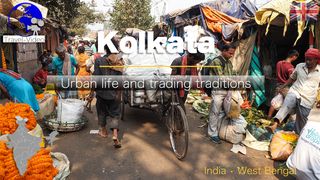
The video begins with scenes from Kolkata’s streets, where pedestrians, vehicles and informal economic activities share often limited urban space. These streets provide a vivid illustration of the city’s scale and energy, while also revealing traces of its historical development through older buildings and commercial areas.
Among the most distinctive elements are the hand-pulled rickshaws that still survive in certain parts of the city. Although largely replaced elsewhere by modern transport, they remain one of Kolkata’s most recognizable symbols. Their continued presence reflects both historical continuity and the unique social landscape of the city.
The route also passes numerous small businesses that form an essential part of neighbourhood life. Barbers, food vendors, juice sellers and other street-side enterprises contribute to a local economy that remains highly visible in the public space. These activities create an urban environment where commerce, social interaction and daily routines are closely intertwined.
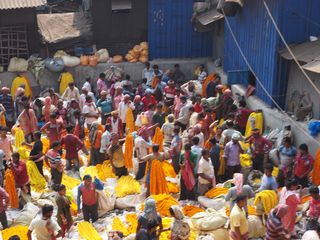
The final section focuses on Mullick Ghat Flower Market, located near the Hooghly River and the Howrah Bridge. The market is one of the largest flower trading centres in India and plays an important role in supplying flowers for temples, religious ceremonies and family celebrations. Vendors, customers and porters carrying large bundles of flowers illustrate the scale of this activity and its continuing importance within the regional economy.
A city built around trade
Although relatively recent by Indian standards, Kolkata quickly emerged as one of the major commercial centres of the subcontinent. Its development was closely linked to the Hooghly River, which provided access to regional and international trade routes. This commercial function profoundly influenced the city’s growth and remains visible today in the numerous specialized markets and business districts that continue to animate urban life.
Mullick Ghat Flower Market is a particularly striking example of this tradition. Every day, flowers arriving from West Bengal and other parts of India pass through the market before being distributed to customers across the region. The activity visible in the market reflects commercial networks that extend far beyond the city itself.
What the videos on this site make particularly visible
The videos on travel-video.info are largely built from carefully selected and animated photographs. This approach allows viewers to observe details that often escape attention in faster-moving footage. Architectural features, shopfronts, vehicles, market stalls and human activity can be examined more closely, while gradual movements help reveal spatial relationships, perspectives and the organization of urban environments. The result is a progressive exploration of the city that encourages careful observation and a deeper understanding of place.
Discovering Kolkata beyond its landmarks
Through its streets, traditional transport and commercial traditions, Kolkata reveals an important aspect of its identity. The scenes presented in this video illustrate how daily life, local trade and historic practices continue to shape one of eastern India’s most influential cities. Visitors wishing to explore these subjects further can consult the detailed pages dedicated to the locations and traditions featured in the film.
Links to related pages


Audio Commentary Transcript
The City
Formerly known as Calcutta, Kolkata developed from the eighteenth century as one of the main urban centres of India under British rule. Today the city is known for the intensity of its daily life. In the crowded streets, buses, taxis, rickshaws and street vendors move through an almost continuous flow, while a few hand-pulled rickshaws still survive, a legacy of a form of transport introduced during the colonial period and one of the most distinctive features of the city.
The Flower market
Not far from the Hooghly River, the Mullick Ghat Flower Market reveals another side of Kolkata. Far more than a simple colourful market, it functions as a vast supply centre where vendors, porters and buyers converge every morning in constant activity. The flowers arrive mainly from the horticultural regions of West Bengal, but also from more distant states such as Karnataka, one of southern India’s major flower-producing regions. Part of these shipments is then redistributed to temples, ceremonies and religious rituals in Kolkata and other cities across eastern India. In this dense and noisy maze, bundles of flowers and garlands move continuously through compact crowds, creating an atmosphere deeply characteristic of large urban gatherings in India.
In the narrow lanes of Mullick Ghat Flower Market, vendors assemble and sell flowers and garlands in an almost continuous flow of activity. Jasmines, roses and marigolds quickly pass from the hands of sellers to those of customers, while garlands intended for temples and religious ceremonies accumulate above the stalls. Despite the crowds and constant movement, the market operates with a well-established organization where every available space is used to prepare, transport or sell flowers.
Amid the crowds, porters constantly move through the market carrying massive bundles of flowers on their heads. In this narrow and congested environment, these loads circulate continuously between the sales areas, storage spaces and delivery vehicles. This constant activity reflects the commercial importance of Mullick Ghat Flower Market, one of the main centres of the flower trade in eastern India.

Original music – personal creation
Disclaimer: Despite its appropriateness, copyright issues prevent the use of traditional music in "Kolkata • Urban Life and Trading Traditions", hence the use of royalty-free music. Despite our careful selection, some might regret this decision, which is necessary to avoid potential lawsuits. Although difficult, this decision is the only viable solution.