Français (France)
  Nederlands (nl-NL)
 00:00 • intro | 00:07 • British Calcutta | 00:42 • Calcutta or Kolkata | 01:49 • Indian Museum | 02:23 • Ancient India’s Hindu heritage | 05:00 • Ancient India’s Buddhist heritage | 06:17 • Victoria Memorial | 08:16 • South Park Street Cemetery | 09:30 • Howrah Bridge
Personal creation from visual material collected during my trip India • Amazing East India: Assam, Odisha, West Bengal (2023)
• Use the markers to explore the content •
Kolkata: Exploring the Colonial Heritage of the British Raj
A city shaped by empire and cultural exchange
Standing on the eastern bank of the Hooghly River, Kolkata occupies a unique place in the history of modern India. For more than a century, it served as the capital of British India, becoming the political, administrative and intellectual heart of the British Raj until the transfer of the capital to New Delhi in 1911. During this period, the city expanded rapidly, acquiring monumental public buildings, religious institutions, museums and educational establishments that reflected both imperial ambitions and the growing importance of Kolkata as one of Asia's leading urban centres.
Today, this remarkable architectural heritage offers a fascinating insight into the complex relationship between colonial administration and Indian society. European architectural styles were adapted to local conditions, while scientific, artistic and educational institutions contributed to the emergence of Kolkata as a centre of scholarship and cultural exchange.
This video introduces some of the city's most significant colonial landmarks, illustrating how architecture, urban planning and public institutions combined to shape the identity of one of India's most influential cities. Together, these sites reveal not only the history of British rule but also the evolution of Kolkata into the vibrant cultural capital of eastern India.
Landmarks that tell the story of colonial Kolkata
Among the city's most important monuments is St. Paul's Cathedral, built during the nineteenth century to serve the Anglican community living in British India's capital. Designed in a Gothic Revival style adapted to Bengal's climate, the cathedral reflects both European architectural traditions and practical solutions developed for tropical conditions. It remains one of the most recognizable religious buildings constructed during the colonial period.
Another essential landmark is the Indian Museum, featured prominently in this video. Founded in 1814, it is one of the oldest museums in Asia and played a pioneering role in the study of archaeology, natural history, geology and anthropology. Its collections helped document the extraordinary diversity of the Indian subcontinent and contributed significantly to the development of scientific research during the nineteenth century. The museum also illustrates the growing interest of scholars in preserving India's artistic, archaeological and cultural heritage.
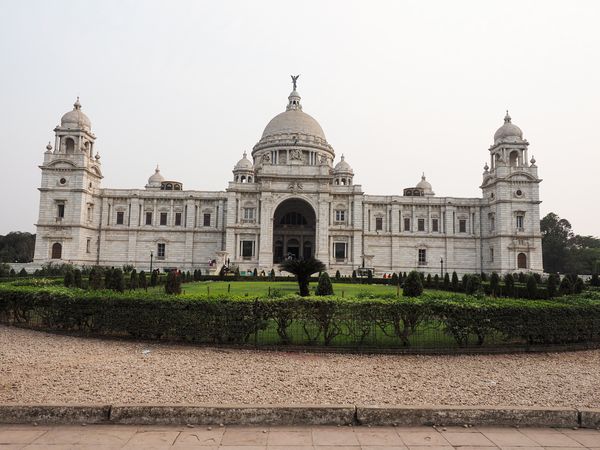
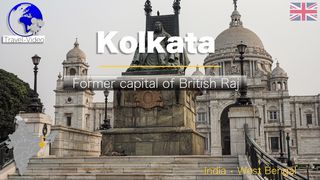
The Victoria Memorial occupies a central position within Kolkata's monumental landscape. Built after the death of Queen Victoria, who became Empress of India in 1876, it was conceived as both a memorial and a symbol of imperial authority. Combining classical European influences with elements inspired by Mughal architecture, the monument demonstrates how colonial architecture gradually developed its own distinctive identity within India.
The South Park Street Cemetery offers a very different perspective on Kolkata's history. Established during the eighteenth century, it preserves the tombs of administrators, merchants, soldiers and missionaries who belonged to the earliest generations of Europeans living in Bengal. Today it provides valuable insight into the social history of colonial Kolkata and the expansion of the East India Company.
Completing this historical panorama is the famous Howrah Bridge. Although built much later, during the twentieth century, it became one of the city's defining engineering achievements. Spanning the Hooghly River without intermediate piers, it symbolizes Kolkata's industrial development and continues to serve as one of India's busiest transport links.
Understanding the historical and architectural context
Kolkata's colonial heritage cannot be separated from the broader history of British expansion across the Indian subcontinent. Beginning as a trading settlement established by the British East India Company, the city gradually became the administrative centre from which vast territories were governed. After the events of 1857, direct Crown rule further strengthened Kolkata's political importance.
Urban planning reflected this new status. Wide avenues, administrative buildings, churches, museums and public gardens were carefully integrated into the growing city. The Maidan, one of the largest urban open spaces in India, created an impressive setting for several of the city's monumental buildings while providing a visual contrast to the densely built historic districts.
Architecturally, Kolkata presents a remarkable combination of influences. Neoclassical façades, Gothic Revival churches, Renaissance-inspired public buildings and Indo-Saracenic decorative elements coexist within a city that continuously adapted imported architectural concepts to local materials, climate and craftsmanship. High ceilings, generous verandas, wide windows and carefully designed ventilation systems illustrate this adaptation.
At the same time, Kolkata became one of India's foremost intellectual centres. Universities, learned societies, museums and publishing houses contributed to what later became known as the Bengal Renaissance, an important cultural movement that influenced literature, science, education and social reform throughout India. The city's institutions therefore represent not only colonial administration but also the development of modern scholarship and cultural life.
Following Indian independence in 1947, these monuments gradually acquired new meanings. Rather than serving as symbols of imperial power, they became part of India's shared historical heritage, offering opportunities to understand a complex period that shaped both the city and the nation.
A different way to appreciate architectural heritage
The videos presented on this website are designed to encourage careful observation rather than rapid sightseeing. Built largely from carefully selected photographs enhanced through subtle animation and smooth transitions, they allow viewers to explore architectural details that are often overlooked during a conventional visit.
This approach makes it easier to examine façades, sculptures, proportions, construction techniques and decorative features while also understanding how individual monuments relate to their urban surroundings. Progressive visual sequences reveal perspectives, spatial relationships and architectural compositions that can be difficult to appreciate in a single glance.
For a city as rich as Kolkata, this method of presentation is particularly valuable. It allows viewers to understand how museums, churches, memorials, bridges and historic public spaces collectively form an urban landscape shaped by centuries of political, cultural and architectural development. Each monument gains additional meaning when seen within its wider historical and geographical context.
Discovering one of India's richest historical landscapes
Kolkata's colonial heritage extends far beyond a collection of remarkable buildings. It tells the story of a city that became the administrative heart of British India while simultaneously developing into one of the country's leading centres of science, education and culture.
Exploring landmarks such as St. Paul's Cathedral, the Indian Museum, the Victoria Memorial, the South Park Street Cemetery and the Howrah Bridge offers a deeper understanding of this exceptional historical legacy. Visitors wishing to learn more can continue their exploration through the dedicated pages for each monument, where their architecture, history and cultural significance are presented in greater detail, revealing the many layers of one of India's most fascinating historic cities.




Audio Commentary Transcript
History of Kolkata
Although British colonial rule is now widely criticized for its economic exploitation, the famines exacerbated by certain imperial policies, and its suppression of Indian national aspirations, it also witnessed the establishment of the country’s first major archaeological institutions. During this period, archaeological museums, including the Indian Museum, as well as several organizations devoted to the scientific study of India’s cultural heritage, were founded in Kolkata and elsewhere.
Today known as Kolkata, the city was called Calcutta for more than two centuries. This anglicized form of an older Bengali name remained official until 2001, when the metropolis officially returned to its traditional pronunciation. Yet it was under the name Calcutta that the city entered history.
For more than a century, it served as the capital of British India and the administrative heart of the Raj. Governors, merchants, military officers and civil servants helped shape a city whose influence extended far beyond Bengal. By the beginning of the twentieth century, Calcutta ranked among the great cities of the British Empire, alongside London, Bombay and Hong Kong.
Although political power was transferred to Delhi in 1911, the legacy of that era remains deeply embedded in the urban landscape. Palaces, museums, cultural institutions and memorials still bear witness to the exceptional role the city played in the history of modern India.
Indian Museum
Among the institutions established during this period was the Indian Museum of Kolkata, founded in 1814. It is the oldest museum in India and one of the oldest museum institutions in Asia. Its collections have played a major role in the study, preservation and promotion of the heritage of the Indian subcontinent. Even today, the museum remains an essential reference for the archaeology and history of India.
The Lion of Ashoka echoes the form of the capitals that crowned the columns erected by Emperor Ashoka in the 3rd century BCE, during the Maurya period. The lions, facing the directions of the world, express sovereign authority and the spread of dharma. Below, the bull, the wheel and the elephant extend this symbolic language, combining strength, moral law and Buddhist memory. At the base, the lotus evokes purity and spiritual emergence.
Other sculptures continue this ancient Hindu universe. More modest in size, they are no less rich in symbolism: Garuda, Varaha, Ganesha and other divine figures give shape to India’s great mythological narratives. Between human bodies, sacred animals and hybrid beings, stone becomes a language of protection, power and cosmic order.
The representations of the Buddha preserved in the Indian Museum illustrate several major themes of Buddhist iconography. The Buddha is shown seated in meditation, in gestures of teaching or protection, and also reclining, evoking the end of his earthly life and his entry into nirvana. The reliefs often associate the central figure with disciples, guardians, stupas, sacred trees or symbolic animals. These elements express key themes of early Buddhism: renunciation, the transmission of teaching, compassion and spiritual awakening.
The Victoria Memorial
The Victoria Memorial and the Indian Museum are among the major buildings of British design in Kolkata, but their meaning differs profoundly. The Indian Museum houses essential pieces from the ancient history of India, while the Victoria Memorial was erected in honour of Queen Victoria, Empress of India. Built in the early twentieth century, this white marble monument combines imperial monumentality, classical European references and Indo-Saracenic elements in an architectural staging of British colonial power in Bengal.
The ceilings and domes of the Victoria Memorial reinforce the monumentality of the interior. Arches, circular galleries, columns and sculpted decoration structure a high, luminous space. The central dome accentuates the sense of solemnity characteristic of this imperial monument.
South Park Street Cemetery
The British did not come to India only to live, trade and govern. Many also died there. Opened in 1767, South Park Street Cemetery received the graves of Europeans settled in Calcutta, often carried off by disease, the climate or the harsh conditions of colonial life. Its imposing mausoleums bear witness to a lasting British presence, but also to its fragility.
At South Park Street Cemetery, tombs in the form of pyramids or obelisks are very numerous. They reflect the European taste for ancient Egypt, but also a certain idea of social rank. In Egypt, these forms were associated with royal power and with the elites close to the sovereign. Reusing them in a colonial cemetery therefore gave the deceased a monumental, almost aristocratic memory, far beyond a simple burial place.
Howrah Bridge
The Howrah Bridge, opened in 1943, replaced an older floating bridge that had become insufficient for the intensity of traffic between Calcutta and Howrah. For the British colonial administration, it was not simply a matter of connecting two banks of the Hooghly, but of improving access to the port of Calcutta, the railway stations, the warehouses and the industrial zones of Howrah. The bridge facilitated the movement of goods, workers and raw materials, especially in a region shaped by the trade in jute, coal and imported products. Through its technical scale, it also asserted the power of imperial engineering. But above all, it revealed the economic logic of colonial rule: organising urban space to better serve trade, industry and export.

Original music – personal creation
Disclaimer: Despite its appropriateness, copyright issues prevent the use of indian traditional music in "Kolkata • Colonial Heritage and Legacy of the Raj", hence the use of royalty-free music. Despite our careful selection, some might regret this decision, which is necessary to avoid potential lawsuits. Although difficult, this decision is the only viable solution.