

 Français (France)
  Nederlands (nl-NL)
 00:00 • intro | 00:51 • Thongsa Gompa monastery | 02:40 • Durpin monastery • Zang Dhok Palri Phodang | 05:19 • city and market
Personal creation from visual material collected during my trip Buddhist India • Sikkim • Bihar • West Bengal (2017)
Map of places or practices in Kalimpong on this site
• Use the markers to explore the content •
Kalimpong Between Himalayan Monasteries and Urban Life
A Hill Town Shaped by Himalayan Connections
Located in the northern part of West Bengal, near the borders of Sikkim and Bhutan, Kalimpong developed as an important crossroads between the Indian plains and the Himalayan world. The town combines religious institutions, mountain landscapes and commercial activity within an urban environment influenced by Tibetan, Bhutanese, Nepali and Indian cultures. This video explores several aspects of Kalimpong through its Buddhist monasteries, its streets and its market life.
The surrounding scenery reveals steep hillsides, humid valleys and mountain roads typical of the eastern Himalayas. Within this environment, monasteries occupy a prominent visual and cultural position. Their colourful architecture and elevated locations contribute strongly to the identity of the town. The video also shows that Kalimpong is not limited to religious heritage alone. Markets, streets and everyday activity remain central to the rhythm of urban life.
The coexistence of monastic traditions and commercial exchanges reflects the historical role of Kalimpong as a contact zone linking different Himalayan regions. Even today, this mixture of religious influence, local trade and mountain culture remains clearly visible throughout the town.
Thongsa Gompa and Zang Dhok Palri Phodang
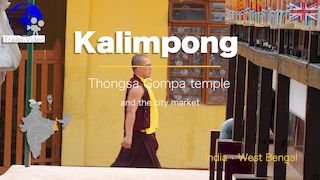
One of the principal sites featured in the video is Thongsa Gompa, also known as the Bhutanese Monastery. This monastery is among the oldest Buddhist religious institutions in Kalimpong and reflects the historical influence of Bhutan in the region. Its architecture follows Tibetan and Bhutanese traditions through layered roofs, painted façades and decorative religious motifs.
The monastery remains an active religious centre used for ceremonies, prayer and monastic life. The images reveal how the complex adapts to the steep terrain through terraces, stairways and elevated circulation areas. The relationship between the buildings and the surrounding hills forms an important aspect of the site’s visual character.
The video also presents Zang Dhok Palri Phodang, often called Durpin Monastery. Built on Durpin Hill overlooking Kalimpong, the monastery dominates the surrounding landscape and remains visible from many parts of the region. Its position reinforces both its religious symbolism and its monumental presence.
The architectural composition combines traditional Tibetan Buddhist forms with more recent construction techniques. Multi-level roofs, brightly painted surfaces and compact monumental volumes contrast with the dense vegetation of the Himalayan foothills. The monastery is also known for housing important Buddhist scriptures and maintaining strong ties with Tibetan religious traditions.
Scenes filmed within the town and around the market introduce another dimension of Kalimpong. The market remains one of the most active spaces in local daily life, bringing together agricultural products, goods from nearby Himalayan regions and a wide range of cultural influences. The movement of traders, residents and visitors illustrates the continued importance of commerce within the town’s identity.
Kalimpong Between Trade Routes and Religious Networks
Kalimpong’s historical development was closely linked to Himalayan trade routes connecting India, Tibet and Bhutan. Before modern border restrictions transformed regional exchanges during the twentieth century, caravans transporting wool, salt, tea and other goods regularly passed through the area. This commercial activity contributed to the growth of a culturally diverse population.
The monasteries shown in the video directly reflect these historical exchanges. Religious institutions in Kalimpong were not isolated buildings but parts of wider networks connecting monasteries and communities across the Himalayas. Monks, pilgrims and traders circulated between Tibet, Bhutan, Sikkim and northern India, reinforcing the town’s religious importance.
Architecturally, the monasteries display adaptations to the climatic conditions of the eastern Himalayas. Wide projecting roofs, elevated terraces and compact building masses respond to heavy monsoon rainfall and steep terrain. Decorative elements such as painted façades, prayer symbols and colourful woodwork reflect Tibetan Buddhist artistic traditions while also contributing to the visual identity of Kalimpong.
During the British colonial period, the town expanded as an administrative and commercial centre within the Darjeeling hills. Despite modern urban growth, many areas of Kalimpong still preserve a strong Himalayan atmosphere visible in its religious buildings, markets and street life.
A Detailed Reading of Architecture and Urban Spaces
The videos presented on travel-video.info are largely constructed from carefully selected photographs combined with progressive camera movements and animated sequences. This approach is particularly well suited to a place like Kalimpong, where architecture, landscape and urban organisation require gradual visual exploration.
Slow movements across the images help reveal the decorative details of the monasteries, the organisation of terraces and stairways, and the relationship between the buildings and the surrounding hillsides. The layered roof structures and painted architectural surfaces become easier to observe through this progressive visual construction.
Within the market scenes and urban sequences, the same approach makes everyday activity more readable. The images allow viewers to observe circulation patterns, commercial exchanges and the coexistence of religious and urban spaces within the town. The contrast between the calm atmosphere of the monasteries and the dense activity of the market also becomes more apparent.
Animated photographs further improve the perception of spatial depth and landscape relationships. The viewer can gradually understand how the monasteries dominate the surrounding valleys and how the town developed along the slopes of the Himalayan foothills.
A Himalayan Town Marked by Cultural Diversity
Kalimpong remains one of the most distinctive hill towns of eastern India. Between Buddhist monasteries, commercial traditions and Himalayan cultural influences, the town preserves a complex identity shaped by centuries of regional exchange. This video offers a detailed view of its religious architecture, urban life and mountain environment while providing a broader understanding of the historical and cultural connections that continue to define Kalimpong today.
Links to related pages



Audio Commentary Transcript
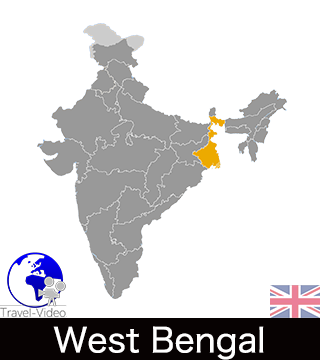
Kalimpong is a small town of less than 50,000 inhabitants in the state of West Bengal, at the foot of the Himalayas in India. The origin of the name is controversial but this one is sympathetic: "Assembly of the ministers of the king" in Tibetan.
Kalimpong was successively part of the kingdoms of Sikkim and Bhutan and when the British took possession in 1864, Kalimpong was only a small hamlet of a few houses.

Music:
- - YouTube video library - Anamalie, (© Anamalie by Kevin MacLeod is licensed under a Creative Commons Attribution 4.0 license. https://creativecommons.org/licenses/by/4.0/
- Source: http://incompetech.com/music/royalty-free/index.html?isrc=USUAN1500007
- Artist: http://incompetech.com/)
- (Inde) - Les Traditions Rituelles des Bonpos Tibétains - Chant de Louange Dédié à la Divinité Protectrice Midu, Ocora (558622)
- - YouTube video library - Evil March, (© Evil March by Kevin MacLeod is licensed under a Creative Commons Attribution 4.0 license. https://creativecommons.org/licenses/by/4.0/
- Source: http://incompetech.com/music/royalty-free/index.html?isrc=USUAN1100727
- Artist: http://incompetech.com/)
Disclaimer: Despite its appropriateness, copyright issues prevent the use of indian traditional music in "Kalimpong • West Bengal, India", hence the use of royalty-free music. Despite our careful selection, some might regret this decision, which is necessary to avoid potential lawsuits. Although difficult, this decision is the only viable solution.


