

 Français (France)
  Nederlands (nl-NL)
 Zang Dhok Palri Phodang Monastery, also known as Durpin Monastery, is one of the main Buddhist religious centres in Kalimpong, in the Indian state of West Bengal. Located on Durpin Hill, it plays an important role in the religious and cultural life of the Himalayan region. Influenced by Tibetan Buddhism, the monastery is linked to the Nyingma tradition and houses sacred texts as well as important religious representations. The site attracts monks, pilgrims and visitors interested in the Buddhist heritage of the eastern Himalayas and in the historical connections between India, Tibet and Bhutan.

Kalimpong • Zang Dhok Palri Phodang Monastery (Durpin)
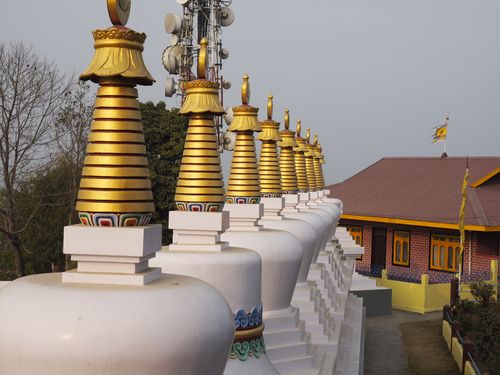
Kalimpong • Zang Dhok Palri Phodang Monastery (Durpin)

Kalimpong • Zang Dhok Palri Phodang Monastery (Durpin)
Monument profile
Zang Dhok Palri Phodang Monastery (Durpin)
Monument category: Monastery
Monument family: Monastery
Monument genre: Religious
Cultural heritage: Buddhist
Geographic location: Kalimpong • West Bengal • India
Construction period: 20th century AD
• Links to •
• List of videos about Kalimpong on this site •
Kalimpong • West Bengal, India
Zang Dhok Palri Phodang Monastery and Tibetan Buddhism in Kalimpong
Foundation of the Monastery and Religious Context
Zang Dhok Palri Phodang Monastery, commonly known as Durpin Monastery because of its location on Durpin Hill, was established in Kalimpong during the second half of the twentieth century. Its construction took place within the context of the reorganisation of Tibetan Buddhist institutions in the Himalayan region following the political upheavals that affected Tibet in the 1950s.
The monastery was founded with the support of the Fourteenth Dalai Lama and religious authorities associated with the Nyingma school of Tibetan Buddhism. Kalimpong already occupied an important position within the Himalayan trade and pilgrimage networks linking India, Tibet, Bhutan and Sikkim. The town had long hosted Tibetan merchants, Buddhist communities and monastic institutions before the arrival of larger refugee populations after 1959.
The monastery was conceived as a religious centre dedicated to preserving Tibetan Buddhist teachings and sacred texts in exile. Its name refers to the celestial paradise associated with Padmasambhava, the Buddhist master regarded as one of the principal figures in the spread of Buddhism in Tibet and the Himalayan world.
Preservation of Sacred Texts and Religious Functions
One of the monastery’s most significant historical roles lies in its function as a repository for sacred Buddhist literature. The complex houses important volumes of the Kangyur, the canonical collection of scriptures regarded as the recorded teachings of the Buddha in Tibetan Buddhism. These texts were transferred from Tibet during a period of political instability in order to ensure their preservation.
The monastery also became a centre for maintaining ritual practices and religious instruction associated with the Nyingma tradition. Ceremonies, prayer gatherings and monastic teachings organised at Durpin contributed to the continuity of Tibetan Buddhist practices within the eastern Himalayas during a period when many religious institutions in Tibet itself faced disruption.
The participation of the Dalai Lama in the inauguration of the monastery reinforced its symbolic importance among Tibetan Buddhist communities established in India after the Tibetan exile. Although the monastery remained relatively modest in scale compared with some larger Tibetan institutions re-established elsewhere in India, it acquired an important spiritual role within Kalimpong and neighbouring Himalayan regions.
Its position on Durpin Hill also strengthened its visibility within the landscape of Kalimpong, transforming the monastery into both a religious landmark and a symbol of the Tibetan Buddhist presence in the region.
Transformations, Use and Contemporary Role
Since its foundation, the monastery has undergone periodic maintenance and restoration campaigns intended to preserve the structure, painted decorations and sacred objects exposed to the humid climatic conditions of the eastern Himalayas. Heavy monsoon rainfall and fluctuating temperatures have required continuous conservation work on the exterior surfaces and interior murals.
The urban and economic evolution of Kalimpong has also affected the environment surrounding the monastery. Formerly an important transit town connected to Himalayan trade routes, Kalimpong gradually shifted toward tourism and administrative functions after the closure of traditional cross-border exchanges with Tibet. Durpin Monastery consequently became one of the principal religious and cultural destinations in the area.
Despite increasing visitor numbers, the site continues to function as an active religious institution rather than solely as a historical monument. Monastic ceremonies, Buddhist festivals and daily rituals remain central to the life of the complex. Resident monks continue to oversee liturgical activities and the preservation of sacred manuscripts and ritual objects kept within the monastery.
The monastery also plays a cultural role in transmitting Tibetan Buddhist traditions to local populations and visitors interested in Himalayan religious heritage. Its symbolic importance therefore extends beyond its immediate monastic community.
The Monastery within the Global Context of the Twentieth Century
The principal development of Zang Dhok Palri Phodang Monastery occurred during a period of major political changes across Asia. During the decades following its establishment, Tibet had come under the authority of the People’s Republic of China, while Tibetan religious institutions were being re-established in exile communities across India and Nepal.
At the same time, Bhutan pursued political modernisation under the Wangchuck monarchy, and Sikkim became part of India in 1975. Internationally, the Cold War shaped global political relations, while cultural preservation movements gained increasing importance in several Asian regions.
Current Status and Preservation
Today, Zang Dhok Palri Phodang remains one of the principal Buddhist monasteries of Kalimpong and an important centre of Tibetan Buddhist practice in West Bengal. Its historical significance is closely connected to the preservation of Nyingma traditions and the safeguarding of sacred texts transferred from Tibet during the twentieth century.
Ongoing conservation work focuses on maintaining the monastery’s structure, murals, decorative elements and manuscript collections. The combination of active religious use and sustained cultural visibility has enabled the monastery to retain an important position within the spiritual and historical landscape of the eastern Himalayas.
Architectural Composition of Zang Dhok Palri Phodang Monastery in Kalimpong
Topographical Position and General Layout
Zang Dhok Palri Phodang Monastery, commonly known as Durpin Monastery, occupies a prominent position on Durpin Hill overlooking Kalimpong and the surrounding Himalayan foothills. Built on elevated terrain with steep slopes descending toward the valleys below, the complex was designed to maximise visibility across the landscape while adapting to the uneven topography of the eastern Himalayas.
The monastery stands on a terraced platform stabilised by retaining structures and graded surfaces. This elevated implantation reinforces the monument’s visual dominance while providing panoramic views toward the Teesta valley and surrounding mountain ranges. The orientation of the principal structures follows the natural contours of the hill rather than a rigid geometric layout.
The complex is organised around a principal temple structure accompanied by open spaces, circulation terraces and ritual areas. Access involves a progressive ascent through stairways and inclined pathways leading toward the elevated entrance zone. This approach gradually reveals the upper sections of the monastery against the skyline.
The relationship between the built structures and the surrounding open areas remains an important architectural characteristic. Large exterior surfaces around the monastery create visual separation between the religious complex and the surrounding vegetation while allowing ceremonial gatherings and circulation during religious events.
Structural Design and Construction Techniques
The monastery combines reinforced masonry construction with decorative architectural forms derived from Tibetan Buddhist religious buildings. Unlike older Himalayan monasteries built mainly from timber and stone, Zang Dhok Palri Phodang reflects twentieth-century construction methods integrating concrete, brick masonry and plastered surfaces while preserving traditional formal compositions.
The principal structural system relies on load-bearing masonry walls combined with reinforced concrete elements providing greater stability under the region’s climatic conditions and seismic risks. Heavy monsoon rainfall, fluctuating humidity and occasional earthquakes influenced the use of more durable construction materials than those traditionally employed in wooden monasteries.
Exterior walls are finished with painted plaster coatings applied over masonry surfaces. These finishes create the smooth coloured façades characteristic of Tibetan Buddhist architecture while protecting the underlying structure from moisture penetration. Elevated terraces and retaining structures were similarly designed to resist erosion caused by seasonal rainfall.
The roof structures combine layered forms inspired by Tibetan temple architecture with modern construction techniques. Multi-tiered rooflines projecting outward above the façades help protect walls and windows from rain exposure. Decorative cornices and projecting eaves contribute both to the visual composition and to water management.
Despite its monumental appearance, the monastery’s massing remains relatively compact. Rather than spreading horizontally across the site, the complex concentrates its architectural volumes into vertically organised levels adapted to the hilltop setting.
Spatial Organisation and Interior Arrangement
The principal temple building contains a structured sequence of ceremonial and devotional spaces organised around the main prayer hall. Interior circulation follows a hierarchical progression beginning with entrance zones and corridors before reaching the central assembly space used for rituals and religious gatherings.
The prayer hall forms the dominant interior volume of the complex. High ceilings, large structural columns and axial alignment reinforce its ceremonial function. The arrangement reflects monastic liturgical requirements, with the principal axis directed toward the main altar and sacred images.
Large statues, ritual platforms and elevated shrines occupy the focal areas of the interior. Their placement establishes a clear visual hierarchy while guiding movement during ceremonies. Monastic seating areas are positioned according to ritual functions and religious hierarchy.
The monastery also houses important manuscript collections, including volumes of the Kangyur preserved within protected interior spaces. Storage and display areas for sacred texts are integrated into the architectural composition rather than isolated in separate archive structures. This arrangement reflects the dual role of the monastery as both ceremonial space and repository of religious literature.
Interior lighting combines natural and artificial sources. Windows positioned along upper wall sections admit filtered daylight while limiting excessive glare inside the prayer halls. These controlled lighting conditions enhance the visibility of murals, painted ceilings and gilded decorative surfaces.
Circulation between levels relies on stairways and corridors adapted to the sloping terrain and vertically layered organisation of the complex. Exterior terraces function simultaneously as circulation areas and viewing platforms overlooking the surrounding landscape.
Decorative Program and Architectural Identity
The decorative treatment of Zang Dhok Palri Phodang forms one of its most distinctive architectural characteristics. Exterior façades display painted ornamentation, coloured bands and symbolic motifs associated with Tibetan Buddhist religious architecture. Red, gold, white and ochre tones dominate the colour palette, reinforcing the monument’s ceremonial appearance.
The rooflines incorporate ornamental finials, gilded elements and layered cornices emphasising the vertical rhythm of the structure. Projecting upper sections create strong shadow effects separating the successive architectural levels.
Openings are framed by painted surrounds incorporating geometric patterns and Buddhist symbolic imagery. Window compositions balance decorative complexity with functional regularity. Their repetitive arrangement contributes to the symmetrical organisation of the façades while preserving interior ventilation.
Interior decorative programs remain especially important within the ceremonial spaces. Painted murals cover extensive wall surfaces, depicting Buddhist figures, cosmological compositions and ritual iconography associated with the Nyingma tradition. Ceiling decorations integrate geometric patterns with painted beams and ornamental detailing.
Columns within the prayer halls are treated not merely as structural supports but as decorative components. Painted capitals, coloured bands and carved elements visually connect the structural framework to the surrounding mural surfaces and altar compositions.
The monastery’s visual identity also derives from the contrast between its brightly coloured architectural surfaces and the surrounding Himalayan landscape. This contrast reinforces the monument’s visibility from distant viewpoints around Kalimpong.
Preservation and Current Architectural Condition
The monastery has undergone periodic restoration and maintenance campaigns intended to preserve both structural stability and decorative integrity. Climatic conditions in the eastern Himalayas create continuous conservation challenges affecting painted surfaces, plaster coatings and ornamental details.
Moisture infiltration and biological growth caused by monsoon humidity periodically damage exterior finishes, requiring repainting and surface treatment. Roof drainage systems and retaining structures also require regular maintenance to prevent water-related deterioration on the hillside site.
Some interior decorative surfaces have been restored to compensate for fading pigments and environmental wear. Preservation efforts focus particularly on murals, painted woodwork and sacred decorative elements exposed to fluctuations in temperature and humidity.
Despite these interventions, the monastery retains a coherent architectural appearance strongly reflecting its original twentieth-century conception. The integration of modern structural materials with traditional Tibetan Buddhist forms remains one of the defining architectural characteristics of Zang Dhok Palri Phodang within the religious landscape of Kalimpong and the eastern Himalayas.