

 Français (France)
  Nederlands (nl-NL)
 Thongsa Gompa, également connu sous le nom de Bhoutan Monastery, est l’un des principaux monastères bouddhiques de Kalimpong, dans l’État indien du Bengale occidental. Fondé au début du XXᵉ siècle, il entretient des liens historiques et religieux avec les communautés bouddhistes himalayennes, notamment celles du Bhoutan et du Tibet. Le monastère joue un rôle important dans la vie religieuse locale à travers les prières, les cérémonies et l’enseignement bouddhique. Son environnement montagneux et son organisation monastique illustrent l’importance de Kalimpong comme centre d’échanges culturels et spirituels dans l’est de l’Himalaya. Le site reste aujourd’hui un lieu de culte actif et fréquenté.
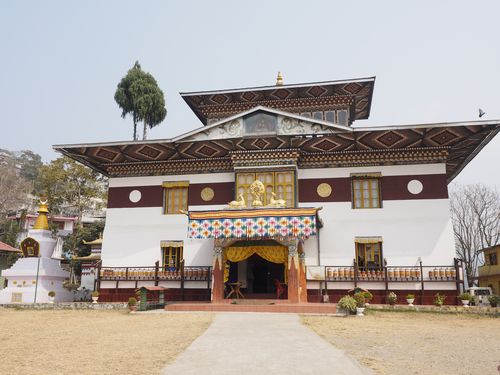
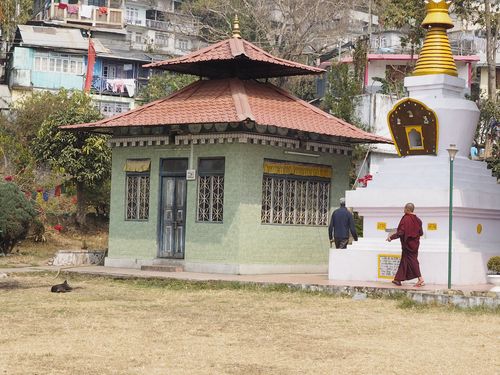

Monument profile
Thongsa Gompa
Monument category: Monastery
Monument family: Monastery
Monument genre: Religious
Cultural heritage: Buddhist
Geographic location: Kalimpong • West Bengal • India
Construction period: 17th century AD
• Links to •
• List of videos about Kalimpong on this site •
Kalimpong • West Bengal, India
Historical Development of Thongsa Gompa in Kalimpong
Foundation of the Monastery and Bhutanese Connections
Thongsa Gompa, also known as Bhutan Monastery, is regarded as one of the oldest Buddhist monasteries in Kalimpong. The monastery was established in the late seventeenth or early eighteenth century under the influence of Bhutanese religious authorities, during a period when Kalimpong remained connected to Bhutanese political and commercial networks before the British annexation of the region in the nineteenth century.
The monastery’s creation reflected both religious and strategic considerations. Kalimpong occupied an important position along trade routes linking Bhutan, Tibet and the plains of Bengal. Thongsa Gompa therefore functioned not only as a religious institution but also as a stopping point for monks, pilgrims and traders travelling through the eastern Himalayan corridor.
Its name refers to Trongsa, the historic administrative and religious centre of central Bhutan, highlighting the monastery’s close institutional relationship with Bhutanese Buddhist traditions. This connection contributed to the monastery’s long-term religious importance within the region.
Political Changes and Transformation of Kalimpong
The historical evolution of Thongsa Gompa was shaped by the political reorganisation of the eastern Himalayas during the nineteenth century. Following the Bhutan War and the Treaty of Sinchula in 1865, Kalimpong came under British administration. The transfer of the territory altered the commercial and political networks that had previously connected the region directly with Bhutan.
Despite these changes, the monastery continued its religious activities. Under British rule, Kalimpong gradually developed into an important Himalayan trading centre attracting Tibetan merchants, Buddhist communities and religious institutions. In this changing urban environment, Thongsa Gompa preserved its role as a Buddhist monastic centre while adapting to the increasingly multicultural character of the town.
Several repairs and modifications were carried out during the twentieth century to maintain the monastery buildings and ceremonial spaces. Climatic conditions in the eastern Himalayas, including heavy rainfall and humidity, periodically affected the structures and required restoration work. Some sections of the complex were rebuilt or reinforced while preserving the monastery’s original religious function.
Religious Functions and Contemporary Role
Thongsa Gompa remains an active Buddhist monastery serving both religious and cultural purposes in present-day Kalimpong. Daily prayers, ritual ceremonies and Buddhist festivals continue to take place within the complex. The monastery also accommodates monks engaged in religious education and spiritual practice.
The site retains particular importance for communities linked to Bhutanese and Tibetan Buddhist traditions in the region. Its continued activity reflects the persistence of Himalayan religious networks despite the political transformations that reshaped the area during the colonial and postcolonial periods.
The monastery also contributes to Kalimpong’s cultural identity. Historically, the town developed as a meeting point for Tibetan, Bhutanese, Lepcha and Nepali populations, and Thongsa Gompa remains one of the visible reminders of these long-standing cultural exchanges.
Maintenance campaigns carried out in recent decades have focused on preserving the buildings, painted surfaces and ritual spaces exposed to the demanding climatic conditions of the eastern Himalayas. These interventions are intended primarily to maintain the monastery’s continued religious use rather than transform the site into a purely heritage monument.
Global Historical Context During the Monastery’s Development
During the period when Thongsa Gompa developed in Kalimpong, the Mughal Empire in India was entering a phase of political decline. In Tibet, Buddhist institutions associated with the Dalai Lama consolidated their religious authority. The eighteenth and nineteenth centuries also coincided with the expansion of British colonial influence across South Asia. In the eastern Himalayas, territorial rivalries involving Bhutan, Sikkim and the British administration significantly reshaped regional trade routes and the religious centres connected to them.
Architectural Organisation of Thongsa Gompa in Kalimpong
Topographical Setting and General Layout
Thongsa Gompa occupies an elevated position within the hilly landscape of Kalimpong in the eastern Himalayas. The monastery was established on sloping terrain overlooking the surrounding valleys, and its architectural organisation reflects the constraints imposed by this mountainous environment. The arrangement of the buildings follows the contours of the hillside rather than a rigid geometric plan, creating a stepped composition adapted to the natural topography.
The complex is organised around a principal temple structure associated with open courtyards, circulation terraces and secondary monastic spaces. Exterior platforms and retaining walls stabilise the terrain while also functioning as transitional spaces between the different levels of the monastery. Access to the complex involves ascending stairways and inclined paths leading progressively toward the principal ceremonial areas.
The monastery maintains visual separation from the surrounding urban fabric through open exterior zones positioned around the main buildings. These spaces accommodate gatherings, ritual circulation and religious activities while reinforcing the monument’s visibility within the landscape of Kalimpong.
Construction Techniques and Structural Characteristics
Thongsa Gompa combines Himalayan monastic architectural traditions with later construction methods introduced during periods of restoration and modification. The primary structures are based on masonry walls coated with painted plaster surfaces. Certain reinforced elements and repaired sections incorporate concrete and more recent materials intended to improve structural stability under local climatic conditions.
The buildings were designed to withstand heavy monsoon rainfall, high humidity and occasional seismic activity characteristic of the eastern Himalayas. Thick exterior walls contribute to thermal insulation and structural resistance, while elevated foundations and drainage arrangements help reduce water infiltration on the sloping site.
Roof structures form one of the most recognisable architectural components of the monastery. Layered rooflines with projecting eaves protect façades and openings from rainfall while contributing to the monument’s visual identity. The overhanging roofs also create shadow zones that reduce direct exposure of painted surfaces to climatic deterioration.
Wood remains visible in structural and decorative elements such as beams, frames, balconies and interior columns. Painted timber details contribute significantly to the monastery’s architectural character while preserving connections with traditional Bhutanese and Tibetan building practices.
Interior Arrangement and Ceremonial Spaces
The principal prayer hall constitutes the dominant interior space within the monastery complex. Its organisation follows a clear axial arrangement directed toward the main altar and sacred Buddhist images. The hall is structured by rows of columns supporting the ceiling and dividing the interior into ceremonial sections adapted to monastic rituals and collective prayers.
Monastic seating areas occupy lateral zones arranged according to liturgical hierarchy. Ritual platforms, statues and offering spaces establish the visual centre of the interior while guiding circulation during ceremonies. The spatial organisation reflects the dual function of the monastery as both a place of worship and a centre of religious instruction.
Additional interior areas are used for the preservation of manuscripts, ritual objects and ceremonial equipment. Rather than being isolated in separate archive buildings, these functions are integrated directly into the main monastic structures. This arrangement reinforces the continuity between religious practice, education and the preservation of sacred texts.
Interior lighting relies largely on filtered natural light entering through relatively narrow openings and upper windows. These controlled lighting conditions enhance the visibility of painted murals, textiles and gilded ritual elements while maintaining a subdued ceremonial atmosphere inside the prayer spaces.
Circulation between levels takes place through stairways, corridors and exterior terraces adapted to the hillside setting. These transitional spaces also function as viewpoints overlooking the surrounding Himalayan landscape.
Decorative Elements and Architectural Identity
The visual identity of Thongsa Gompa derives largely from its painted decorative programme and the contrast between brightly coloured surfaces and the surrounding green mountain environment. Exterior façades incorporate coloured bands, symbolic Buddhist motifs and painted frames emphasising the organisation of the architectural volumes.
Red, yellow, white and blue tones dominate the decorative palette. Painted cornices, ornamental roof details and projecting upper sections reinforce the vertical rhythm of the buildings while visually separating the different architectural levels. The repetition of windows and openings contributes to a relatively symmetrical façade composition despite the irregular terrain.
Interior decoration focuses mainly on painted murals representing Buddhist figures, ritual iconography and cosmological imagery associated with Himalayan Buddhist traditions. Decorative patterns extend across walls, beams and ceilings, integrating structural and ornamental functions within the same visual composition.
Columns inside the prayer halls are treated as decorative as well as structural elements. Painted capitals, coloured bands and carved details visually connect the supporting framework with the surrounding mural surfaces and altar structures.
The monastery has undergone periodic restoration campaigns intended to preserve painted surfaces, plaster coatings and timber elements exposed to moisture and climatic wear. Maintenance work remains necessary because of the effects of monsoon humidity, biological growth and temperature variations affecting both exterior façades and interior decorative programs.