Français (France)
  Nederlands (nl-NL)
 Of the Republic of India ruled for approximately 75 years, ± between 1950 and over all or part of Central India, East India, North India, South India, the Himalayan region and West India, during the Modern Period.
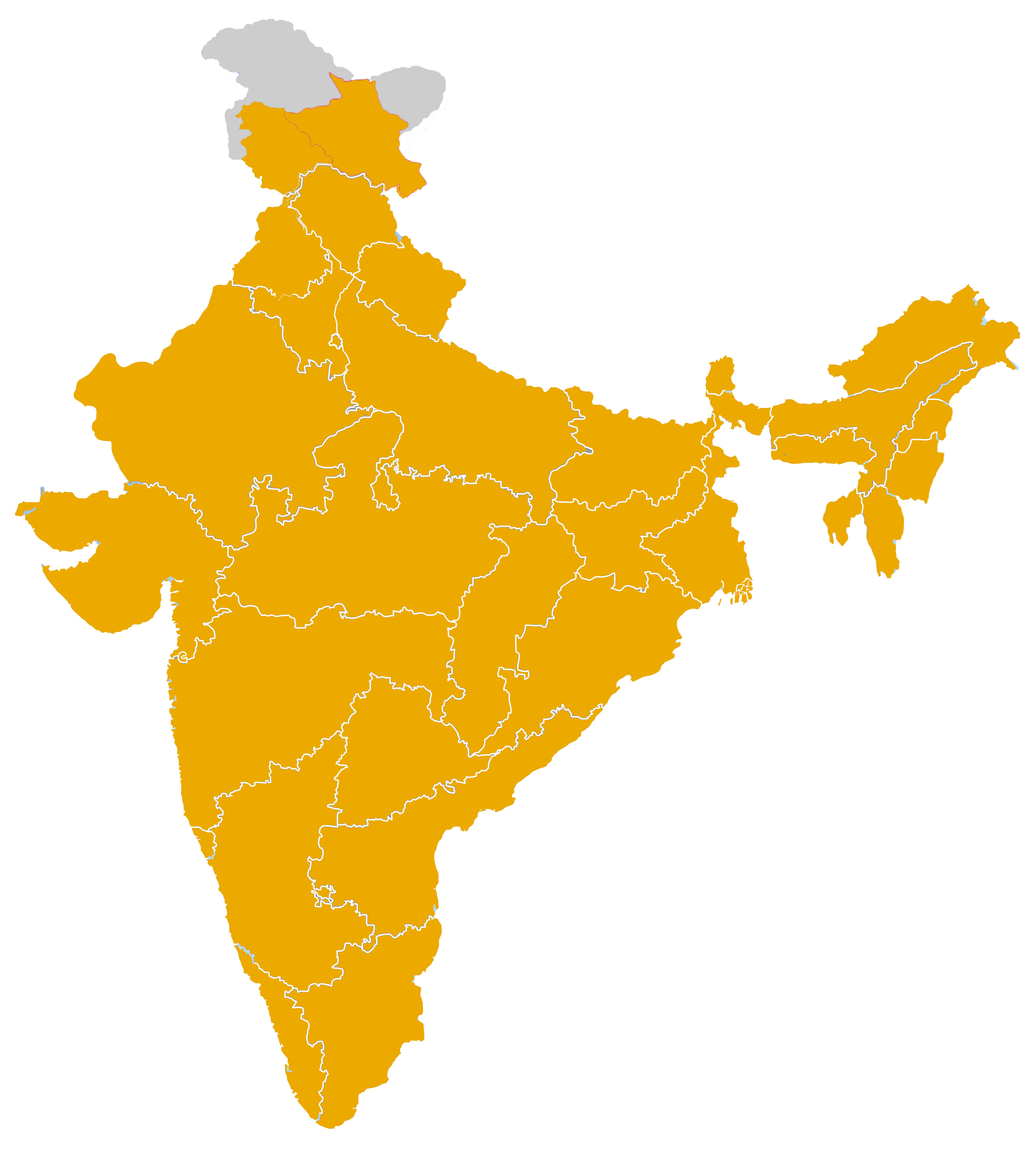
This map illustrates the maximum territory that the Republic of India Dynasty had reached at its height, covering the current regions of Assam, Bihar, Chhattisgarh, Delhi (NTC), Goa, Haryana, Himachal Pradesh, Jharkand, Karnataka, Kerala, Ladakh, Madhya Pradesh, Maharashtra, Meghalaya, Mizoram, Odisha, Punjab, Rajasthan, Sikkim, Tamil Nadu, Telangana, Tripura, Uttar Pradesh and Uttarakhand in India. Its main purpose is to provide a visual aid to understand the geographical extent of this dynasty. However, it's important to note that the contemporary borders of these regions may not necessarily coincide with the historical territories.
The Republic of India and the Transformation of Modern Indian History
A constitutional regime rather than a ruling dynasty
The Republic of India is not a dynasty in the historical or monarchical sense. It is a constitutional, parliamentary and federal state established on 26 January 1950, when the Constitution of India came into force. Its origins lie in the independence of India on 15 August 1947, the end of British colonial rule, the partition of the subcontinent and the integration of hundreds of former princely states into a single political framework.
In historical terms, the Republic represents one of the most important phases in the long history of India. It replaced hereditary sovereignty and colonial authority with representative institutions, universal adult suffrage, a written constitution, an elected parliament and a federal structure. Unlike earlier dynasties, its continuity does not depend on a royal lineage, but on institutions, elections, laws and constitutional procedures.
The political role of prime ministers in a parliamentary system
In the Republic of India, the president is the constitutional head of state, but effective political power is exercised mainly by the Prime Minister and the Council of Ministers, who are responsible to the Lok Sabha. For this reason, the political history of republican India is best understood through its prime ministers rather than through its presidents.
Jawaharlal Nehru shaped the early Republic by strengthening parliamentary democracy, central planning, secular institutions and non-alignment in foreign policy. Indira Gandhi marked a more centralised phase, associated with the 1971 war, the creation of Bangladesh and the controversial Emergency of 1975 to 1977. Later prime ministers reflected changing political conditions: coalition politics, regional party influence, economic reform and the rise of the Bharatiya Janata Party.
From P. V. Narasimha Rao’s economic reforms to Atal Bihari Vajpayee’s coalition governments, Manmohan Singh’s period of growth and global integration, and Narendra Modi’s majoritarian political dominance, the office of Prime Minister has remained the principal centre of political authority.
Federalism as a framework for governing diversity
The Republic’s major historical achievement has been the maintenance of a democratic federal state in an exceptionally diverse society. India includes many languages, religions, caste groups, regions and historical identities. The federal system allowed the country to manage this diversity within a single constitutional order.
The reorganisation of states on linguistic lines was a decisive step. It recognised the importance of regional languages such as Tamil, Telugu, Kannada, Malayalam, Marathi, Gujarati, Bengali, Punjabi and others, while preserving the political unity of the Union. This structure gave regional identities institutional expression and helped prevent linguistic diversity from becoming a permanent threat to national cohesion.
Federalism also shaped relations between the central government and states such as Tamil Nadu, Kerala, Punjab, West Bengal, Maharashtra, Gujarat, Karnataka and the northeastern states. Tensions remained, but the Republic provided mechanisms for elections, state governments, regional parties and constitutional negotiation.
Economic change from planning to liberalisation
The economic history of the Republic passed through several major phases. In the early decades, India adopted a model based on planning, public sector industries, import substitution and state regulation. This approach reflected the desire to build economic sovereignty after colonial rule and to reduce dependence on foreign capital. It also led to bureaucratic controls and relatively slow growth.
A major turning point came in 1991, when economic liberalisation began under Prime Minister P. V. Narasimha Rao and Finance Minister Manmohan Singh. India reduced many controls, opened parts of the economy to foreign investment, encouraged private enterprise and integrated more deeply into global markets.
Since then, India has become one of the world’s largest emerging economies. Its growth has been driven by services, information technology, pharmaceuticals, manufacturing, infrastructure and a large domestic market. At the same time, the Republic has continued to face major challenges: rural poverty, unemployment, social inequality, uneven development, environmental pressure and the persistence of informal labour.
Cultural identity between heritage and modern nationhood
The Republic of India also transformed the cultural history of the country. It inherited a vast and complex past including ancient, Buddhist, Jain, Hindu, Islamic, Sikh, Rajput, Mughal, regional and colonial traditions. Rather than belonging to a single dynasty or religion, the Republic developed a national cultural framework that attempted to include multiple historical layers.
Institutions such as museums, universities, archaeological agencies, academies, public broadcasting and cultural bodies helped define modern Indian heritage. Ancient monuments, temples, mosques, forts, palaces, stupas, colonial buildings and archaeological sites became part of a broader national narrative.
Cinema played a particularly important role. Hindi cinema, often called Bollywood, became internationally visible, while Tamil, Telugu, Malayalam, Kannada, Bengali, Marathi and other film industries strengthened regional cultures. Literature, music, dance, television, sport and digital media also contributed to the formation of a modern Indian public culture.
Social transformation and democratic participation
The Republic introduced universal adult suffrage from the beginning, giving political voice to groups previously excluded from power. Democratic participation became one of the defining features of modern India. Elections, political parties, social movements and constitutional protections reshaped public life.
The Constitution also established affirmative measures for Scheduled Castes and Scheduled Tribes, while later politics gave greater visibility to other backward classes and regional communities. These changes did not eliminate inequality, but they altered the structure of political representation. Caste, class, region, religion and language became active forces within democratic competition.
A central phase in the history of India
The Republic of India occupies a central place in Indian history because it created the institutional framework of the modern Indian state. It integrated former princely states, managed a vast federal territory, maintained electoral democracy and guided major economic and cultural transformations.
It is not a dynasty, but it is a historical period of comparable importance to earlier imperial and regional formations. Its legacy lies in constitutional continuity, democratic participation, economic change, cultural pluralism and the ongoing effort to govern one of the most diverse societies in the world.
The Geographical Formation of the Republic of India and the Territory of the Modern State
A constitutional state shaped by independence and partition
The Republic of India is not a dynasty in the historical sense, but a constitutional state created through independence, partition, integration and federal reorganisation. India became independent on 15 August 1947 and a republic on 26 January 1950, when its Constitution came into force. Its geographical extent was not formed by a sequence of dynastic conquests, but by the transformation of British India and the former princely states into a sovereign federal Union.
The territory of the Republic covers most of the Indian subcontinent south of the Himalayas, from Gujarat and Rajasthan in the west to Assam and the northeastern states in the east, and from Jammu, Kashmir and Ladakh in the north to Tamil Nadu, Kerala and the Indian Ocean in the south. This vast geographical range gives India a central position in South Asia and makes its territory one of the main factors shaping its political, economic and diplomatic history.
Territories inherited from British India
The territorial base of the Republic came partly from the provinces of British India. These included large regions of northern, eastern, western, central and southern India. However, independence was accompanied by partition, which divided British India into India and Pakistan. The partition separated Punjab and Bengal, created new international borders and caused major population movements.
This division permanently shaped the geography of modern India. The western border with Pakistan became one of the most sensitive frontiers of the new state. The eastern border, first with East Pakistan and later with Bangladesh, created a complex frontier around West Bengal, Assam, Meghalaya, Tripura and Mizoram. Partition therefore did not simply reduce the territory inherited from British rule. It created a new political map that defined India’s relations with its neighbours from the beginning.
Integration of the princely states into the Indian Union
A second essential element in the territorial formation of the Republic was the integration of the former princely states. At the end of British rule, hundreds of princely entities existed alongside the directly administered provinces. They were ruled by maharajas, nawabs, nizams, rajas and other hereditary rulers under British paramountcy.
Most of these states joined the Indian Union through instruments of accession and later administrative integration. This process was crucial for the creation of a continuous national territory. Rajasthan, Madhya Pradesh, Gujarat, Karnataka, Himachal Pradesh and several other regions took shape through the incorporation of former princely states.
Some cases were more complex. Hyderabad, ruled by the Nizam, was integrated after military action in 1948. Junagadh, on the Kathiawar peninsula, became part of India after a disputed accession and political intervention. Jammu and Kashmir acceded to India in 1947 under exceptional circumstances, leading to a conflict that still influences regional geopolitics. The integration of princely states transformed a fragmented political landscape into a federal republic.
Federal reorganisation and linguistic states
After 1950, the geography of the Republic continued to evolve internally. One of the most important developments was the reorganisation of states on linguistic lines. This process recognised the political importance of major regional languages and helped adapt the federal system to India’s cultural diversity.
Andhra Pradesh became a key early example of linguistic state formation. Later, states such as Maharashtra, Gujarat, Karnataka, Kerala, Tamil Nadu, Punjab and Haryana took shape through reorganisation. The process did not eliminate regional tensions, but it gave many linguistic and cultural identities a recognised place within the Union.
This federal structure made India different from earlier dynastic states. Its territory was not merely controlled from a capital. It was divided into states and union territories, each with its own administrative institutions, political leadership and regional identity.
Himalayan frontiers and northern strategic relations
India’s northern geography strongly influences its relations with neighbouring countries. The Himalayan frontier connects India with Pakistan, China, Nepal and Bhutan. Jammu and Kashmir, and later the reorganised territories of Jammu and Kashmir and Ladakh, occupy a central place in India’s security and diplomacy because of their disputed borders and strategic location.
Relations with Pakistan have been shaped by partition, wars and the Kashmir question. Relations with China are deeply affected by frontier disputes in Ladakh and Arunachal Pradesh. Nepal and Bhutan, although not hostile neighbours, are important because of their location along the Himalayan belt and their historical, cultural and strategic links with India.
The northern frontier therefore gives the Republic a geography of both protection and vulnerability. The Himalayas form a natural barrier, but they also contain some of the most politically sensitive borders in Asia.
Northeastern India and connections with Southeast Asia
The northeastern states form a distinctive geographical zone connected to the rest of India by the narrow Siliguri Corridor. Assam, Arunachal Pradesh, Nagaland, Manipur, Mizoram, Tripura, Meghalaya and Sikkim link India to Bhutan, Bangladesh, Myanmar and China. Their location gives them major strategic importance.
This region has influenced India’s relations with Bangladesh and Myanmar, as well as its policies toward Southeast Asia. It is also one of the most diverse areas of the Republic, with many ethnic, linguistic and religious communities. Integrating the Northeast into the Union required special constitutional arrangements, infrastructure development, security policies and political negotiation.
Maritime territory and the Indian Ocean
The Republic of India also has a major maritime dimension. Its long coastline extends along the Arabian Sea, the Indian Ocean and the Bay of Bengal. Ports such as Mumbai, Kochi, Chennai, Visakhapatnam and Kolkata connect India to global trade networks.
The islands of Lakshadweep and the Andaman and Nicobar Islands give India additional strategic depth. The Andaman and Nicobar archipelago is especially important because of its proximity to the Strait of Malacca, a major maritime passage between the Indian Ocean and Southeast Asia.
A territorial legacy based on integration rather than conquest
The geographical extent of the Republic of India is the result of independence, partition, accession, integration and federal reorganisation. Its territory includes former British provinces, princely states, Himalayan frontiers, northeastern borderlands, coastal regions and island territories.
This geography has shaped India’s relations with Pakistan, China, Nepal, Bhutan, Bangladesh, Myanmar and the wider Indian Ocean world. Unlike earlier dynasties, the Republic did not build its territory as a royal empire. It created a modern federal state from a diverse and fragmented historical landscape, making geography one of the foundations of contemporary Indian power.
India has been independent since 15 August 1947 and a republic since 26 January 1950. In this parliamentary system, the president is the constitutional head of state, but effective political power rests mainly with the Prime Minister and the Council of Ministers, who are responsible to the Lok Sabha; this list therefore presents the main heads of government of independent and republican India.
- Jawaharlal Nehru (15 August 1947–27 May 1964) • The first Prime Minister of independent India, he led the creation of the state, economic planning and the policy of non-alignment.
- Gulzarilal Nanda (27 May 1964–9 June 1964, acting) • An experienced minister, he briefly ensured governmental continuity after Nehru’s death.
- Lal Bahadur Shastri (9 June 1964–11 January 1966) • He governed during the Indo-Pakistani War of 1965 and was associated with the slogan Jai Jawan Jai Kisan.
- Gulzarilal Nanda (11 January 1966–24 January 1966, acting) • He served a second time as acting prime minister after Shastri’s death.
- Indira Gandhi (24 January 1966–24 March 1977) • The first woman Prime Minister of India, she strongly centralised power and governed during the 1971 war and the Emergency.
- Morarji Desai (24 March 1977–28 July 1979) • The first non-Congress head of government, he led the Janata government after the end of the Emergency.
- Charan Singh (28 July 1979–14 January 1980) • His minority government was brief and depended on unstable parliamentary support.
- Indira Gandhi (14 January 1980–31 October 1984) • Returned to power, she governed during a period of internal tensions and was assassinated in office.
- Rajiv Gandhi (31 October 1984–2 December 1989) • He launched policies of technological modernisation and led India after a massive electoral victory.
- Vishwanath Pratap Singh (2 December 1989–10 November 1990) • He headed a coalition government and remained associated with the implementation of the Mandal recommendations.
- Chandra Shekhar (10 November 1990–21 June 1991) • He governed with limited parliamentary support during a period of political and economic crisis.
- P. V. Narasimha Rao (21 June 1991–16 May 1996) • He oversaw the economic reforms of 1991 and presided over a major transformation of the Indian economy.
- Atal Bihari Vajpayee (16 May 1996–1 June 1996) • He formed a very short first government after failing to secure a lasting parliamentary majority.
- H. D. Deve Gowda (1 June 1996–21 April 1997) • He led a United Front coalition government during a period of parliamentary fragmentation.
- Inder Kumar Gujral (21 April 1997–19 March 1998) • He governed briefly and gave his name to a foreign policy doctrine based on regional conciliation.
- Atal Bihari Vajpayee (19 March 1998–22 May 2004) • He led a durable coalition government during the 1998 nuclear tests, the Kargil War and economic reforms.
- Manmohan Singh (22 May 2004–26 May 2014) • An economist and former finance minister, he led two coalition governments and continued India’s economic integration.
- Narendra Modi (26 May 2014–present) • Leader of the Bharatiya Janata Party, he has held power since 2014 and began a third term in 2024.
 Links to the main sections of the site