

 Français (France)
  Nederlands (nl-NL)
 The Capitol Complex is an administrative and symbolic ensemble located in Chandigarh, a planned city in northern India. Designed in the 1950s by the Swiss-French architect Le Corbusier, it forms one of the central components of the urban plan created for the new capital of Punjab following the partition of 1947. The complex brings together several institutional buildings along with open spaces intended for civic and ceremonial functions. Through its spatial organization and modern architectural language, the site reflects the political and cultural aspirations of newly independent India. It is now regarded as a significant example of twentieth-century modernist urban planning.
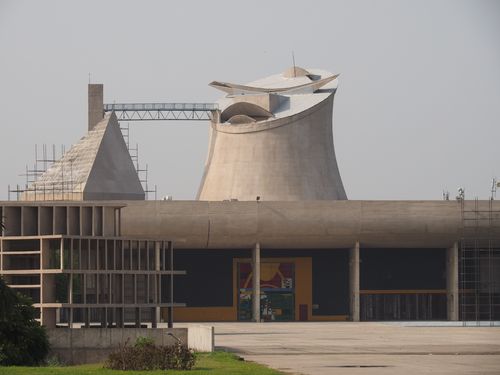
Chandigarh • Capitol Complex
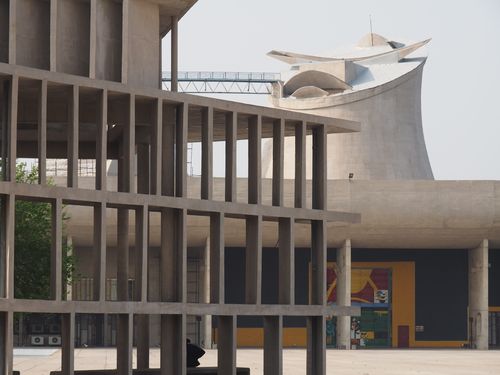
Chandigarh • Capitol Complex

Chandigarh • Capitol Complex
Monument profile
Capitol Complex
Monument category: Architectural modernism
Monument family: Modern architecture
Monument genre: Cultural or scientific
Geographic location: Chandigarh • Punjab • India
Construction period: 20th century AD
This monument in Chandigarh is inscribed on the UNESCO World Heritage List since 2016 and is part of the serial property "The Architectural Work of Le Corbusier, an Outstanding Contribution to the Modern Movement".See the UNESCO monuments featured on this site
• Links to •
• Dynasties that contributed to the construction of the monument •

• List of videos about Chandigarh on this site •
Chandigarh, city of Le Corbusier • Punjab & Haryana, India
• References •
Wikipedia EN: Chandigarh Capitol Complex
History of the Capitol Complex in Chandigarh
A political project born from the partition of India
The Capitol Complex in Chandigarh emerged from one of the most significant political transformations in the history of the Indian subcontinent: the partition of British India in 1947. This event accompanied the end of colonial rule and led to the creation of two independent states, India and Pakistan. The division had profound consequences for the historic region of Punjab. The city of Lahore, which had served as the provincial capital and a major administrative center, became part of Pakistan. As a result, the Indian state of Punjab suddenly found itself without a capital.
In response, the Indian government decided to construct an entirely new administrative city. The project was conceived not only as a practical solution but also as a powerful symbol of the aspirations of the newly independent nation. Prime Minister Jawaharlal Nehru strongly supported the creation of a modern city that would represent a decisive break with the colonial past. Chandigarh was envisioned as a forward-looking urban center reflecting the values of democracy, progress, and rational planning.
Within this new city, the Capitol Complex was designed as the institutional and political core. It was intended to house the main branches of the regional government and to embody the authority of democratic institutions. Its creation therefore reflected broader national ambitions: to present an image of India as a modern, confident state capable of shaping its own urban and political future.
Planning a new capital and the ambitions of a modern republic
The planning of Chandigarh began in the early 1950s and quickly developed into one of the most ambitious urban projects of the postcolonial era. The Indian authorities assembled an international team of architects, planners, and engineers to design the new city. Their objective was to create an urban environment that would serve as a model for modern planning in independent India.
The Capitol Complex occupied the northern edge of the city and formed the focal point of the entire urban plan. The site was chosen deliberately, positioned against the foothills of the Shivalik range in order to establish a dramatic visual relationship between the built environment and the surrounding landscape.
The complex was conceived as a monumental civic center composed of several major institutional buildings. These structures were arranged around large open spaces designed to emphasize the dignity and authority of public institutions. The scale and spatial organization of the site reflected the desire to create a symbolic setting for democratic governance.
For the leadership of the new republic, the complex represented more than a set of administrative buildings. It embodied a vision of governance rooted in transparency, order, and civic participation. The architecture and urban planning of Chandigarh were meant to project the image of a nation embracing modernity while forging a new national identity after centuries of colonial domination.
Chandigarh in the global context of postwar modernism
The construction of the Capitol Complex occurred during a period of profound transformation in global architecture and urban planning. In the decades following the Second World War, many countries embarked on ambitious reconstruction and modernization programs. Governments increasingly turned to modernist architecture as a means of expressing political renewal and technological progress.
Across Europe, the Americas, and parts of Asia, new administrative centers and civic complexes were designed according to principles of functional planning, geometric order, and monumental simplicity. These projects often aimed to symbolize national recovery, modernization, or newly achieved independence.
Chandigarh must be understood within this broader international context. The city became one of the most widely discussed examples of modernist urban planning in the mid-twentieth century. Its creation attracted attention from architects, planners, and scholars worldwide, who saw it as a laboratory for new ideas about the relationship between architecture, governance, and urban space.
At a time when several newly independent countries were seeking architectural forms capable of representing their political aspirations, Chandigarh stood out as one of the most ambitious experiments. The Capitol Complex, as the institutional heart of the city, played a central role in projecting this vision of a modern democratic state.
Political changes and evolving administrative functions
The political landscape of northern India changed significantly in the decades following the construction of the complex. In 1966, a major administrative reorganization divided the former state of Punjab into two separate states: Punjab and Haryana. Chandigarh was designated as the shared capital of both states, while also becoming a union territory administered directly by the central government of India.
This unusual arrangement had a direct impact on the use of the buildings within the Capitol Complex. Some institutions began to serve both states, while others were reorganized to reflect the new administrative structure. Despite these changes, the complex continued to function as the principal governmental center of the region.
Over time, the surrounding city expanded according to the original planning principles established for Chandigarh. New residential sectors, commercial areas, and public facilities developed around the institutional core. The Capitol Complex remained spatially distinct, however, preserving its symbolic role as the center of political authority.
Transformations, preservation efforts, and evolving urban context
Although the core structures of the Capitol Complex have remained largely unchanged, the site has experienced gradual transformations related to its use and maintenance. As the city grew and administrative demands evolved, certain buildings required modernization and structural reinforcement.
Maintenance of the large-scale modernist structures posed specific challenges. The materials and construction techniques used during the mid-twentieth century required careful preservation strategies in order to withstand the effects of climate, pollution, and natural aging.
Urban development around Chandigarh also altered the broader context in which the complex exists. Increasing population density and infrastructural expansion created pressures that required careful management in order to preserve the monumental character of the site. Authorities implemented planning regulations intended to maintain the visual and spatial integrity of the complex.
Efforts to restore and conserve the buildings intensified toward the end of the twentieth century, when scholars and heritage organizations began to recognize the international significance of Chandigarh’s modernist architecture.
Cultural significance and symbolic role in contemporary India
Today, the Capitol Complex occupies an important place in the cultural and political identity of modern India. It represents one of the most visible architectural expressions of the optimism that followed independence and the early efforts to shape a modern democratic society.
For residents of Chandigarh, the complex serves as a powerful civic symbol. Its monumental buildings and vast open spaces form a defining feature of the city’s urban identity. The site continues to host important governmental functions, reinforcing its role as a living center of administration rather than a purely historical monument.
Beyond its local significance, the complex has become a reference point in discussions about modern architecture and urban planning. It is frequently studied in universities and research institutions as an example of how architecture can express political ideals and social ambitions.
Public events, official ceremonies, and civic gatherings occasionally take place in or around the complex, emphasizing its continuing connection with democratic institutions and public life.
International recognition and contemporary conservation challenges
The architectural and historical importance of the Capitol Complex has been acknowledged internationally through its inclusion in the UNESCO World Heritage List as part of a group of modernist works associated with twentieth-century architecture. This recognition highlights the global significance of the site and its contribution to the history of modern urbanism.
World Heritage status has also increased awareness of the need to protect the complex from environmental and urban pressures. Conservation programs have been developed to address issues such as structural aging, weathering of exposed materials, and the impact of pollution.
Another challenge involves balancing the preservation of the original architectural vision with the practical needs of a functioning administrative center. The buildings must continue to accommodate government activities while maintaining their historical authenticity.
Despite these challenges, the Capitol Complex remains one of the most influential architectural ensembles of post-independence India. Its historical development reflects the broader story of a nation redefining itself after colonial rule and seeking architectural forms capable of expressing its aspirations for the future.
Architecture of the Capitol Complex in Chandigarh
A monumental civic ensemble within a planned urban landscape
The Capitol Complex forms the institutional and symbolic center of Chandigarh and represents one of the most influential architectural ensembles of twentieth-century modernism in South Asia. Positioned at the northern edge of the city and framed by the foothills of the Shivalik range, the complex was conceived as the culmination of Chandigarh’s carefully structured urban plan. Its spatial organization establishes a deliberate relationship between architecture, landscape, and civic symbolism.
The ensemble was designed as a monumental governmental precinct composed of several principal institutional buildings arranged around a vast ceremonial esplanade. This configuration reflects a modernist conception of civic architecture in which public institutions are expressed through spatial clarity and monumental scale rather than through traditional ornamentation. The open landscape surrounding the buildings reinforces their visual prominence and establishes long axial views toward the mountains.
Three major structures define the complex: the Secretariat, the High Court, and the Legislative Assembly. These buildings are accompanied by several sculptural and symbolic elements, including the Open Hand Monument and the Tower of Shadows. Together, these elements form a carefully composed architectural landscape in which administrative power is represented through geometry, proportion, and spatial hierarchy.
The layout of the complex also reflects a broader urban strategy. Chandigarh itself was organized into sectors arranged within a rational grid, and the Capitol Complex was intended as the culminating point of this system. Its location and scale emphasize the importance of governance within the structure of the planned city.
Technological and architectural innovations of mid-twentieth-century modernism
The architecture of the Capitol Complex illustrates the adaptation of international modernist principles to the climatic and environmental conditions of northern India. During the mid-twentieth century, architects working in tropical and subtropical regions began to develop new strategies for managing heat, sunlight, and seasonal variation. Chandigarh became one of the most influential laboratories for these experiments.
A central feature of the complex is the extensive use of sun-control devices integrated into the structural design. These include deep overhangs, projecting brise-soleil panels, and recessed façades. Such elements reduce solar heat gain while allowing natural light to penetrate interior spaces. The result is a façade system that functions simultaneously as structure, shading device, and architectural expression.
Ventilation also played a significant role in the design. Many parts of the buildings incorporate open galleries, shaded corridors, and elevated volumes that promote airflow. These features help regulate interior temperatures and reduce reliance on mechanical cooling systems, an important consideration in the climatic conditions of the region during the 1950s.
Structural stability was achieved through reinforced concrete frameworks capable of supporting large spans and heavy roof structures. These frameworks allowed architects to create monumental forms while maintaining relatively flexible interior layouts. The ability to produce large cantilevers and deep porticos also contributed to the dramatic visual character of the complex.
The spatial design reflects modern urban planning principles in which buildings are separated by expansive public spaces. These areas serve not only ceremonial functions but also contribute to environmental comfort by allowing airflow and reducing heat accumulation between structures.
Materials and construction methods
Reinforced concrete is the dominant material used throughout the Capitol Complex. Its adoption reflects both technological ambition and aesthetic intention. Concrete allowed the creation of large sculptural volumes and bold structural forms that would have been difficult to achieve using traditional masonry techniques.
In many areas the concrete surfaces were deliberately left exposed. This approach emphasized the raw structural character of the buildings and created a distinctive visual language defined by mass, shadow, and geometric rhythm. The texture of the material also interacts with natural light, producing changing patterns across the façades during different times of day.
The construction process required significant technical expertise for the period. Large-scale formwork systems were developed to produce complex roof profiles and structural elements. Careful sequencing of concrete pours was necessary to ensure structural integrity across the expansive spans of the buildings.
Stone and other local materials were incorporated in certain areas, particularly in external paving and ground-level surfaces. These elements provide durability and connect the complex visually with regional building traditions. The combination of modern materials and locally sourced stone contributes to a balance between international architectural language and regional context.
The scale of the construction project also required extensive coordination among engineers, contractors, and craftsmen. At the time of its construction, the complex represented one of the most technologically advanced building programs undertaken in independent India.
Architectural influences and cultural synthesis
The architectural language of the Capitol Complex reflects the broader ideals of the modernist movement while incorporating elements adapted to the cultural and climatic context of India. The emphasis on geometric clarity, structural honesty, and monumental scale aligns with architectural developments in Europe and the Americas during the mid-twentieth century.
However, several features reveal a conscious dialogue with regional traditions. The deep porticos and shaded colonnades evoke architectural strategies long used in South Asian buildings to create transitional spaces between exterior and interior environments. These semi-open areas serve both functional and symbolic roles within the architectural composition.
The monumental sculptures integrated into the complex introduce an additional layer of cultural expression. The Open Hand Monument, in particular, functions as both a sculptural landmark and a symbolic representation of openness and exchange. Its rotating structure responds to the wind, adding a dynamic element to the otherwise static architectural environment.
Symbolism is also embedded in the spatial relationships between buildings. The separation and alignment of the major structures reflect the concept of institutional balance within a democratic system. Architecture is thus used to convey political ideals through spatial organization rather than through traditional decorative motifs.
Spatial organization and structural composition
The Capitol Complex is organized around a vast ceremonial plaza that establishes the primary spatial axis of the ensemble. Each of the major buildings occupies a carefully positioned site around this open area, creating a balanced architectural composition.
The Secretariat is the largest structure in the complex and extends horizontally across a considerable distance. Its façade is articulated by a repetitive structural grid combined with vertical and horizontal shading elements. This rhythmic arrangement emphasizes the modular organization of administrative offices within the building.
The High Court building is distinguished by its monumental parasol-like roof structure. The roof extends far beyond the façade line, creating a deep shaded portico supported by massive columns. This configuration produces a powerful architectural silhouette while also providing environmental protection from intense sunlight and seasonal rainfall.
The Legislative Assembly presents a more sculptural composition. Its central chamber is covered by a distinctive roof form that contrasts with the rectilinear geometry of surrounding structures. The building’s internal circulation system organizes movement through broad corridors and open spaces designed to accommodate public gatherings and parliamentary functions.
Additional structures within the complex include symbolic installations and architectural experiments such as the Tower of Shadows. This structure demonstrates different methods of solar control through a series of geometric openings that filter sunlight throughout the day.
Dimensions, notable figures, and architectural anecdotes
The Capitol Complex occupies a site covering several dozen hectares, making it one of the largest civic architectural ensembles of its time. The open spaces between buildings contribute significantly to this scale, reinforcing the monumental character of the site.
The Secretariat building extends for several hundred meters in length and rises multiple stories above the surrounding plaza. Its size reflects the administrative functions it was designed to accommodate and emphasizes the horizontal dimension of the architectural composition.
The High Court portico, with its deep roof canopy and massive structural supports, is among the most recognizable elements of the complex. Its proportions create a dramatic play of light and shadow across the façade.
An interesting aspect of the project lies in the integration of sculptural works and symbolic structures into the architectural design. The Open Hand Monument, positioned within the complex landscape, became an emblem of Chandigarh itself and represents the philosophical ideals associated with the city’s creation.
The Tower of Shadows, meanwhile, serves as an architectural demonstration of climatic design principles. Its carefully calculated openings illustrate how sunlight can be controlled through geometry rather than mechanical systems.
International recognition and architectural conservation
The Capitol Complex is widely regarded as one of the most significant examples of modernist civic architecture in the twentieth century. Its design and urban context have attracted sustained attention from architects, historians, and urban planners.
The ensemble has been recognized internationally through its inclusion in the UNESCO World Heritage List as part of a group of architectural works representing modernist design. This recognition reflects the global importance of the project as a pioneering example of modern urban planning applied to a newly independent nation.
Conservation of the complex presents particular challenges. The exposed concrete surfaces that define much of the architecture are vulnerable to weathering, pollution, and structural aging. Preservation programs therefore focus on maintaining the integrity of these materials while respecting the original architectural appearance.
Urban growth around Chandigarh also requires careful management in order to preserve the spatial relationships that define the complex. Planning authorities have introduced regulations intended to protect sightlines, landscape features, and the monumental scale of the site.
Despite these challenges, the Capitol Complex continues to function as both a working administrative center and a major architectural landmark. Its design demonstrates how modernist architecture could be adapted to regional climate, cultural symbolism, and the political aspirations of a newly independent nation.