

 Français (France)
  Nederlands (nl-NL)
 00:00 • intro | 00:38 • Trailokya Mohan Narayan | 00:57 • Shree Kaal Bhairav temple | 02:59 • Swet Bhairab | 03:44 • Garuda Dhwaja | 05:07 • Kumari Ghar | 06:24 • Lohanchowk
Personal creation from visual material collected during my trip Nepal (2024)
Map of places or practices in Kathmandu on this site
• Use the markers to explore the content •
Kathmandu Durbar Square, Historic Royal and Religious Center of Nepal
A monumental ensemble at the heart of Kathmandu’s history
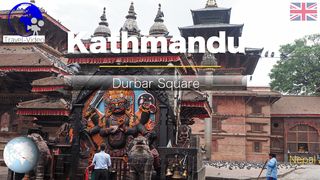
Durbar Square forms one of the major historical and ceremonial centers of the Kathmandu Valley. Located within the former royal core of Nepal’s capital, the square concentrates palaces, temples, courtyards and sacred monuments linked to several centuries of political authority and religious traditions. The video explores part of this dense urban and ceremonial environment where architecture, ritual life and daily activity remain closely interconnected.
The monuments visible throughout the film mainly reflect the period of the Malla kings, who transformed Kathmandu into an important artistic, political and religious center between the late medieval period and the eighteenth century. Although several earthquakes, including the devastating earthquake of 2015, damaged parts of the square, the area still preserves a remarkable concentration of Newar architecture characterized by brick construction, elaborately carved wooden structures and layered temple roofs.
The monuments shown in the video also demonstrate that Durbar Square remains an active ceremonial and religious space rather than a purely historical site. Temples continue to host rituals and festivals, while the surrounding plazas remain integrated into the urban life of Kathmandu. The coexistence of sacred traditions, royal heritage and modern city activity gives the square its distinctive atmosphere.
Temples, sacred images and royal courtyards
Among the monuments presented in the video is the Trailokya Mohan Narayan Temple, dedicated to Vishnu. Its traditional Newar architecture is distinguished by carefully proportioned roof structures, carved wooden details and a vertically organized composition typical of the Kathmandu Valley. Like many temples surrounding the square, it contributes to a sacred urban landscape where religious buildings stand directly within public circulation spaces.
The Shree Kaal Bhairav Temple introduces another important aspect of Kathmandu’s religious culture. The monumental image of Bhairava, a fierce manifestation of Shiva, occupies a central symbolic role within Durbar Square. Historically, the site also possessed political significance, as official oaths and declarations were once made before the deity. The video allows viewers to observe the relationship between the imposing sacred image and the open ceremonial spaces surrounding it.
The presence of Swet Bhairab adds a more ritual and festive dimension to the square’s religious traditions. The enormous sacred mask associated with this deity is revealed during important ceremonies and festivals. Its ceremonial role illustrates the continuing importance of public religious celebrations in Kathmandu and highlights the close connection between architecture and ritual practices.
Garuda Dhwaja, the ceremonial pillar surmounted by Garuda, reinforces the symbolic organization of the royal square. Positioned near former palace structures, it reflects the historical relationship between Hindu kingship and sacred iconography. Nearby, Lohanchowk reveals another dimension of the royal complex through its enclosed courtyards, richly carved façades and ceremonial architectural spaces integrated into the palace environment.
Kumari Ghar occupies a unique position within Durbar Square. This richly decorated traditional residence is associated with the Kumari, the living goddess revered in Kathmandu’s religious traditions. Its carved wooden windows, inner courtyard and refined architectural details represent some of the most sophisticated forms of Newar residential and ceremonial architecture. The building also illustrates how religious practices remained integrated into the royal and urban structure of the city.
Royal power, Newar craftsmanship and religious continuity
The historical development of Durbar Square is closely linked to the rise of the Malla kingdoms within the Kathmandu Valley. Between the thirteenth and eighteenth centuries, successive rulers sponsored the construction of temples, palace courtyards and ceremonial spaces intended to reinforce political legitimacy and religious authority. During this period Kathmandu became a major artistic center where Newar craftsmen developed highly refined architectural traditions.
The monuments visible in the video reflect this concentration of political and religious power. Royal palaces hosted official ceremonies, while surrounding temples structured many of the major religious festivals connected to the Hindu and Buddhist calendars of the valley. The close proximity between political and sacred spaces remains one of the defining characteristics of Durbar Square.
Over the centuries the architectural ensemble underwent repeated modifications. Fires, earthquakes and later dynastic transformations led to reconstructions and additions under the Shah and Rana periods. The earthquake of 2015 caused severe damage across the Kathmandu Valley and initiated extensive restoration campaigns aimed at stabilizing monuments and reconstructing damaged sections of the square.
Despite these transformations, Durbar Square retains a strong architectural coherence based on the extensive use of brick masonry, stone platforms and highly elaborate carved woodwork. Windows, struts, balconies and roof supports continue to demonstrate the exceptional technical skill of Newar artisans.
What the videos on this site make especially clear
The videos presented on travel-video.info rely extensively on animated photography and gradual visual movement that encourage careful observation of monuments and urban spaces. This approach is particularly effective for Kathmandu Durbar Square, where architectural density and decorative complexity often require slower visual reading.
Progressive camera movements help reveal the carved wooden façades, temple proportions and spatial organization of courtyards and ceremonial plazas. Changes in scale also make it easier to understand the relationships between monumental statues, palace structures and surrounding circulation spaces.
In places such as Kumari Ghar or Lohanchowk, animated photographs allow viewers to better perceive enclosed courtyards, layered architectural compositions and the detailed craftsmanship of windows and galleries. For the sacred sites associated with Bhairava, the gradual visual construction emphasizes both the symbolic power of the religious images and their integration into public urban life.
Close-up sequences and slow transitions also help illustrate how Durbar Square remains deeply connected to the daily rhythms of Kathmandu through rituals, gatherings and continuous public activity.
A living ceremonial center within Kathmandu
Kathmandu Durbar Square remains one of Nepal’s most important historical and religious centers. Combining royal palaces, Hindu sanctuaries, Newar artistic traditions and still-active ceremonial practices, the square continues to occupy a central place in the cultural identity of Kathmandu. The video offers a detailed exploration of several of its major monuments while helping viewers better understand the close relationship between architecture, political authority and religious life in the history of the Nepalese capital.
Links to related pages
• Main dynasties that ruled the region •


Audio Commentary Transcript
Durbar Square
Durbar Square literally means “palace square.” The term durbar, of Persian origin, refers to the royal court.
Until the late fifteenth century, the Kathmandu Valley formed a single kingdom. After the death of King Yaksha Malla, around 1482, the territory was divided among his heirs.
Three capitals then emerged: Kantipur — present-day Kathmandu —, Patan, and Bhaktapur. Separated by only a few kilometres, each developed its own palace and its own Durbar Square.
This geographic proximity, unusual for rival kingdoms, fostered intense political and artistic competition, which explains the remarkable concentration of monuments throughout the valley.
The square in Kathmandu became the political centre of the Kingdom of Kantipur until the conquest of the valley by Prithvi Narayan Shah in 1768.
The ensemble brings together monuments built over several centuries. Their number makes a detailed presentation here impossible; each monument is examined individually on travel-video.info.
Monuments of Durbar Square
At the heart of Kathmandu, Durbar Square brings together a remarkable concentration of monuments. Many of them date back to the Malla period, between the 12th and 18th centuries, when the Kathmandu Valley was divided into three rival kingdoms whose capitals were Kathmandu, Patan and Bhaktapur.
Around the former royal palace stand temples, shrines, pavilions and ceremonial courtyards. Yet the distinction between religious and political architecture is not always clear. In the Nepali tradition, royal authority and the sacred were closely intertwined: a pavilion could serve both as a place of worship, a ceremonial space, or an administrative building.
Swet Bhairav
The mask of Swet Bhairav appears behind a grille on Durbar Square. Bhairav is a fierce manifestation of the god Shiva, associated with protection and destructive power. According to tradition, the mask was installed during the Malla period.
Most of the time it remains hidden from the public. But during the Indra Jatra festival it is revealed and becomes the focus of rituals and ceremonies that draw large crowds around this powerful image of the deity.
Garuda Dhwaja
The Garuda Dhwaja is a votive pillar erected in the late sixteenth century, probably during the reign of King Lakshmi Narsingh Malla.
At the top of the column stands a sculptural group associated with the cult of Vishnu: a seated divine figure protected by a spreading cobra and surrounded by symbolic figures and animals on a lotus-shaped base.
Despite its name, this composition does not clearly represent Garuda, the mythological mount of Vishnu. It is possible that a statue of Garuda originally stood here, before successive restorations caused by earthquakes that frequently damaged the monuments of the Kathmandu Valley.
Facing the royal palace, the pillar illustrates the close relationship between political authority and religious tradition in the kingdoms of the valley.
Kumari Palace
At the heart of Kathmandu’s Durbar Square stands the Kumari Ghar, the palace of the Kumari, Nepal’s Living Goddess. According to an ancient tradition of the Kathmandu Valley, a young girl from the Newar community is chosen to embody the goddess Taleju, once regarded as the royal protector deity of the city.
The Kumari lives in this palace of brick and finely carved wood, built in the seventeenth century. Although she leads a secluded life here, she continues to play an important role in the religious traditions of the valley.
Every day, around eleven o’clock, a brief moment draws the attention of visitors and devotees gathered in the courtyard. The Kumari appears at one of the palace windows.
She stands behind a carved wooden lattice, known as a tikijhya, a characteristic feature of Newar architecture that allows people inside to observe the outside while preserving the privacy of the house.
For just a few moments, the Living Goddess silently looks over the courtyard. For the faithful present, this simple gaze is considered a blessing. Then the shutters close, and the Kumari disappears once again into the quiet of her palace.
Taking a photograph of the Kumari is considered a serious offense in Nepal and is strictly forbidden.

Original music – personal creation
Disclaimer: Despite its appropriateness, copyright issues prevent the use of nepalese traditional music in "Kathmandu • Durbar Square, historic royal and religious centre", hence the use of royalty-free music. Despite our careful selection, some might regret this decision, which is necessary to avoid potential lawsuits. Although difficult, this decision is the only viable solution.


