Français (France)
  Nederlands (nl-NL)
 00:00 • intro | 00:22 • Presentation of the Pashuatinath site | 01:22 • Pashupatinath: the ghats | 02:45 • Bagmati River | 03:46 • the cremation | 06:15 • the cremations site | 07:39 • holy men
Personal creation from visual material collected during my trip Nepal (2024)
Map of places or practices in Kathmandu on this site
• Use the markers to explore the content •
Pashupatinath and the Sacred Ritual Landscape of the Bagmati River
A major Hindu sanctuary in the Kathmandu Valley
Pashupatinath stands among the most important Hindu religious sites in Nepal and remains one of the principal sanctuaries dedicated to Shiva in the Himalayan world. Located along the banks of the Bagmati River on the eastern side of Kathmandu, the complex combines temples, cremation ghats, shrines and ritual spaces within an environment where religion continues to shape daily life.
The video presents several dimensions of this sacred place. Religious monuments, funerary rituals, holy men and the landscape of the Bagmati together form a ceremonial setting where architecture and spirituality remain closely connected to the urban fabric of Kathmandu. The scenes shown throughout the film also illustrate the continuing religious role of the site within contemporary Nepalese society.
Beyond its monumental significance, Pashupatinath remains an active pilgrimage center visited daily by worshippers, pilgrims, priests and ascetics. Religious ceremonies, funeral rites and devotional practices structure the organization of the complex from morning until night, giving the sanctuary a constantly evolving atmosphere.
The ghats, the Bagmati River and cremation rituals
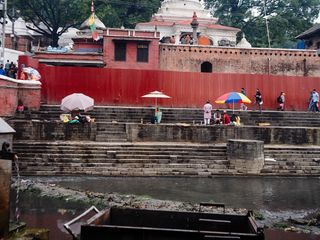
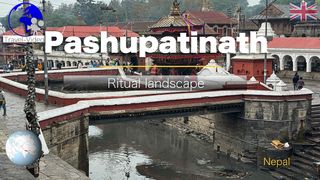
The ghats of Pashupatinath form one of the most recognizable elements of the site. Built along the Bagmati River, these stone platforms are used for various religious practices, particularly Hindu cremation ceremonies. The video shows how stairways descending toward the river organize movement and ritual activity around the sacred waterway.
The Bagmati occupies an essential symbolic place within Nepalese Hindu traditions. Its waters are associated with purification and with rites linked to death, transition and spiritual liberation. The images of the river help explain the close relationship between the natural environment and the ceremonial life of the sanctuary.
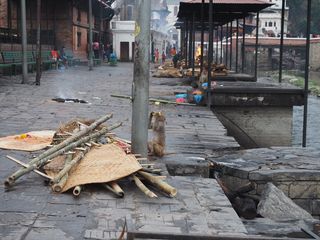
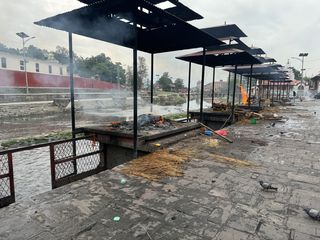
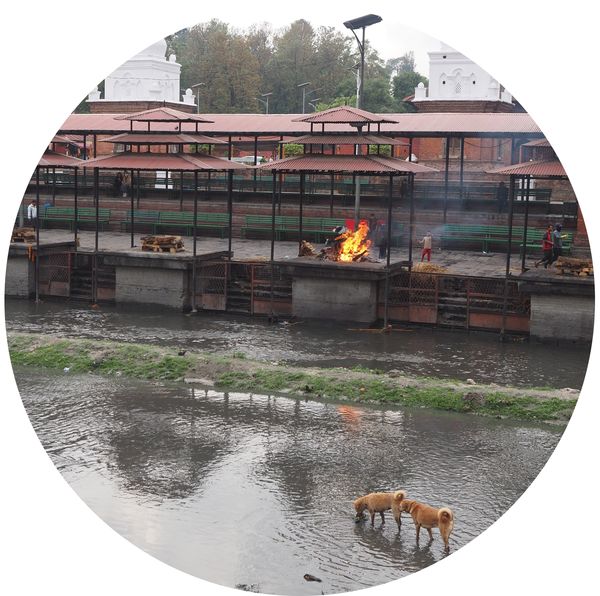
The scenes dedicated to cremation rituals reveal one of the central functions of Pashupatinath. Funeral pyres placed on the ghats are used daily for ceremonies conducted by the families of the deceased. Fire, river water and ritual gestures performed by priests and relatives form part of a religious understanding of life, death and rebirth.
The video also places the cremation grounds within their broader architectural and urban context. Platforms, pavilions and open spaces distributed along the riverbanks create a structured ceremonial landscape designed around ritual practice. Despite the funerary character of the area, these activities remain fully integrated into the everyday life of both the sanctuary and the city itself.
The sanctuary complex and the presence of holy men
The principal temple of Pashupatinath forms the religious center of the entire complex. Dedicated to Shiva as Pashupati, “Lord of Living Beings,” the sanctuary has attracted pilgrims from Nepal and the Indian subcontinent for centuries. Its pagoda-style architecture, characterized by layered roofs and decorative metal elements, reflects the architectural traditions of the Kathmandu Valley.
Around the main sanctuary stand numerous secondary temples, shrines, lingams and votive structures spread across both sides of the Bagmati River. This dense concentration of sacred architecture creates a highly complex ritual environment where prayer spaces, ceremonial zones and circulation paths remain closely interconnected.
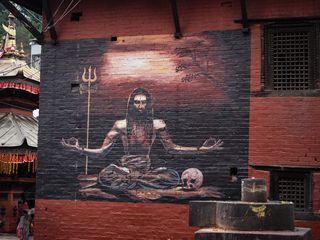
The holy men visible in the video also contribute strongly to the identity of Pashupatinath. Ascetics, sadhus and religious figures are permanently present around the sanctuary. Some live near the temple complex and reinforce the spiritual atmosphere of the site through meditation, ritual practices and symbolic presence within the sacred landscape.
Pashupatinath therefore fulfills several simultaneous roles: pilgrimage center, funerary site, active place of worship and historical monument. This coexistence of functions contributes significantly to the uniqueness of the sanctuary within the religious geography of Nepal.
Religious history and architectural organization
The development of Pashupatinath is closely linked to the religious history of the Kathmandu Valley. The sanctuary appears in ancient traditions associated with the worship of Shiva and was progressively expanded under several Nepalese dynasties, particularly during the Malla and Shah periods.
The present organization of the site results from multiple phases of construction and restoration. Temples, ghats and ceremonial pavilions visible today belong to different historical periods while maintaining a strong architectural coherence rooted in the Newar traditions of the valley.
The complex has also been affected by several major earthquakes that struck Kathmandu over the centuries. Some structures were rebuilt or restored following these disasters, including after the earthquake of 2015, which caused extensive damage across many religious monuments in Nepal.
The religious importance of Pashupatinath extends far beyond Kathmandu itself. The sanctuary remains one of the principal centers of Shaivism in the Himalayan region and continues to host major religious festivals, especially during Maha Shivaratri, when large numbers of pilgrims gather at the site.
What the videos on this site make especially clear
The videos presented on travel-video.info rely extensively on animated photography and gradual movement within the image, allowing detailed observation of monuments and ritual spaces. This approach is particularly effective for Pashupatinath, where relationships between architecture, river landscapes, ceremonial circulation and religious practice often require careful visual reading.
Slow transitions make it easier to understand the organization of the ghats, the different levels of the sanctuary and the proximity between temples and cremation areas. Animated photographs also help clarify the relationship between the Bagmati River, the funeral platforms and the sacred structures lining the riverbanks.
Close-up sequences emphasize architectural details, decorative elements and ritual gestures performed on the ghats. This progressive visual construction also reveals how religious ceremonies, funerary practices and everyday urban activity coexist within the same sacred environment at the center of Kathmandu.
A living sacred center beside the Bagmati
Pashupatinath remains one of the most important religious centers in Nepal today. Combining Hindu temples, funerary rituals, Shaivite traditions and the sacred landscape of the Bagmati River, the sanctuary continues to occupy a central place in the spiritual and cultural identity of the Kathmandu Valley. The video offers a detailed exploration of its religious spaces and ceremonial life while illustrating the continuing relationship between sacred architecture and daily practice in one of the Himalayas’ most significant Hindu sites.
Links to related pages
• Main dynasties that ruled the region •



Audio Commentary Transcript
Pashupatinath is the most sacred Hindu sanctuary in Nepal.
It is dedicated to Shiva in the form of Pashupati, the “lord of living beings,” whose temple gave its name to this place.
For centuries, pilgrims and devotees have come here to pray in one of the major religious centres of the Kathmandu Valley.
Like in Benares, now called Varanasi, in India, this sanctuary is closely linked to the rites of death.
On the banks of the Bagmati River, families perform funeral ceremonies in the hope of granting the deceased spiritual iberation.
According to Hindu tradition, being cremated in a sacred place dedicated to Shiva helps the soul break free from the cycle of rebirth.
Along the banks of the Bagmati River, the ghats of Pashupatinath are used for cremations according to Hindu rites.
The bodies are burned there in order to help the soul break free from the cycle of rebirth.
On this bank, the small shrines have accumulated over time, built by different families, priests, or donors, which explains their variety of forms.
On the opposite side, a long row of identical structures forms a more ordered ensemble.
These small temples dedicated to Shiva, built according to a coherent plan, are used for prayers and offerings for the deceased, creating a ritual landscape of memory and purification.
In this way, the two riverbanks express two complementary aspects of the funeral rite: the transformation of the body through fire, and the spiritual remembrance embodied in sacred architecture.
For Hindu devotees, the Bagmati is not just a river.
It flows through the Pashupatinath sanctuary, dedicated to Shiva, and its waters are associated with those of the Ganges, into which it eventually flows.
This is why cremations take place here.
Being cremated on the banks of a sacred river is considered part of the path toward the soul’s liberation.
From this perspective, death is not only a moment of mourning.
On the ghats, some families sit, talk, or eat while the funeral pyre burns: the ceremony marks the end of a life, but also the passage toward a new existence.
Cremations take place on these platforms, beside the sacred river.
The body is placed on a wooden pyre, then set alight according to a precise ritual carried out by the relatives of the deceased.
Fire plays a central role in the ceremony.
It transforms the body and releases the soul, which can continue its journey through the cycle of rebirth.
Once the pyre has burned down, the ashes are collected and entrusted to the river, completing the final step of the funeral rite.
In the sanctuary, one also encounters ascetics of the Hindu tradition.
Some live in detachment, devoting their time to meditation and prayer.
Others, often called sadhus, occupy a more visible place in the life of the temple.
They bless pilgrims, exchange a few words, and sometimes accept an offering.
The world of the sadhus is very diverse.
Some seek isolation, while others live in close contact with worshippers and visitors.
All of them, in their own way, contribute to the spiritual atmosphere that surrounds the sanctuary.
Original music – personal creation
Disclaimer: Despite its appropriateness, copyright issues prevent the use of nepalese traditional music in "Kathmandu • Pashupatinath, Hindu sanctuary on the Bagmati River", hence the use of royalty-free music. Despite our careful selection, some might regret this decision, which is necessary to avoid potential lawsuits. Although difficult, this decision is the only viable solution.