

 Français (France)
  Nederlands (nl-NL)
 00:00 • intro | 00:20 • Boudhanath Stoepa | 00:57 • Kora: ritual circumambulation | 02:42 • Buddhist monks in front of a monastery near the stupa | 04:01 • Swayambhunath (Swoyambhu Mahachaitya) | 04:14 • Temples ans small stupas round the main stupa | 07:31 • Swayambhunath, the main stupa
Personal creation from visual material collected during my trip Nepal (2024)
Map of places or practices in Kathmandu on this site
• Use the markers to explore the content •
Kathmandu and the Great Buddhist Stupas of the Sacred Valley
A major sacred landscape in the Kathmandu Valley
The Kathmandu Valley preserves some of the most important Buddhist religious sites in Nepal. Among them, the stupas of Boudhanath and Swayambhunath occupy a central place in the religious, architectural and cultural history of the Nepalese capital. The video explores these two major sacred centers through their monumental structures, ritual spaces and the religious practices that continue to shape daily life around them.
The monuments visible throughout the film reveal several dimensions of Kathmandu’s Buddhist sacred landscape. The stupas themselves organize both urban and ceremonial space, while surrounding temples, monasteries and circumambulation paths demonstrate the importance of collective ritual movement around sacred monuments. Scenes showing monks and pilgrims also emphasize that these sites remain active religious centers rather than purely historical monuments.
Beyond their spiritual role, Boudhanath and Swayambhunath dominate the visual identity of the Kathmandu Valley. Their massive white domes, towers bearing the painted eyes of Buddha and dense concentrations of secondary shrines create some of the most recognizable architectural silhouettes in Nepal.
Boudhanath and the ritual practice of kora
Boudhanath Stupa ranks among the largest Tibetan Buddhist stupas in the world. Its immense circular base, crowned by the white dome and the square tower displaying the eyes of Buddha, forms a ceremonial environment organized around the ritual circumambulation known as kora. The video shows how this continuous movement structures the life of the monument.
Pilgrims walk clockwise around the stupa while turning prayer wheels incorporated into the surrounding buildings. The repetition of these gestures forms an essential aspect of the religious atmosphere of the site and illustrates the importance of ritual movement within Himalayan Buddhist traditions.
Around the central monument stand numerous monasteries, religious shops and buildings linked to Tibetan Buddhist communities established in Kathmandu after successive periods of migration from Tibet. The scenes showing Buddhist monks near one of the monasteries also highlight the educational and monastic role of the Boudhanath district, which developed into one of the major Tibetan Buddhist centers in Nepal.
The spatial organization of the site relies on a strong visual hierarchy. The stupa dominates the surrounding urban environment, while terraces, open plazas and peripheral structures orient circulation toward the central sacred monument.
Swayambhunath and the sacred hilltop complex
Swayambhunath, also known as Swoyambhu Mahachaitya, occupies a hill overlooking the Kathmandu Valley. This elevated position reinforces the visibility of the monument across the city and gives the site a powerful symbolic presence within the landscape. The complex combines the principal stupa with a dense concentration of temples, smaller stupas, shrines and ritual structures distributed across several terraces.
The ascent toward the main sanctuary already forms an important architectural and religious experience. Stairways, platforms and aligned monuments progressively organize the approach to the summit. The video allows viewers to observe the relationship between topography, ceremonial circulation and sacred architecture.
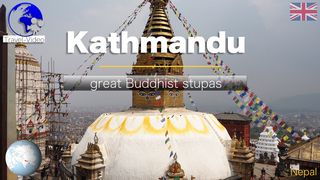
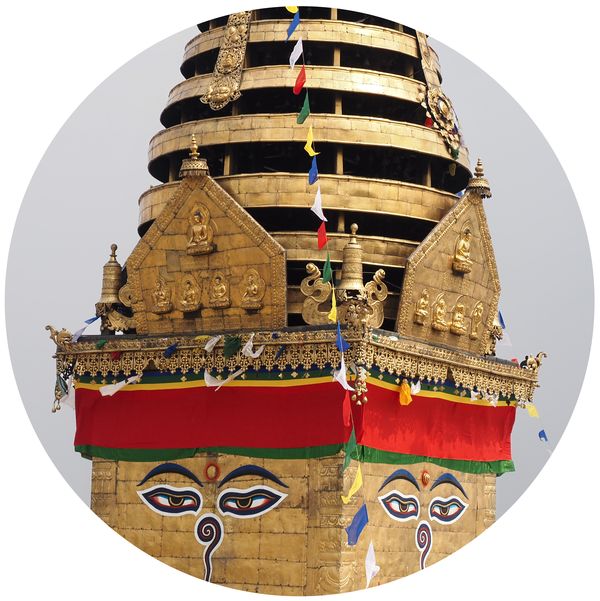
The principal stupa of Swayambhunath contains several characteristic elements of Nepalese Buddhist architecture. The white dome symbolizes the world, while the square tower displaying the eyes of Buddha forms one of the most recognizable visual symbols of Nepal. Prayer flags, prayer wheels and secondary shrines reinforce the ritual atmosphere surrounding the monument.
The temples and smaller stupas distributed around the principal sanctuary also demonstrate the coexistence of Buddhist and Hindu traditions within the Kathmandu Valley. Several shrines dedicated to Hindu deities stand alongside Buddhist monuments, reflecting the religious interactions that have shaped Nepalese history for centuries.
Buddhist traditions, trade routes and monumental architecture
The development of Kathmandu’s great stupas is closely connected to long-standing trade and religious exchanges linking Nepal with Tibet and northern India. Boudhanath occupied an important position along former caravan routes crossing the Himalayas. This strategic role encouraged the settlement of Buddhist communities and the development of monastic institutions around the stupa.
Swayambhunath possesses an especially ancient place within Nepalese religious traditions. The site is associated with several legendary accounts concerning the formation of the Kathmandu Valley and retains major symbolic importance for both Newar and Tibetan Buddhist communities.
The architecture of both sites reflects the traditions of Newar craftsmanship. Brick masonry, carved woodwork, layered terraces and peripheral shrines characterize the organization of these sacred ensembles. Successive earthquakes, restorations and reconstructions nevertheless modified several structures over the centuries.
The earthquake of 2015 caused severe damage throughout the Kathmandu Valley and led to extensive restoration campaigns affecting numerous religious monuments, including parts of the Buddhist sacred sites shown in the video.
What the videos on this site make especially clear
The videos presented on travel-video.info rely extensively on animated photography and gradual visual movement that encourage detailed observation of monuments and ritual spaces. This approach is particularly effective for Kathmandu’s great stupas, whose architecture depends on circular forms, layered terraces and continuous ceremonial circulation.
Slow visual transitions emphasize the proportions of the stupas, the details of the eyes of Buddha, the rows of prayer wheels and the relationships between secondary shrines and surrounding open spaces. Animated photographs also make it easier to understand ritual movement patterns and the progressive organization of the sacred complexes.
At Swayambhunath, this visual construction helps viewers better perceive the relationship between the principal stupa, the surrounding temples and the topography of the sacred hill. At Boudhanath, it reveals the collective rhythm created by pilgrims, monks and constant ritual circulation around the monument.
Close-up views and gradual transitions also illustrate how these religious monuments remain deeply integrated into the daily life of Kathmandu through worship, social interaction and continuous ceremonial activity.
Two major Buddhist centers of Nepal
Boudhanath and Swayambhunath remain among the most important Buddhist religious centers in Nepal today. Combining monumental architecture, living ritual traditions and the historical heritage of the Kathmandu Valley, these sacred complexes continue to play a central role in the cultural and spiritual identity of the Nepalese capital. The video offers a detailed exploration of their architecture, ceremonial spaces and religious atmosphere while revealing the enduring relationship between sacred monuments and urban life in Kathmandu.
Links to related pages
• Main dynasties that ruled the region •



Audio Commentary Transcript
The stupa of Boudhanath, one of the most important Buddhist sanctuaries in Nepal, probably dates back to the 5th century, during the early kingdoms of the Kathmandu Valley.
Located on an ancient trade route between India and Tibet, it soon became a major spiritual center for pilgrims and merchants.
For centuries, devotees have walked around its white dome in a clockwise direction.
This ritual, known as kora, is a form of prayer in motion: each step around the monument is considered an act of devotion and a way to accumulate merit.
In the Kathmandu Valley, Buddhism and Hinduism have long coexisted.
The stupa of Boudhanath is therefore visited not only by Buddhists, but also by Hindus, reflecting a shared and deeply rooted religious tradition.
In April 2015, a powerful earthquake struck the valley and severely damaged the stupa.
The upper spire had to be dismantled, and part of the structure was rebuilt.
Thanks to donations from devotees around the world and the work of local artisans, the monument was restored using traditional techniques.
In 2016, the stupa was consecrated once again, resuming its role as a spiritual heart of Kathmandu.
If tradition places the foundation of Boudhanath around the 5th century, the history of the great stupas of the Kathmandu Valley remains complex.
Most of these monuments have been rebuilt or transformed several times over the centuries, which makes their exact dating difficult.
The present appearance of Boudhanath probably dates from the 15th or 16th century, at a time when the stupa still stood in an open landscape, outside the dense urban setting that surrounds it today. Houses, monasteries, and shops gradually developed around the monument, transforming its environment over time.
The stupa of Swayambhunath is generally considered the oldest Buddhist sanctuary in the valley.
Built on top of a sacred hill, it has a very different appearance from Boudhanath.
Here, the main stupa is not isolated within a wide circular space.
It is surrounded by a multitude of temples, small stupas, and shrines that were added gradually over the centuries.
This difference is mainly due to their location and their role.
Boudhanath was designed as a large stupa intended for circumambulation, at the center of an open space.
Swayambhunath, on the other hand, developed as a religious complex on a revered hill, blending Buddhist and Hindu traditions.
Despite these contrasts, the two monuments share the same symbolic architecture:
the great white dome, the square tower with the eyes of the Buddha, and the golden spire representing the stages on the path to enlightenment.
Like Boudhanath, Swayambhunath was affected by the earthquake of 2015. Several temples and secondary structures were damaged or destroyed, and restoration work was carried out in the following years to preserve the sanctuary.
Today, both stupas play an essential role in the spiritual life of the valley.
Swayambhunath is deeply connected to the Newar Buddhist traditions, while Boudhanath has become a major center of Tibetan Buddhism in Nepal.
Thus, these two sanctuaries, both different and complementary, reflect the diversity and continuity of Buddhism in the Kathmandu Valley.
Original music – personal creation
Disclaimer: Despite its appropriateness, copyright issues prevent the use of nepalese traditional music in "Kathmandu • Great Buddhist stupas and sacred landscape", hence the use of royalty-free music. Despite our careful selection, some might regret this decision, which is necessary to avoid potential lawsuits. Although difficult, this decision is the only viable solution.


