

 Français (France)
  Nederlands (nl-NL)
 The Swayambhu Mahachaitya is a Buddhist religious monument located in Kathmandu, Nepal. Dating from the 5th century, this stupa is regarded as one of the oldest Buddhist sanctuaries in the Kathmandu Valley. It holds a prominent position within the urban landscape and remains an important place of religious practice. The site attracts both Buddhist devotees and visitors interested in Nepal’s religious heritage. Since 1979, the monument has been included in the UNESCO World Heritage Site of the Kathmandu Valley as part of a serial inscription.
Kathmandu •
Kathmandu •
Kathmandu •
Monument profile
Monument category: Stupa
Monument family: Pagoda or stupa
Monument genre: Religious
Cultural heritage: Buddhist
Geographic location: Kathmandu • Nepal
Construction period: 5th century AD
This monument in Kathmandu is inscribed on the UNESCO World Heritage List since 1979 and is part of the serial property "Kathmandu Valley".See the UNESCO monuments featured on this site
• Links to •
• List of videos about Kathmandu on this site •
Kathmandu • Great Buddhist stupas and sacred landscape
Kathmandu • Durbar Square, historic royal and religious centre
Kathmandu • Urban life, local temples and everyday spaces
Kathmandu • Pashupatinath, Hindu sanctuary on the Bagmati River
History of the Swoyambhu Mahachaitya, Kathmandu
Political and Social Context of Construction
The origins of Swoyambhu Mahachaitya are traditionally dated to the early historic period of the Kathmandu Valley, commonly associated with the 5th century CE. At that time, the valley was undergoing a phase of political consolidation marked by the rise of the Licchavi dynasty, which established durable administrative structures and fostered religious patronage. Buddhism and Hinduism coexisted closely, supported by ruling elites who viewed religious monuments as instruments of legitimacy, territorial cohesion, and spiritual merit.
The construction of a major stupa such as Swoyambhu must be understood within this context of royal sponsorship and social integration. Stupas functioned not only as religious markers but also as symbols of authority and continuity. By supporting such a monument, rulers aligned themselves with the moral prestige of Buddhism while reinforcing their control over a strategically important region linking the Indian plains with the Himalayan corridors.
Socially, the site reflected the diversity of the valley’s population, bringing together monastic communities, lay devotees, artisans, and pilgrims. The prominence of Swoyambhu suggests an ambition to establish a unifying sacred landmark, capable of transcending local affiliations and reinforcing Kathmandu’s emerging role as a regional religious center.
Major Historical Events and Dynastic Transitions
Over the centuries, Swoyambhu Mahachaitya witnessed numerous political transitions that shaped its physical and symbolic history. Following the Licchavi period, the valley experienced fragmentation and later reunification under successive dynasties, notably the Malla kings from the 12th to the 18th centuries. During this era, the monument benefited from sustained patronage, reflected in restorations, the addition of subsidiary shrines, and the reinforcement of ritual practices.
The Malla period was marked by frequent rivalries among city-states such as Kathmandu, Patan, and Bhaktapur. Despite these conflicts, Swoyambhu retained a supra-local status. Even during times of warfare or economic strain, the stupa was rarely targeted, underscoring its shared cultural value. Instead, rulers competed in embellishing the site, using patronage as a means of asserting piety and political legitimacy.
The conquest of the Kathmandu Valley by the Gorkha king Prithvi Narayan Shah in the mid-18th century introduced a new political order. The unification of Nepal did not diminish Swoyambhu’s importance; rather, it reinforced its role as a national symbol. Subsequent regimes continued to support the monument, recognizing its significance for both Buddhist communities and the broader cultural identity of Nepal.
Reuse, Transformations, and Continuity
Unlike secular buildings, Swoyambhu Mahachaitya was never fundamentally repurposed. Its transformations were additive rather than substitutive, reflecting a principle of continuity. Over time, the stupa underwent periodic renovations, including the renewal of its dome, the repair of terraces, and the replacement of decorative elements. These interventions responded to environmental wear, seismic activity, and changing ritual needs, while preserving the monument’s core form.
The surrounding complex expanded gradually, incorporating monasteries, chapels, and votive structures. Each phase of construction added layers of meaning, embedding the stupa within a dense religious landscape. This accumulation illustrates how Swoyambhu functioned as a living monument, continually reinterpreted without losing its original identity.
Global Context at the Time of Construction
The early centuries of Swoyambhu’s existence coincided with a broader florescence of Buddhist architecture across Asia. From the Indian subcontinent to Central Asia and East Asia, stupas and monasteries were being erected as Buddhism expanded along trade routes. While Swoyambhu remained rooted in local traditions, it participated in this transregional movement of ideas, forms, and devotional practices.
The Kathmandu Valley occupied a strategic position between South and Central Asia, facilitating cultural exchanges. Swoyambhu thus reflects both regional continuity and global currents, embodying a localized response to architectural and religious models circulating across the Buddhist world.
Periods of Decline and Restoration
Despite its resilience, Swoyambhu experienced phases of relative neglect, particularly during times of political instability or economic hardship. Earthquakes posed recurring threats, periodically damaging the structure and necessitating repairs. Nonetheless, these challenges prompted collective responses rather than abandonment. Restorations were often community-driven, involving monks, patrons, and craftsmen working together to restore the stupa’s integrity.
In the modern era, especially during the 19th and 20th centuries, formal conservation efforts became more systematic. These initiatives aimed to balance traditional practices with emerging concepts of heritage preservation, ensuring the monument’s survival amid rapid urban growth.
Contemporary Role and Cultural Importance
Today, Swoyambhu Mahachaitya occupies a central place in Nepal’s cultural and religious landscape. It is revered by Buddhist communities, particularly those of Vajrayana tradition, while also attracting Hindu worshippers and international visitors. Rituals, festivals, and daily acts of devotion continue to animate the site, maintaining its function as a living center of faith.
Beyond its religious role, Swoyambhu has become a symbol of Kathmandu itself, representing the city’s historical depth and spiritual diversity. It contributes to national identity and serves as a focal point for cultural tourism, education, and intercultural dialogue.
Conservation Challenges and Heritage Status
The inscription of Swoyambhu as part of the Kathmandu Valley World Heritage Site in 1979 formalized its global significance. This recognition brought both opportunities and challenges. Conservation policies now address threats such as pollution, uncontrolled urbanization, seismic vulnerability, and the pressures of mass tourism.
Modern preservation strategies seek to protect the monument’s authenticity while accommodating contemporary use. Ensuring structural stability, managing visitor flows, and preserving ritual practices are ongoing concerns. Swoyambhu’s continued relevance depends on maintaining this delicate balance between safeguarding heritage and sustaining living traditions.
Conclusion
The history of Swoyambhu Mahachaitya is one of remarkable continuity. From its early construction in a formative political landscape to its present status as a global heritage site, the monument has endured dynastic changes, environmental challenges, and social transformations. Its persistence reflects not only architectural resilience but also the enduring power of shared belief and collective stewardship. As both a historical landmark and an active religious center, Swoyambhu remains a key witness to the long and complex history of the Kathmandu Valley.
Architecture of the Swoyambhu Mahachaitya in Kathmandu
Overall concept and site setting
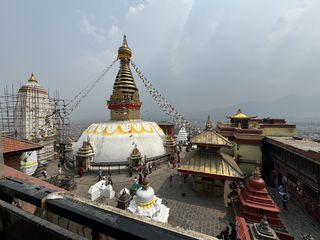
Swoyambhu Mahachaitya is conceived as an architectural landmark rather than an interior building. The monument is a stupa—essentially a solid, symbolic form—whose primary “use” is experienced through approach, circulation, and visual orientation. Its placement on a hill west of Kathmandu is integral to its design logic: the site is meant to be read at multiple scales, from the valley skyline to the close-up sequence of terraces, stairways, and ritual platforms that lead to the main structure. The hilltop setting amplifies the stupa’s presence and establishes a clear relationship between sacred architecture and topography, where ascent becomes part of the spatial narrative.
The complex is not a single, frozen plan. It is an accretional ensemble organized around a stable core (the main stupa) and a ring of auxiliary structures—small shrines, monasteries, gateways, statuary, and viewing terraces—added over time. This layered growth is architecturally coherent because the stupa remains the compositional anchor: secondary elements are arranged to support movement, ritual pauses, and framing of the central volume, rather than competing with it.
Structural logic and technological effectiveness
The stupa’s structural strength is rooted in mass, geometry, and compressive stability. Its primary volumes are low and continuous, designed to distribute loads evenly and to resist lateral stress—an important consideration in the seismically active Kathmandu Valley. Instead of relying on tall, slender members, the stupa uses a compact configuration: a broad base, a hemispherical dome-like body, and a lighter superstructure above. The transitions between these parts are gradual, reducing abrupt stress concentrations and helping the monument endure repeated cycles of repair and renewal.
The hilltop environment introduces additional technical requirements. Terraces and retaining walls stabilize the slopes, control runoff during monsoon rains, and provide level surfaces for circulation. Drainage and surface protection are therefore not secondary issues but essential architectural components. Steps and platforms are built not only to guide pilgrims but also to manage erosion and to maintain the integrity of the hill’s built edges.
Materials and construction methods
Traditional masonry dominates: brick and stone form the structural core, bound with mortars that have historically varied by period and restoration practice. The exterior is typically finished with a light-colored plaster or render. This finish is both protective and visual: it shields the masonry from moisture and weathering, creates a unified surface that conceals patchwork repairs, and reinforces the monument’s legibility from afar. The renewal of surface layers is a normal part of the monument’s life cycle and can be understood as a conservation strategy embedded in traditional practice—periodic replacement of vulnerable “skin” elements to preserve the durable core.
The uppermost features—crowning elements and ornamental details—often incorporate metal components. Compared with the heavy masonry body, these parts are lighter and more replaceable, which allows targeted maintenance without compromising the main structure. Timber, so characteristic of Nepal’s historic architecture, is more prominent in the surrounding buildings (shrines, pavilions, roofed structures) than in the stupa itself, whose monumental identity is primarily mineral and mass-based.
Spatial organization and ritual movement
Swoyambhu’s spatial plan is fundamentally circumambulatory. The stupa is not approached as a façade with a singular front; rather, it is experienced through circular motion around a center. The principal ritual path is organized as an encircling route, allowing devotees to move continuously while maintaining the stupa as an ever-present reference point. This differs sharply from temple architectures that rely on axial entry and interior sanctums. Here, meaning is enacted in the open air through repetition, rhythm, and proximity.
Approach sequences are staged through thresholds: stair flights, gates, terraces, and changes in level that produce a gradual transition from the surrounding city to the elevated sacred precinct. These thresholds create a layered spatial hierarchy—open viewing areas, more concentrated ritual zones, and finally the immediate perimeter of the stupa. The architecture thus orchestrates both movement and pause, accommodating gatherings without turning the stupa into an interior assembly structure.
Form, proportions, and key architectural elements
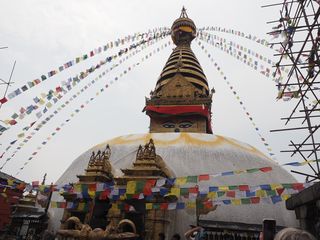
As a stupa, Swoyambhu follows a recognizable volumetric grammar. A substantial base supports a hemispherical body (often read as a “dome” in silhouette), above which sits a square element that mediates the transition to the vertical crowning components. This circle–square–axis relationship is central to many stupa traditions: the form is simultaneously stable, symbolic, and visually clear.
One of the most distinctive elements is the set of painted eyes on the upper portion of the structure. Architecturally, these features do more than decorate; they give the monument a directional presence and transform an abstract volume into a sign-bearing landmark. Because the eyes are oriented toward the cardinal directions, the stupa gains a kind of omnidirectional “frontality,” remaining readable and iconic regardless of approach angle. This graphic identity is integral to the monument’s architectural perception and is inseparable from its role in the city’s visual culture.
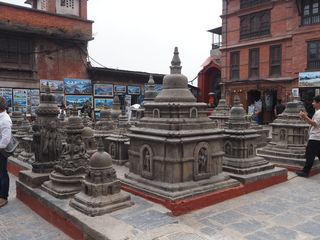
Swoyambhu’s broader complex contributes to its architectural character. Small shrines, statues, and platforms densify the perimeter and create micro-spaces for offerings and prayer. The ensemble is therefore both monumental and granular: a dominant core surrounded by a textured field of devotional architecture that supports varied practices without diluting the stupa’s primacy.
Artistic influences and hybrid traditions
Swoyambhu’s architecture reflects a long-term coexistence of Buddhist and Hindu cultural currents in the Kathmandu Valley. The stupa form itself belongs to a Buddhist architectural lineage originating in South Asia, yet the surrounding complex incorporates multiple stylistic registers that emerged locally. This hybrid character is particularly evident in the ancillary structures: their forms, iconography, and spatial placement reflect an environment where religious traditions intersect and where sacred sites evolve through addition rather than replacement.
The hilltop setting also aligns Swoyambhu with Himalayan patterns of sacred geography, where elevation, panorama, and pilgrimage ascent are integral to religious experience. This relationship between architecture and landscape distinguishes it from stupas built on flat terrain. At Swoyambhu, the monument is not simply “placed” on a site; the site’s verticality becomes part of the architecture’s meaning and use.
Notable facts, measurements, and architectural anecdotes
Exact dimensions reported for Swoyambhu can vary depending on measurement standards and restoration phases, but certain architectural constants define it: a compact, mass-driven structure designed for circular experience; a strong contrast between the heavy masonry body and the lighter crown; and a site plan that integrates terraces and circulation as functional architecture. The monument’s iconic graphic features (notably the eyes) also operate as a unique architectural signature—an element that functions simultaneously as symbol, wayfinding marker, and identity device within the city.
Another noteworthy aspect is the monument’s “maintenance architecture.” Regular surface renewal, localized repairs, and replacement of exposed upper elements are not signs of instability but part of how the structure has remained legible and intact over long periods. The architecture is therefore best understood as resilient not because it never changes, but because it can be repaired without losing its essential form.
Heritage value and conservation constraints
Swoyambhu’s architectural importance contributes directly to its inclusion in the Kathmandu Valley World Heritage inscription (1979). Its value lies in typological clarity, continuity of ritual use, and the relationship between monumental form and historic urban landscape. Conservation challenges are closely tied to architecture: seismic risk demands careful structural monitoring; pollution and weathering accelerate surface deterioration; monsoon runoff threatens terraces and slope infrastructure; and heavy visitation increases wear on circulation surfaces and peripheral structures.
Preservation thus requires balancing traditional maintenance cycles with contemporary safety and management needs. The goal is to protect both the monument’s physical integrity and the spatial practices that define it—approach, circumambulation, and the layered experience of the hilltop ensemble.
Synthesis
Architecturally, Swoyambhu Mahachaitya is an exemplary stupa complex: a stable, mass-based core designed for movement around it, set within an evolving ring of ancillary sacred structures and terraces. Its effectiveness rests on structural simplicity, durable materials, repairable surface systems, and a spatial organization that makes ritual circulation the primary “interior.” The result is a monument whose architectural power derives as much from its form and construction as from its integration with topography and lived practice in the Kathmandu Valley.