

 Français (France)
  Nederlands (nl-NL)
 The Mask of Swet Bhairab is a monumental cult image integrated into the urban fabric of Kathmandu, representing a powerful and fearsome form associated with Shiva. Revealed only at specific ritual moments, it is not an autonomous structure but a device activated during collective ceremonies. The mask belongs to a broader cultic setting shared with the nearby Shree Kaal Bhairav temple, located on the same square. While the temple embodies a permanent divine presence associated with authority and justice, the Mask of Swet Bhairab represents a periodic manifestation intended to symbolically channel forces engaged during major public gatherings.
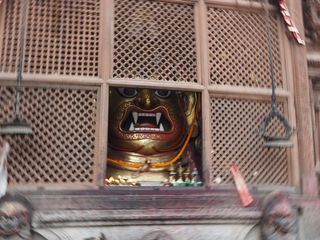
Kathmandu • Swet Bhairab mask
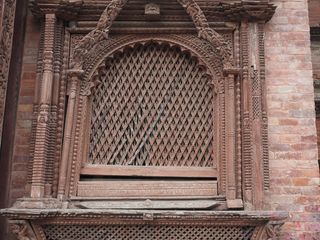
Kathmandu • Swet Bhairab mask
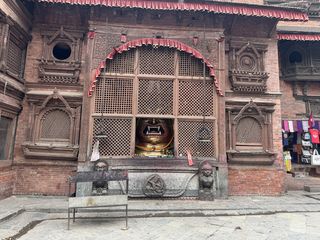
Kathmandu • Swet Bhairab mask
Monument profile
Swet Bhairab mask
Monument category: Monumental cult image
Monument family: Giant statues or set of statues
Monument genre: Religious
Cultural heritage: Hindu
Geographic location: Kathmandu • Nepal
Construction period: 15th century AD
This monument in Kathmandu is inscribed on the UNESCO World Heritage List since 1979 and is part of the serial property "Kathmandu Valley".See the UNESCO monuments featured on this site
• Links to •
• Dynasties that contributed to the construction of the monument •

• List of videos about Kathmandu on this site •
Kathmandu • Great Buddhist stupas and sacred landscape
Kathmandu • Durbar Square, historic royal and religious centre
Kathmandu • Urban life, local temples and everyday spaces
Kathmandu • Pashupatinath, Hindu sanctuary on the Bagmati River
History of the Mask of Swet Bhairab in Kathmandu (Nepal)
Political and social context of its establishment
The Mask of Swet Bhairab emerged within the complex political and social framework of the Kathmandu Valley during the late medieval period, when urban power, religious authority, and civic identity were closely intertwined. The figure of Bhairab, a fierce manifestation associated with Shiva, was widely regarded as a guardian deity whose presence symbolized protection, justice, and the containment of disorder. Installing a monumental image of Swet Bhairab within the urban fabric served as a visible assertion of authority, projecting the capacity of rulers to maintain cosmic and social balance.
During the era of the Malla kings, Kathmandu developed as a highly ritualized city in which political legitimacy was reinforced through religious patronage. Monumental cult images placed in prominent locations acted as intermediaries between rulers and the population, reinforcing allegiance and shared values. The Mask of Swet Bhairab was not conceived as a secluded temple object but as a public-facing symbol, embedded in daily urban life while remaining ritually controlled. Its construction reflected the ambitions of royal authorities to affirm sovereignty, stabilize civic order, and demonstrate continuity with earlier religious traditions embraced by the Newar community.
Historical events and dynastic transitions
Over the centuries, the site of the Mask of Swet Bhairab witnessed the major political shifts that shaped the Kathmandu Valley. Rivalries among the three principal city-states—Kathmandu, Patan, and Bhaktapur—heightened the symbolic importance of religious monuments that articulated civic identity. Despite periods of conflict, the cult image remained a shared reference point, maintained and respected across successive reigns.
The unification of Nepal in the eighteenth century under the Shah altered the political landscape, centralizing power beyond the valley. Nevertheless, the Mask of Swet Bhairab retained its relevance. Rather than being displaced, it was incorporated into a broader national framework that acknowledged the cultural significance of Kathmandu’s historic monuments. Natural disasters, particularly earthquakes, caused periodic damage to the surrounding structures, prompting restoration efforts that ensured the continued presence of the mask. Its survival through regime changes and urban transformations underscores its resilience as a symbol embedded in collective memory.
Global context at the time of its consolidation
The prominence of monumental religious imagery in Kathmandu corresponds to broader developments across the medieval world. In South and Southeast Asia, rulers commissioned large-scale representations of deities to articulate political authority and religious devotion. Comparable processes unfolded elsewhere: in Europe, sculpted façades of cathedrals communicated theological narratives and civic pride; in East Asia, imposing guardian figures marked sacred and administrative spaces.
Within this global pattern, the Mask of Swet Bhairab represents a localized response to universal concerns of governance, belief, and public representation. Its integration into an urban façade reflects a distinctive approach in which sacred imagery interacts directly with civic space. This strategy allowed religious symbolism to permeate daily life, reinforcing social cohesion without requiring monumental freestanding structures.
Transformations and adaptations over time
The Mask of Swet Bhairab has undergone multiple phases of modification and adaptation. Structural reinforcements followed seismic events, while adjustments to its enclosure and protective elements reflected evolving needs for preservation and ritual management. Although the essential form of the mask remained consistent, its immediate architectural context evolved alongside the city’s growth.
Urban expansion transformed the surroundings from a primarily traditional environment into a denser, more complex cityscape. Despite these changes, the mask maintained its role as a focal point, demonstrating an ability to adapt without losing its symbolic function. Ritual practices associated with the monument were periodically adjusted to accommodate larger gatherings and modern safety considerations, reflecting a balance between continuity and practicality.
Contemporary role and cultural significance
Today, the Mask of Swet Bhairab occupies a prominent place in Kathmandu’s cultural landscape. It is closely associated with public rituals and festivals, particularly Indra Jatra, during which the image is temporarily revealed and ritually activated. For local communities, the monument embodies continuity with ancestral traditions and serves as a reminder of the city’s historical identity.
At a national level, it contributes to Nepal’s image as a country where living traditions coexist with historic monuments. The mask functions both as a religious symbol and as a marker of cultural heritage, bridging local devotion and broader recognition. Its presence reinforces a sense of place, anchoring collective memory within the evolving urban environment.
Conservation status and modern challenges
The Mask of Swet Bhairab faces challenges common to many historic monuments in rapidly urbanizing contexts. Environmental pollution, vibrations from traffic, and exposure to climatic variations pose ongoing risks. Tourism adds further pressure, necessitating careful management to prevent physical and symbolic degradation.
Conservation efforts are guided by the monument’s inclusion within the Kathmandu Valley, inscribed on the UNESCO World Heritage List in 1979. This status imposes responsibilities related to documentation, restoration, and sustainable management. Authorities aim to preserve traditional materials and techniques while introducing discreet reinforcements to enhance structural stability. The central challenge lies in maintaining the monument as a living religious symbol while ensuring its long-term preservation.
Conclusion
The history of the Mask of Swet Bhairab reflects the enduring relationship between religion, power, and urban life in Kathmandu. Conceived as a public-facing image of divine authority, it has adapted to political transitions, environmental challenges, and social change without losing its symbolic core. As both a historic monument and an active component of contemporary ritual life, it exemplifies the capacity of urban religious heritage to sustain relevance across centuries. Its continued presence affirms the resilience of Kathmandu’s cultural identity and the significance of preserving monuments that remain embedded in living traditions.
Architecture of the Mask of Swet Bhairab in Kathmandu (Nepal)
The architecture of the Mask of Swet Bhairab represents a distinctive approach to monumental religious imagery in the Kathmandu Valley. Rather than constituting an independent building, the mask is conceived as a monumental cult image integrated into an urban façade, a design choice that profoundly shapes its architectural logic. Its form, materials, and structural solutions reflect the technical expertise of Newar builders and their ability to embed religious symbolism directly into the fabric of the city.
Technological and architectural innovations of the period
One of the most notable architectural innovations embodied by the Mask of Swet Bhairab is the integration of large-scale sculptural imagery into load-bearing urban architecture. The mask is not an applied ornament but a carefully engineered element designed to coexist with the surrounding structure. This required a precise understanding of weight distribution, anchoring techniques, and the interaction between sculpture and masonry.
Newar construction traditions emphasized resilience in a seismically active region. The mask’s architectural system reflects this priority through the use of flexible structural components, particularly timber frameworks embedded within masonry. These elements absorb movement during seismic activity and reduce the risk of catastrophic failure. Such techniques demonstrate an advanced awareness of structural dynamics, well adapted to local environmental conditions.
Ventilation and moisture control also influenced the design. Although the mask itself forms a solid visual surface, the space behind it was conceived to allow airflow and prevent water accumulation. This architectural consideration protected both the sculptural surface and the supporting structure, ensuring long-term durability in a monsoon-affected climate. The careful calibration of visibility and concealment further illustrates the sophistication of the design, balancing ritual requirements with practical architectural needs.
Materials and construction methods
The primary material used for the visible face of Swet Bhairab is carved wood, a hallmark of Newar architectural and artistic production. Wood was favored not only for its availability and workability but also for its capacity to convey expressive detail at a monumental scale. The pronounced facial features, deep cavities, and projecting forms required a material that could be shaped with precision while maintaining structural integrity.
This wooden sculpture is supported and framed by brick and stone masonry, bound with traditional lime-based mortars. Such mortars provided sufficient strength while retaining a degree of flexibility, an essential property in an earthquake-prone environment. The combination of wood and masonry created a hybrid structure in which each material compensated for the limitations of the other.
Construction methods relied on joinery techniques refined over generations. Mortise-and-tenon joints, wooden pegs, and layered framing systems ensured stability without excessive reliance on metal fasteners, which were used sparingly and strategically. The movable wooden panels that conceal the mask when it is not displayed constitute another technical feature, combining protective function with mechanical simplicity and durability.
Architectural and artistic influences
The architectural language of the Mask of Swet Bhairab is deeply rooted in Newar traditions, yet it also reflects broader South Asian influences. The frontal, confrontational presentation of the face aligns with pan-Indic iconographic conventions associated with protective deities. At the same time, the urban placement of the image demonstrates a localized adaptation, prioritizing interaction with public space rather than enclosure within a sanctum.
Ornamental details surrounding the mask draw from a repertoire of regional motifs, including geometric patterns and symbolic forms associated with Hindu cosmology. These elements are integrated into the façade in a restrained manner, ensuring that the primary focus remains on the central image. The absence of excessive embellishment enhances legibility and reinforces the monument’s visual authority.
Architecturally, the mask shares conceptual similarities with monumental façade sculptures found in other parts of Asia, where religious imagery functions as both protector and marker of sacred territory. However, its execution in Kathmandu reflects a unique synthesis, shaped by local materials, craftsmanship, and urban density.
Spatial organization and structural configuration
The spatial organization of the Mask of Swet Bhairab is defined by a dual structure of visibility and concealment. The visible face occupies a carefully proportioned opening in the façade, framed to emphasize symmetry and frontal alignment. This opening establishes a clear visual axis, directing attention toward the mask and reinforcing its symbolic dominance.
Behind the façade lies a concealed technical space, accessible only for maintenance and ritual preparation. This area accommodates structural supports and functional elements required for the monument’s use. The separation between the public-facing image and the hidden architectural infrastructure is a defining feature, reflecting an architectural philosophy that privileges symbolic clarity while accommodating practical requirements.
Unlike contemporary monumental religious buildings, the Mask of Swet Bhairab does not incorporate architectural elements such as domes, towers, or colonnades. Its architectural identity is instead concentrated in a single plane, relying on scale, proportion, and expressive detail to achieve monumentality. This approach distinguishes it from other structures of the period and underscores its unique role within the urban environment.
Dimensions, technical features, and notable facts
The mask is characterized by its imposing dimensions, with the face measuring several meters in height. These proportions ensure visibility from a distance and enhance its impact within the dense urban setting of Kathmandu. The scale of the carving required coordinated effort among skilled artisans, reflecting a high degree of organization and technical planning.
A notable architectural feature is the discreet channel integrated into the mouth of the mask, designed to accommodate specific ritual functions. This element required precise alignment within the structure, demonstrating that architectural planning and ritual practice were considered simultaneously during construction. Such functional integration distinguishes the mask from purely decorative architectural sculpture.
Local traditions attribute symbolic significance to the orientation and placement of the mask, emphasizing its role as a guardian of the surrounding area. While these interpretations belong to the realm of belief, they underscore the intentionality behind architectural decisions related to location and alignment.
International recognition and conservation challenges
The architectural significance of the Mask of Swet Bhairab contributes to the global importance of the historic urban ensemble in which it is located, recognized as part of the Kathmandu Valley. This recognition highlights the value of integrated urban monuments that combine architecture, sculpture, and ritual function.
Conservation challenges are closely linked to the materials used. Wood remains vulnerable to humidity, temperature fluctuations, and biological agents, while masonry is affected by pollution and vibration in a congested city. Conservation strategies therefore focus on preventive maintenance, controlled restoration, and the preservation of traditional construction techniques.
Urban density presents additional constraints, limiting physical interventions and requiring careful coordination between heritage preservation and daily urban activity. The architectural design of the mask, originally conceived for a compact historic city, must now withstand pressures far beyond those anticipated at the time of its creation.
Architectural significance in a broader perspective
The architecture of the Mask of Swet Bhairab exemplifies a mode of monumental expression that prioritizes symbolic concentration over volumetric expansion. Through the integration of sculpture and façade, it demonstrates how architectural innovation can arise from the need to adapt religious imagery to complex urban contexts. Its continued presence attests to the durability of Newar architectural solutions and their relevance across centuries.
By combining technical ingenuity, material mastery, and symbolic clarity, the Mask of Swet Bhairab stands as a distinctive architectural achievement within the Kathmandu Valley. It illustrates how architecture can function simultaneously as structure, image, and urban marker, maintaining coherence and meaning in an evolving cityscape.