Français (France)
  Nederlands (nl-NL)
 In Kathmandu, cremations are a fundamental funerary practice within Hindu tradition. They follow a structured ritual framework intended to guide the deceased through the cycle of death and rebirth. Fire is regarded as a purifying element that enables the release of the soul, while water adds a symbolic dimension linked to transition. These rites are performed in public spaces, according to established religious norms, involving relatives and ritual specialists. Cremations hold strong social significance, reflecting enduring beliefs and the continuity of religious customs within Nepali society.
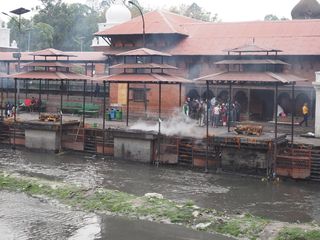
Kathmandu • Cremations
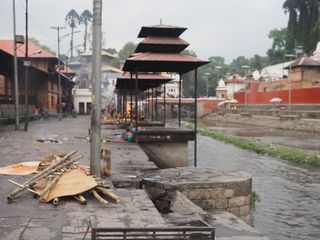
Kathmandu • Cremations
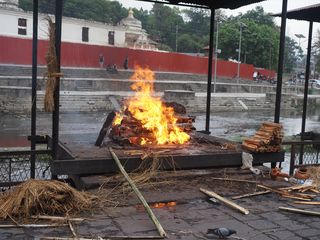
Kathmandu • Cremations
Tradition profile
Cremations
Tradition category: Hindu celebrations
Tradition family: Religious traditions
Tradition genre: Religious Festivals and Celebrations
Cultural heritage: Hindu
Geographic location: Kathmandu • Nepal
• Links to •
• List of videos about Kathmandu on this site •
Kathmandu • Great Buddhist stupas and sacred landscape
Kathmandu • Durbar Square, historic royal and religious centre
Kathmandu • Urban life, local temples and everyday spaces
Kathmandu • Pashupatinath, Hindu sanctuary on the Bagmati River
The History of Cremation Traditions in Kathmandu, Nepal
Political and Social Context of Emergence
The practice of cremation in Kathmandu developed within a religious and social framework deeply shaped by Hindu philosophy and ritual norms originating in the Indian subcontinent. Its emergence is inseparable from concepts of samsara (the cycle of rebirth) and moksha (liberation), which define death not as an end but as a transitional state. Cremation became the preferred funerary practice because it was believed to facilitate the separation of the soul from the physical body and enable its onward journey.
In the Kathmandu Valley, early urban societies were organized around caste hierarchies, kinship networks, and religious authorities. Cremation practices were codified within this social structure, ensuring ritual continuity and reinforcing communal order. Political fragmentation during early periods meant that no single authority monopolized funerary rites; instead, religious specialists and local elites oversaw their regulation. This decentralization contributed to the durability of the tradition, as it remained anchored in religious obligation rather than dynastic patronage.
Power Structures, Communities, and Ritual Authority
The organization of cremation rites traditionally involved specific castes and priestly groups responsible for ritual knowledge and performance. These groups played a central role in preserving the formal sequence of rites and transmitting ritual expertise. Families, particularly male heirs, were assigned prescribed roles, reflecting broader social norms regarding lineage and inheritance.
Although rulers and local elites occasionally supported cremation sites through endowments or protective measures, the practice itself remained largely autonomous from direct political control. This autonomy limited the impact of regime changes on the continuity of cremation customs, even during periods of political instability.
Major Historical Developments and Transformations
Over centuries, Kathmandu experienced shifts in political authority, including the rise and decline of local dynasties and the eventual formation of a centralized Nepali state. These transformations affected urban organization and religious institutions but did not fundamentally alter cremation practices. The tradition proved adaptable, absorbing administrative changes while retaining its core ritual structure.
Colonial influence in the broader South Asian region introduced new legal and administrative frameworks, but Nepal’s relative political independence allowed cremation customs to continue largely uninterrupted. In the modern era, state institutions gradually introduced regulatory measures related to public health and environmental management, influencing the organization of cremation spaces without abolishing traditional rites.
Global Context at the Time of Emergence
When cremation practices were becoming established in Kathmandu, similar funerary customs were developing across South Asia, particularly within Hindu and Buddhist cultural spheres. In contrast, other regions of the world favored burial or exposure practices, reflecting different cosmological views of death and the body.
Globally, cremation in Kathmandu aligns with a broader pattern of ritual practices that emphasize transformation through elemental forces, particularly fire. While distinct in its theological underpinnings, the practice shares conceptual parallels with funerary traditions in other ancient cultures that viewed death as a process rather than a final rupture.
Evolution and External Influences
Despite its longevity, the cremation tradition has not remained static. Changes in population density, economic conditions, and technological developments have influenced how rites are conducted. The availability of resources, such as wood, and the introduction of new materials occasionally altered practical aspects of cremation, though the ritual framework remained intact.
Periods of decline were rare, but temporary adaptations occurred during times of crisis, including natural disasters or public health emergencies. In recent decades, increased awareness of environmental concerns has prompted discussions about alternative practices, yet traditional cremation remains dominant in Kathmandu due to its deep religious significance.
Role in Contemporary Society
Today, cremation remains a central component of Kathmandu’s cultural and religious identity. It is practiced as a public ritual, reinforcing communal bonds and collective memory. The visibility of cremation ceremonies underscores the integration of death into everyday life, contrasting with societies where funerary practices are privatized or institutionalized.
Cremation continues to serve social functions beyond its religious purpose. It reaffirms family roles, marks transitions within kinship structures, and provides a framework for collective mourning. Religious calendars and commemorative rites further embed cremation within the rhythm of social life.
Cultural Significance and Identity
The persistence of cremation traditions contributes to Kathmandu’s distinct cultural landscape. The practice symbolizes continuity between past and present, linking contemporary society to ancient belief systems. It also functions as a marker of identity, distinguishing local customs from external influences while accommodating gradual change.
For many communities, cremation sites are not merely functional spaces but places of memory and reverence. Their continued use reinforces a shared understanding of mortality and spiritual responsibility.
Preservation and Modern Challenges
Modern challenges to the cremation tradition include urban expansion, environmental pressures, and shifts in social values. Increased population density places strain on traditional cremation areas, while concerns about pollution and resource consumption prompt calls for reform.
Efforts to preserve the tradition focus on balancing respect for ritual integrity with practical considerations. Community organizations, religious authorities, and public institutions collaborate to manage cremation spaces, ensure ritual continuity, and address environmental impacts. While the tradition itself is not separately listed as intangible heritage, its close association with recognized cultural landscapes enhances its visibility and protection.
Synthesis
The history of cremation traditions in Kathmandu reflects a complex interplay of religion, society, and adaptation. Rooted in ancient cosmological beliefs, the practice has endured political change, social transformation, and modern pressures. Its resilience lies in its capacity to integrate continuity and change, ensuring its relevance within both historical and contemporary contexts.
Characteristics of the Cremation Tradition in Kathmandu, Nepal
Origins and Context of Emergence
The cremation tradition practiced in Kathmandu is rooted in a religious and social framework shaped by Hindu cosmology and ritual law. Its emergence is closely linked to beliefs concerning the impermanence of the body and the continuity of the soul, concepts that have structured South Asian religious life for centuries. In this worldview, cremation is not merely a funerary act but a necessary process that enables the transition between death and rebirth.
The tradition developed in a society organized around caste, lineage, and ritual obligation. Cremation fulfilled an essential social function: it ensured the proper separation between the living and the dead while maintaining cosmic and social order. The practice was never informal; it followed precise norms governing who could perform rites, where they could be conducted, and how responsibilities were distributed within families and communities. These conditions allowed cremation to become a stable and enduring institution within Kathmandu’s cultural landscape.
Constituent Elements and Ritual Practices
Cremation in Kathmandu follows a structured sequence of actions, each governed by ritual prescription. The process begins with preparation of the body, which involves washing, wrapping, and symbolic gestures performed by close relatives. These acts are not decorative but serve to ritually detach the deceased from worldly identity.
The cremation itself is conducted outdoors and relies on the controlled use of fire as a purifying and transformative element. Specific gestures accompany the ignition, often performed by a designated family member according to lineage rules. Objects such as fire, water, offerings, and ritual implements are used with codified meanings, and their placement and timing are strictly regulated.
Participants assume clearly defined roles: ritual specialists oversee ceremonial correctness, family members perform obligations linked to kinship, and the broader community may be present as witnesses. The transmission of practical knowledge—how to arrange materials, conduct rites, and manage sequences—is largely oral and experiential, passed down through families and specialist groups across generations.
Symbolism and Systems of Meaning
Cremation embodies a dense symbolic system in which fire represents transformation rather than destruction. The burning of the body signifies the release of the soul from material constraints and its reintegration into a larger cosmic cycle. This symbolism reinforces the notion that death is not a rupture but a passage.
Colors, sounds, and gestures carry specific meanings. White garments commonly worn by mourners signify detachment and renunciation. Chanting, silence, and controlled movement are used to regulate emotion and reinforce solemnity. The absence of expressive lamentation in certain phases reflects the ideal of acceptance rather than resistance to death.
Local symbolic variations exist, particularly in the emphasis placed on certain gestures or the interpretation of ritual sequences. These differences do not contradict the broader tradition but illustrate its adaptability within a shared symbolic framework.
Evolution and External Influences
Although the core structure of cremation rites has remained stable, the tradition has evolved in response to social and material changes. Over time, adjustments have been made to accommodate shifts in population density, availability of resources, and administrative regulation. These changes affected practical aspects rather than symbolic foundations.
External influences, including modern legal frameworks and environmental awareness, have introduced new considerations into the practice. While these influences prompted discussion and occasional modification, they did not displace cremation’s central role. Comparisons with other regions reveal both similarities and contrasts: cremation traditions in other cultures may share the use of fire but differ significantly in ritual meaning and social organization.
Social Organization and Community Impact
Cremation plays a significant role in structuring social relations in Kathmandu. It reinforces kinship hierarchies by assigning ritual responsibilities according to family position and gender roles. Participation in cremation rites confirms social belonging and fulfills obligations toward ancestors and descendants.
The tradition also serves a regulatory function within the community. By providing a public and codified response to death, it limits disorder and channels grief into socially acceptable forms. Cremation sites function as communal spaces where individual loss is acknowledged within a collective framework.
Across generations, the practice contributes to continuity by linking the living to past lineages. Younger participants learn through observation and participation, ensuring that ritual knowledge is preserved even as broader social conditions change.
Statistics, Anecdotes, and Notable Features
Cremation in Kathmandu occurs with high frequency due to population density and religious norms favoring the practice. Rites typically unfold within a limited time after death, emphasizing immediacy and ritual efficiency. Individual ceremonies may last several hours, while the broader mourning period extends beyond the physical act of cremation.
Numerous narratives surround the tradition, often highlighting exemplary performances of filial duty or miraculous signs interpreted as spiritual confirmation. These anecdotes reinforce moral values associated with proper ritual conduct rather than serving as historical accounts.
Institutions such as religious councils and community organizations have contributed to maintaining standardized practices. Their involvement ensures continuity while allowing coordinated responses to practical challenges.
Recognition and Preservation Challenges
The cremation tradition in Kathmandu does not exist as an isolated ritual but as part of a broader cultural system recognized for its historical depth and social importance. While not independently designated as intangible heritage, it is closely linked to protected cultural landscapes and religious sites, which indirectly support its preservation.
Modern challenges include urban expansion, environmental concerns, and changing attitudes among younger generations. Space constraints and pollution issues place pressure on traditional practices, while modernization introduces alternative perspectives on funerary customs.
Preservation efforts focus on maintaining ritual integrity while addressing practical constraints. Community engagement remains central, as the tradition depends on collective participation rather than formal institutionalization.
Synthesis
The cremation tradition practiced in Kathmandu is characterized by its ritual precision, symbolic depth, and social integration. Its enduring presence reflects a balance between continuity and adaptation, allowing it to remain meaningful across centuries. By structuring responses to death, reinforcing social bonds, and embodying core religious values, the tradition continues to function as a foundational element of Kathmandu’s cultural identity.
 Links to the main sections of the site