

 Français (France)
  Nederlands (nl-NL)
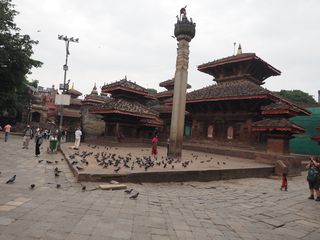
 Durbar Square is a monumental complex located in Kathmandu, Nepal, comprising palaces, temples, and shrines historically associated with royal authority and Hindu religious practices. The site represents a major urban reference within the Kathmandu Valley and reflects centuries of political, social, and religious organization. Formerly used for official ceremonies and public gatherings, Durbar Square continues to hold strong symbolic and cultural significance. It forms part of the serial property “Kathmandu Valley,” which was inscribed on the UNESCO World Heritage List in 1979, acknowledging its outstanding value as a cultural site of regional and international importance.


Monument profile
Durbar Square
Monument category: Set of Monuments
Monument family: Museum, remarkable architecture or group of buildings
Monument genre: Cultural or scientific
Cultural heritage: Hindu
Geographic location: Kathmandu • Nepal
Construction period: 6th century AD
This monument in Kathmandu is inscribed on the UNESCO World Heritage List since 1979 and is part of the serial property "Kathmandu Valley".See the UNESCO monuments featured on this site
• Links to •
• Dynasties that contributed to the construction of the monument •


• List of videos about Kathmandu on this site •
Kathmandu • Great Buddhist stupas and sacred landscape
Kathmandu • Durbar Square, historic royal and religious centre
Kathmandu • Urban life, local temples and everyday spaces
Kathmandu • Pashupatinath, Hindu sanctuary on the Bagmati River
History of Durbar Square in Kathmandu
Durbar Square in Kathmandu represents one of the most historically significant monumental ensembles in Nepal. Over several centuries, it functioned as the political, ceremonial, and symbolic center of royal authority in the Kathmandu Valley. Rather than being conceived as a single construction project, Durbar Square developed gradually through successive phases of political consolidation, dynastic rivalry, and urban transformation. Its historical evolution reflects the broader trajectory of state formation, religious authority, and social organization in central Nepal.
Political and social context of construction
The earliest foundations of Durbar Square can be traced back to the Licchavi period, beginning in the sixth century, when Kathmandu emerged as an organized political entity. During this era, the construction of a royal compound served the practical need to centralize administrative authority and establish a visible locus of power. The palace complex became the site where legal decisions were rendered, tribute was collected, and royal rituals were performed, reinforcing the sovereign’s legitimacy through spatial and ceremonial control.
The political significance of Durbar Square intensified under the Malla dynasty from the twelfth century onward. The Malla rulers governed a fragmented political landscape in which Kathmandu, Patan, and Bhaktapur existed as rival city-states. Architecture became a crucial instrument of political competition. Each ruler sought to enhance the prestige of his capital by commissioning new temples, palace wings, and ceremonial spaces. Durbar Square thus evolved as a stage for royal ambition, where construction projects asserted authority not only over subjects but also over competing dynasties within the valley.
Socially, the square functioned as a shared civic space that linked royal power with religious practice and urban life. The proximity of palaces and temples underscored the interdependence of political authority and Hindu ritual. Festivals, coronations, and public ceremonies reinforced social hierarchies while integrating the population into a shared symbolic order centered on the monarch.
Major historical events and dynastic changes
Throughout its history, Durbar Square was shaped by periods of conflict, transition, and reconstruction. The recurrent wars between the Malla kingdoms occasionally resulted in targeted damage to royal and religious structures, followed by restoration efforts intended to reaffirm legitimacy. Each reconstruction phase added new layers to the site, embedding political change within the built environment.
A decisive transformation occurred in the eighteenth century with the conquest of the Kathmandu Valley by Prithvi Narayan Shah. The unification of Nepal under the Shah dynasty reduced the political autonomy of Kathmandu and diminished Durbar Square’s role as an exclusive seat of power. Nevertheless, the site retained strong symbolic value. Royal rituals, proclamations, and state ceremonies continued to take place there, preserving its association with sovereignty even as administrative functions shifted elsewhere.
Natural disasters, particularly earthquakes, also played a defining role. Major seismic events in 1833, 1934, and 2015 caused widespread destruction across Durbar Square. Each disaster prompted extensive rebuilding campaigns that altered the site’s architectural fabric while attempting to maintain continuity with established forms. These cycles of destruction and restoration contributed to the complex historical stratification visible today.
Global context of monumental construction
The development of Durbar Square occurred within a broader global context in which monumental architecture served as a key expression of political authority. Across South Asia, royal courts invested heavily in palace complexes and temple cities to articulate sovereignty and religious legitimacy. Similar dynamics were visible in Southeast Asia, where rulers constructed monumental religious-political centers, and in medieval Europe, where palaces and cathedrals symbolized centralized power.
Durbar Square fits within this global pattern while reflecting a distinct regional adaptation. Its integration of political, religious, and civic functions into a compact urban setting exemplifies a model of monumental space rooted in ritual performance rather than purely defensive or administrative concerns. The emphasis on ceremonial visibility aligns it with contemporaneous traditions of sacred kingship found across Asia.
Transformations and changing functions
Over time, Durbar Square underwent significant functional and spatial transformations. As the political center of gravity shifted following national unification, the square gradually lost its administrative primacy. Buildings once used for governance were repurposed, abandoned, or integrated into new ceremonial frameworks. These changes altered patterns of use without erasing the site’s historical identity.
Urban expansion further transformed the square’s context. As Kathmandu developed into a modern capital, dense construction encroached upon the historic core, reducing the spatial dominance of the royal complex. Despite these pressures, Durbar Square continued to operate as a cultural and religious reference point, maintaining its relevance within a rapidly changing city.
Contemporary role and cultural significance
Today, Durbar Square occupies a central position in Nepal’s cultural consciousness. It remains an active site of religious observance, hosting festivals, rituals, and commemorative events that connect contemporary society with historical traditions. For local communities, the square embodies continuity with a royal and religious past that continues to shape collective identity.
At the national level, Durbar Square functions as a symbol of Nepal’s historical depth and cultural diversity. It is frequently invoked in narratives of national heritage and serves as a focal point for cultural education and tourism. Its continued use for public and ceremonial activities underscores its role as a living historical space rather than a static monument.
Conservation status and modern challenges
Durbar Square forms part of the Kathmandu Valley World Heritage property, inscribed on the UNESCO World Heritage List in 1979. This designation recognizes its outstanding universal value but also highlights the vulnerabilities inherent in its preservation. Environmental factors, seismic risk, urban pollution, and intense tourism exert ongoing pressure on the site.
Post-earthquake restoration efforts have raised complex questions regarding authenticity, traditional craftsmanship, and the integration of modern safety standards. Conservation policies seek to balance historical accuracy with structural resilience, while also accommodating the needs of local communities. The challenge lies in preserving the square’s historical character without isolating it from the urban and social life that has defined it for centuries.
Architecture of Durbar Square in Kathmandu
Durbar Square in Kathmandu is not a single monument but a compact architectural ensemble where royal, religious, and civic structures form a coherent urban composition. Palaces, courtyards, pagoda-style temples, shrines, platforms, gateways, and ceremonial thresholds were developed over long periods, producing a layered fabric that remains legible through consistent principles. The square exemplifies the Newar building tradition of the Kathmandu Valley: brick masonry combined with sophisticated timber construction and a highly developed system of carved ornament that is inseparable from structure. Its architectural value lies in the interaction between dense urban staging and refined craft—an environment designed for visibility, processions, ritual hierarchy, and the symbolic presentation of authority.
Technological and architectural innovations
The ensemble reflects construction strategies adapted to a monsoon climate, a crowded urban core, and persistent seismic risk. A key regional innovation is the systematic integration of timber as a structural component rather than a secondary finish. Traditional carpentry relies on joinery—mortise-and-tenon connections, wooden pegs, scarf joints, and layered roof framing—creating assemblies that can tolerate limited movement. In seismic contexts, such ductile behavior can reduce catastrophic brittle failure, especially where timber frames and ties help distribute loads and stabilize openings. The use of elevated plinths also contributes to performance: plinths separate buildings from ground moisture, create a stable level base, and provide sacrificial surfaces that can be repaired more readily after damage.
Climatic control is achieved through architectural form rather than mechanical systems. Deep eaves and multiple roof tiers shelter walls from heavy rain, reduce direct solar exposure, and protect mortar joints from accelerated erosion. Courtyards serve as ventilation reservoirs and light wells, supporting airflow across surrounding rooms and galleries. Carved window screens and controlled openings allow ventilation while maintaining privacy and filtering glare. Transitional spaces—porches, arcaded passages, shaded stair landings—buffer temperature and humidity shifts and also frame ceremonial movement.
At the urban scale, Durbar Square operates as a designed stage. Sightlines, approach axes, and elevated platforms organize crowds and direct attention toward specific temple fronts or palace façades. The built edges define public space while a system of gateways and inner courts regulates access, turning the ensemble into a spatial expression of hierarchy: open square, raised plinth, threshold, and controlled interior.
Materials and construction methods
Brick is the dominant material across the ensemble. Locally produced fired bricks form load-bearing walls, terrace structures, and many plinths. Brick offers availability, modularity, and repairability—important in a setting shaped by earthquakes and incremental rebuilding. Exposed brickwork gives Durbar Square its characteristic warm tonal palette, while traditional mortars (often lime- or earth-based) allow some breathability, provided roofs and drainage remain effective.
Stone is used selectively for high-wear and high-stress points: foundations or base courses, steps, thresholds, and platform edges. These elements resist abrasion, seasonal moisture, and heavy foot traffic. Stone also anchors critical structural points where compression concentrates, improving durability at ground interface and along principal circulation lines.
Timber is the defining construction medium and the most technically complex. It forms columns, beams, floor and roof structures, brackets, struts, doorways, and window frames. The bracket-and-strut system that carries deep eaves is both structural and expressive: carved components transfer roof loads outward and downward while articulating the façade. Timber frames around openings reduce weakness in masonry walls by reinforcing door and window apertures. In this tradition, ornament is not applied decoration; it is shaped into structural members, where carving and profiling coexist with load paths and joint geometry.
Roofing systems emphasize water management. Multi-tiered pagoda roofs shed rain rapidly and limit exposure of masonry to direct precipitation. Their stepped geometry also reduces the vulnerability of a single large roof plane. Drainage details—drip edges, terrace slopes, and protected junctions—are decisive for long-term conservation, because moisture infiltration is among the most destructive forces for both brick mortars and timber components.
Architectural and artistic influences
Durbar Square illustrates a synthesis of South Asian Hindu temple conventions with distinct Himalayan and Newar forms. The pagoda temple type—stacked roofs, strong eaves, and timber emphasis—differs from many stone-dominated temple traditions in other parts of South Asia, while maintaining Hindu ritual logic and iconographic programs. The ensemble’s artistic language is strongly craft-based: carved windows, bracket struts, tympanum-like panels, and threshold elements display deities, guardians, and auspicious motifs, forming a continuous narrative surface on façades.
The square also includes later layers that reflect shifting tastes and political contexts, including palace fronts with more formalized rhythms and occasional hybrid details. These additions did not replace the Newar core but introduced contrasting registers, making the ensemble a record of changing patronage. The coexistence of typologies—major temples, minor shrines, palace wings, ceremonial pavilions—creates variety while preserving consistency through material palette and timber vocabulary.
Spatial organization and structural features
The ensemble is structured by the relationship between open space and built edges. Palace buildings tend to form continuous or semi-continuous fronts, punctuated by gateways that lead to inner courtyards. Temples and shrines are positioned as focal points, approached via frontal stairways and raised platforms. Plinths are central to the spatial grammar: they separate sacred or royal ground from ordinary circulation, provide seating and gathering surfaces, and create a stage-like setting for ritual visibility. Staircases establish axial approaches and reinforce frontal reading of temple façades.
Temple architecture emphasizes vertical silhouette. Sanctuaries are often compact in plan, while stacked roofs build height through repetition and diminishing tiers. Deep eaves produce strong shadow lines and emphasize the layered construction. Palace architecture is generally more horizontal: façades are articulated by rhythmic window bays, timber balconies, and layered rooflines. Courtyards act as climatic and organizational cores, distributing rooms around open voids that provide light, air, and controlled access.
In terms of elements associated with other monumental traditions—minarets, large domes, extensive stone colonnades—Durbar Square is distinctive for its reliance on post-and-beam logic and bracketed eaves. Arches may appear in certain gateways or later façades, but the ensemble’s primary structural identity remains timber-centered rather than vault-centered.
Notable figures, metrics, and architectural anecdotes
As an ensemble, Durbar Square is best characterized by typological markers rather than a single canonical set of dimensions. Many temples present two or three roof tiers (sometimes more), with progressively diminishing roof footprints. Plinth heights vary considerably, from modest stepped bases to substantial terraces that establish prominent ceremonial stages. The architectural “statistic” that matters most is density: a high concentration of royal and sacred structures within a limited urban area produces layered spatial sequences—platform, stair, porch, façade, and roof—experienced at close range.
Local narratives often focus on craftsmanship. Carved windows and eave struts are sometimes treated as signatures of workshops, or as competitive demonstrations commissioned to outdo rivals in the valley’s inter-city patronage culture. Threshold symbolism is particularly emphasized: protective figures, auspicious emblems, and deity representations are positioned where movement transitions from public to restricted or sacred space. Whether read as legend, memory, or ritual logic, such accounts highlight an architectural principle: boundaries and interfaces are functional, symbolic, and structurally significant.
International recognition and conservation concerns
Durbar Square contributes directly to the global significance of the Kathmandu Valley World Heritage property. Its architectural value rests on the continuity of a timber-based monumental tradition at urban scale and the persistence of living ritual use. Conservation challenges are closely tied to materials and setting. Timber requires vigilant protection against insects, rot, and moisture; brickwork and mortars are vulnerable to water infiltration and urban pollution; and seismic risk repeatedly tests connections between walls, frames, and roof systems. Tourism and everyday circulation concentrate wear on steps, platforms, and thresholds, while dense urban surroundings complicate drainage management, visual integrity, and construction control.
Architecturally, Durbar Square remains a complex system rather than a fixed artifact. Its lasting coherence derives from repeated rebuilding within a stable grammar: brick massing, timber structure, deep eaves, elevated plinths, courtyard organization, and a carved vocabulary that merges craft and engineering. These principles allow the ensemble to remain recognizable despite centuries of transformation, while continuing to anchor cultural life in the historic core of Kathmandu.