Français (France)
  Nederlands (nl-NL)
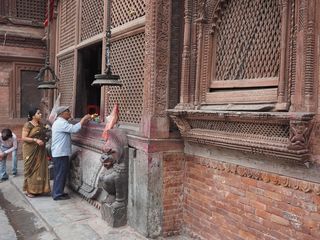
 Swet Bhairab is a Hindu religious tradition practiced in Kathmandu, associated with Bhairab, a fearsome manifestation linked to Shiva, invested with a protective and regulatory role within the urban space. It is expressed through public ceremonies embedded in the city’s ritual calendar and engages the community in codified collective practices. This tradition forms part of a broader cultic framework shared with the Shree Kaal Bhairav, located nearby on the same square. Together, these two complementary manifestations combine a permanent divine presence associated with authority and justice with a periodic ritual activation linked to major public gatherings, reflecting a structured symbolic organization of religious and civic life.

Kathmandu • Swet Bhairab
Kathmandu • Swet Bhairab

Kathmandu • Swet Bhairab
Tradition profile
Swet Bhairab
Tradition category: Local religious rite
Tradition family: Religious traditions
Tradition genre: Religious Festivals and Celebrations
Cultural heritage: Hindu
Geographic location: Kathmandu • Nepal
• Links to •
• List of videos about Kathmandu on this site •
Kathmandu • Great Buddhist stupas and sacred landscape
Kathmandu • Durbar Square, historic royal and religious centre
Kathmandu • Urban life, local temples and everyday spaces
Kathmandu • Pashupatinath, Hindu sanctuary on the Bagmati River
History of the Swet Bhairab tradition in Kathmandu (Nepal)
Political and social context of emergence
The tradition of Swet Bhairab developed within the urban and religious landscape of Kathmandu at a time when political authority, social organization, and ritual practice were closely interconnected. Its emergence is linked to the need for protective cults capable of regulating urban life and symbolically containing forces perceived as threatening, whether social, natural, or cosmic. Bhairab, a fierce manifestation associated with Shiva, fulfilled this role by embodying both fear and protection, making the deity particularly suitable for public ritual use in a densely populated city.
The tradition took shape during the medieval period, especially under the rule of the Malla, when Kathmandu functioned as a ritualized capital governed through symbolic as well as administrative means. Royal authorities, urban elites, and religious specialists supported the tradition as a mechanism for reinforcing civic order. Newar communities, organized through caste-based and professional associations, played a central role in maintaining and transmitting the rites. Early development was also shaped by rivalries among the cities of the Kathmandu Valley, which encouraged the reinforcement of distinctive local traditions as markers of identity and cohesion.
Major historical events shaping the tradition
Over the centuries, the Swet Bhairab tradition adapted to significant political and social transformations. Dynastic changes did not lead to its disappearance but often altered the framework within which it was practiced. The unification of Nepal in the eighteenth century under the Shah shifted political power toward a centralized state, yet the tradition continued as an established component of Kathmandu’s ritual life. Rather than being suppressed, it was integrated into a broader narrative of cultural continuity.
Periods of political instability, social reform, or crisis occasionally resulted in interruptions or reduced visibility of the rites. At other times, the tradition benefited from institutional encouragement as a symbol of stability and historical depth. Temporary declines were often followed by phases of revival, driven by local communities seeking to reaffirm their cultural heritage. These cycles of contraction and renewal demonstrate the flexibility of the tradition and its capacity to survive changing political contexts.
Global context at the time of emergence
The formation of the Swet Bhairab tradition corresponds to broader patterns observed in many parts of the medieval world, where public rituals and protective cults played an essential role in urban societies. In South and Southeast Asia, fierce guardian deities were commonly invoked during festivals to ensure prosperity and collective security. Comparable practices existed elsewhere, such as processions honoring patron saints in medieval Europe or protective rites associated with city gods in East Asia.
Within this global context, Swet Bhairab represents a localized expression of a universal phenomenon: the use of ritualized public performance to regulate social order and express communal identity. Its specific characteristics reflect Kathmandu’s urban density and its cultural emphasis on integrating religious symbols directly into civic space. While parallels can be drawn with other cultures, the tradition’s integration into everyday urban life distinguishes it from more centralized or temple-based ritual systems.
Transformations and adaptations over time
The Swet Bhairab tradition has not remained static. Changes in social structure, economic conditions, and political authority influenced how the rites were performed and perceived. Some ritual elements were simplified or restructured to accommodate larger crowds and changing urban conditions. Other aspects gained prominence as the tradition became more visible beyond its immediate community.
In the modern period, the tradition has increasingly been interpreted through a cultural heritage lens. Media exposure and documentation have contributed to its wider recognition, while also raising questions about authenticity and continuity. Technological change has affected transmission, shifting some knowledge from exclusively oral forms to recorded media. Despite these transformations, the core symbolic framework has remained largely intact, allowing the tradition to adapt without losing its defining features.
Contemporary role and cultural significance
Today, Swet Bhairab remains an important component of Kathmandu’s ritual calendar. It is closely associated with major public festivals, particularly Indra Jatra, during which the tradition becomes highly visible and engages a broad segment of the population. For local communities, participation in these rites affirms continuity with ancestral practices and reinforces a shared sense of belonging.
At the national level, the tradition contributes to Nepal’s image as a society where living religious practices coexist with historical heritage. It is perceived not only as a religious observance but also as a cultural marker that distinguishes Kathmandu within the wider region. The tradition thus operates simultaneously as devotion, collective memory, and public expression of identity.
Preservation status and modern challenges
The preservation of the Swet Bhairab tradition faces several challenges. Rapid urbanization, changing lifestyles, and the pressures of cultural globalization can weaken intergenerational transmission. Younger generations may engage with the tradition more as spectators than as active participants, raising concerns about long-term continuity.
Efforts to safeguard the tradition focus primarily on community-based initiatives and informal institutional support. While Swet Bhairab is not individually listed as UNESCO intangible heritage, it benefits indirectly from the recognition of the Kathmandu Valley, which highlights the cultural value of the city’s living traditions. Educational programs, documentation projects, and community-led organization aim to balance adaptation with respect for established forms. The future of the tradition depends on its ability to remain meaningful within contemporary urban life while retaining its historical depth.
Characteristics of the Swet Bhairab Tradition in Kathmandu (Nepal)
Origin and context of emergence
The tradition of Swet Bhairab developed in the Kathmandu Valley within a political and social environment where religious practice was deeply embedded in urban organization and collective life. Its emergence was favored by a context in which cities relied on protective cults to regulate social order, manage uncertainty, and symbolically control forces perceived as potentially destructive. Bhairab, a fierce manifestation associated with Shiva, embodied both danger and protection, making this figure particularly suitable for public ritual use in a dense urban setting.
Initially, the function of the Swet Bhairab tradition was collective rather than individual. It operated as a mechanism through which the community could acknowledge disorder while affirming its containment through ritual. The tradition fits into a broader cultural framework characteristic of Newar society, where religious observances are closely tied to civic identity, spatial organization, and historical continuity. Rather than existing as an isolated belief, Swet Bhairab emerged as part of a structured ritual system integrated into the rhythm of urban life.
Constituent elements and ritual practices
The Swet Bhairab tradition is defined by a set of clearly codified practices activated at specific moments in the ritual calendar. These practices take place primarily during public ceremonies associated with major urban festivals. The ritual sequence follows an established order, beginning with preparatory acts conducted by designated religious specialists and continuing with public participation that marks the collective dimension of the tradition.
Material elements play a central role. The monumental face associated with Swet Bhairab serves as the focal point, but it is accompanied by ritual objects such as vessels, offerings, textiles, and symbolic substances. Gestures are deliberate and restrained, emphasizing respect and control rather than spontaneous expression. Sound also contributes to the ritual atmosphere through chants, signals, or percussion, which structure time and signal transitions within the ceremony.
Participants assume distinct roles based on social position, ritual expertise, or communal responsibility. Religious officiants oversee the correct execution of rites, while members of specific communities or associations manage logistics and crowd regulation. The transmission of knowledge relies largely on practice-based learning. Skills related to ritual timing, symbolic gestures, and organizational coordination are passed down through families, professional groups, and community institutions, ensuring continuity across generations.
Symbolism and meanings
Symbolically, the Swet Bhairab tradition conveys a complex set of meanings centered on the management of power and fear. Bhairab represents a force that is inherently dangerous yet necessary, embodying the idea that order depends on the recognition and containment of destructive potential. The tradition therefore communicates values of discipline, vigilance, and communal responsibility.
Colors, sounds, and bodily attitudes are carefully selected to reinforce these meanings. Visual contrasts emphasize the extraordinary nature of the ritual moment, distinguishing it from everyday life. Sound marks the boundaries of ritual time and reinforces collective attention. Physical comportment, often formal and restrained, signals submission to a higher order and respect for communal norms.
Local variations introduce subtle symbolic differences without altering the fundamental structure. These variations may reflect neighborhood identities or historical affiliations, demonstrating the adaptability of the tradition within a shared symbolic framework. Such flexibility allows Swet Bhairab to remain relevant across different social contexts while preserving its core significance.
Evolution and external influences
Over time, the Swet Bhairab tradition has undergone gradual transformations shaped by political change, social reorganization, and external influences. While its symbolic core has remained stable, specific practices have evolved in response to shifting urban conditions. Adjustments in ritual timing, scale, or presentation have accommodated population growth and changing patterns of public assembly.
External influences have been indirect rather than imposed. Contact with broader cultural currents, including modern forms of communication and documentation, has altered how the tradition is perceived and transmitted. In some contexts, Swet Bhairab has been reinterpreted as cultural heritage alongside its religious significance. Comparable practices can be observed in other regions, where guardian figures or public rituals serve similar functions of social regulation and identity reinforcement, highlighting both universal patterns and local specificity.
Social organization and community impact
The Swet Bhairab tradition plays a structuring role within the social organization of Kathmandu. It mobilizes different segments of the population and reinforces relationships between generations. Responsibilities associated with the ritual are distributed according to established hierarchies, reflecting broader patterns of social organization within Newar society.
Politically, the tradition has functioned as a symbolic interface between authority and community. Participation by leaders historically signaled their role as guardians of order, while collective engagement reaffirmed communal cohesion. In contemporary society, the tradition continues to foster a sense of belonging by linking present-day practice with historical memory.
Its place within major festivals ensures that Swet Bhairab remains a shared reference point. These events extend beyond religious observance, serving as moments of social interaction, negotiation of roles, and reaffirmation of collective values.
Statistics, anecdotes, and notable narratives
Ritual events associated with Swet Bhairab can attract large gatherings, sometimes involving several thousand participants depending on the occasion. The duration of ceremonies varies, ranging from brief ritual acts to sequences integrated into multi-day festivals. This variability reflects the adaptability of the tradition to different contexts.
Oral narratives and anecdotes form an important layer of meaning. Stories often recount episodes in which Swet Bhairab is credited with protecting the city during periods of crisis, reinforcing belief in its efficacy. Other accounts highlight the dedication of priests, community leaders, or organizations that ensured continuity during times of political or social disruption. These narratives contribute to the tradition’s resilience by embedding it in collective memory.
Recognition and preservation challenges
At present, the Swet Bhairab tradition enjoys strong local recognition and is widely regarded as an integral component of Kathmandu’s cultural identity. While it does not hold a separate status as internationally recognized intangible heritage, it benefits from broader recognition of the city’s living traditions. This acknowledgment underscores its cultural value without formalizing it in a way that would restrict its evolution.
Preservation challenges are significant. Urban expansion, modernization, and changing lifestyles can weaken traditional modes of transmission. Younger generations may engage with the tradition primarily as observers, raising concerns about long-term participation. There is also a risk of reducing the tradition to a cultural display detached from its social and religious context.
In response, local initiatives emphasize education, documentation, and community involvement. Efforts focus on maintaining active participation rather than freezing the tradition in a fixed form. The future of Swet Bhairab depends on balancing continuity and adaptation, allowing the tradition to remain meaningful within contemporary urban life while preserving the values and practices that define its identity.
 Links to the main sections of the site