Français (France)
  Nederlands (nl-NL)
 The Chinese fishing nets of Kochi, located in the Indian state of Kerala, represent a traditional fishing method dating back several centuries. These large structures, positioned along the waterfront, operate through a system of levers and counterweights to efficiently catch fish. Introduced by traders from Asia, the nets reflect the region's long-standing cultural and commercial exchanges. Today, they remain an essential part of the local scenery and continue to be used for both fishing and tourism purposes.
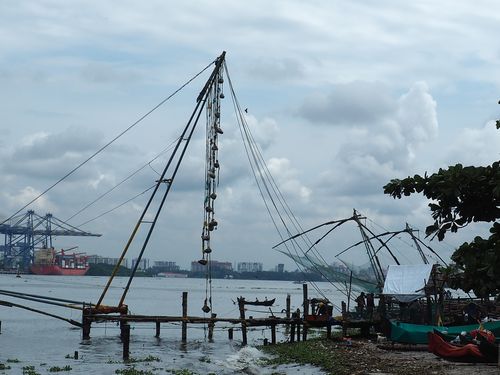
Kochi • Chinese fishing nets
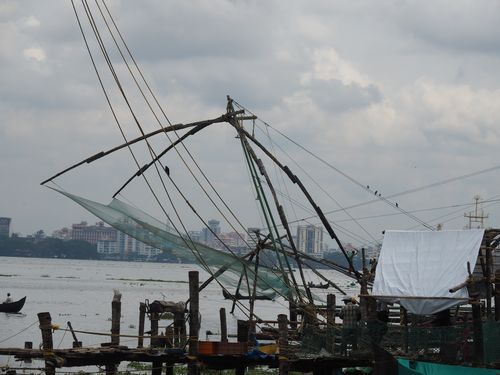
Kochi • Chinese fishing nets

Kochi • Chinese fishing nets
Tradition profile
Chinese fishing nets
Tradition category: Traditional fishing
Tradition family: Crafts and professions
Tradition genre: Trade and Local Creativity
Geographic location: Kochi • Kerala • India
• Links to •
• List of videos about Kochi on this site •
Kochi • Kathakali, Dhobi Khana and Jewish Quarter • Kerala
Chinese Fishing Nets in Kochi: A Testament to Social and Cultural Innovation
The Chinese fishing nets of Kochi, located in the Indian state of Kerala, represent a unique blend of cultural exchange and social ingenuity dating back to the 14th or 15th century. Introduced by Chinese traders, possibly during the reign of the Yuan or Ming dynasties, this traditional fishing practice reflects the economic and social values of the time while embodying the region's openness to external influences.
Social and Cultural Innovation
The introduction of Chinese fishing nets in Kochi revolutionized local fishing practices by introducing a collective approach to fishing, contrasting with the previously predominant individual techniques. These nets, which require the coordinated effort of several fishermen, fostered a sense of community collaboration and shared labor, reinforcing social bonds within fishing communities.
Moreover, the large-scale deployment of these nets symbolized technological progress, demonstrating the local population’s ability to adapt and integrate foreign techniques into their way of life. Their successful adoption illustrates how trade and cultural exchanges with China influenced not only the economy but also social organization and resource management.
Symbolism and Ritual Practices
Chinese fishing nets are not merely functional tools; they are deeply intertwined with the cultural and spiritual fabric of Kochi’s fishing communities. Before each use, fishermen traditionally perform prayers and rituals, invoking divine blessings for a bountiful catch and safe working conditions. Offerings are made to deities associated with the sea, highlighting the spiritual connection between the fishermen and their environment.
Certain decorative elements, such as coir ropes adorned with shells and hand-carved wooden pulleys, reflect local craftsmanship and the integration of indigenous artistic elements into the foreign fishing technique. These embellishments underscore the regional pride and respect for tradition that continue to accompany the practice.
A Fusion of Regional and Foreign Influences
The Chinese fishing nets exemplify the confluence of indigenous fishing knowledge with external influences from China. While the technique itself originated abroad, the materials and maintenance practices have been adapted to suit the coastal environment of Kerala. The use of locally sourced teak wood for the poles and traditional coir ropes demonstrates the seamless integration of available resources with foreign innovation.
Over centuries, the practice has evolved to incorporate elements of Portuguese and Dutch colonial influences, reflecting the dynamic history of Kochi as a melting pot of cultures. The result is a fishing tradition that retains its distinctive foreign heritage while being deeply rooted in the local identity.
Notable Statistics and Anecdotes
The nets can span up to 20 meters in width, and their operation requires the synchronized effort of 6 to 10 fishermen, emphasizing the communal nature of the practice.
It is said that the explorer Zheng He, a Chinese admiral, played a crucial role in introducing the technique during his maritime expeditions to the Malabar Coast.
Despite their declining commercial use, around 150 Chinese fishing nets are still operational along the shores of Kochi, primarily maintained for their historical and touristic value.
International Recognition and UNESCO Prospects
Chinese fishing nets have become one of the most recognizable symbols of Kochi, attracting tourists and serving as a reminder of the city’s historical ties with the maritime Silk Road. Their potential inclusion in UNESCO’s list of intangible cultural heritage could enhance efforts to preserve and promote this unique tradition. Recognition at this level would help raise awareness about the importance of safeguarding traditional practices in the face of rapid modernization.
Challenges to Preservation
Despite their cultural significance, Chinese fishing nets face numerous challenges:
Declining fish stocks and environmental degradation, which have reduced their effectiveness and economic viability.
Urbanization and infrastructure development, leading to encroachment on traditional fishing grounds.
Tourism pressure, which, while providing economic support, sometimes results in the commercialization and trivialization of the practice.
Efforts to preserve the tradition include government-led initiatives and grassroots campaigns to involve younger generations in learning and maintaining these historical structures.
Conclusion
The Chinese fishing nets of Kochi are more than a method of fishing; they are a living testimony to the cultural exchanges that have shaped the region for centuries. As a symbol of resilience and adaptation, they continue to reflect the innovative spirit of the people of Kochi. Ensuring their preservation will not only maintain a vital link to the past but also support sustainable tourism and cultural heritage management in the future.
Chinese Fishing Nets in Kochi: A Symbol of Social and Cultural Innovation
The Chinese fishing nets of Kochi, in the Indian state of Kerala, stand as a remarkable example of social and cultural innovation dating back to the 14th and 15th centuries. Introduced by Chinese traders, possibly during the reign of the Yuan or Ming dynasties, these nets are a testament to the region's openness to foreign influences and its ability to integrate them into local customs. This practice reflects not only the economic aspirations of the time but also the collaborative and adaptive spirit of the fishing communities in Kochi.
Social and Cultural Innovation
The arrival of Chinese fishing nets introduced a new approach to fishing, emphasizing collective effort and efficient resource management. Unlike traditional fishing methods that were labor-intensive and individualistic, these nets required coordinated teamwork, encouraging social cohesion and cooperation among fishermen. The operation of these large cantilevered structures necessitated precise coordination, strengthening communal bonds and promoting shared responsibility.
Furthermore, the nets signified a step forward in technological advancement, as their pulley and counterweight system allowed for efficient fishing without excessive manual labor. This innovation enabled fishermen to increase their productivity while reducing physical strain, marking a significant shift in local fishing practices.
Symbolism and Rituals
The Chinese fishing nets are not just practical tools; they are deeply rooted in cultural traditions and spiritual beliefs. Fishermen often perform ritualistic prayers and blessings before deploying the nets, seeking divine favor for a bountiful catch. Offerings are made to deities associated with the sea, reflecting the strong spiritual connection between the fishing community and the natural elements.
The nets themselves are adorned with symbols of protection, such as seashells, religious talismans, and hand-carved wooden elements, believed to bring good fortune and safeguard against misfortunes. These ritualistic practices highlight the values of respect for nature and community resilience, which continue to be integral to the fishing tradition in Kochi.
A Fusion of Regional and External Influences
The Chinese fishing nets epitomize a unique blend of regional traditions and foreign influences, demonstrating the historical maritime interactions between Kerala and China. While the fundamental design was introduced by Chinese traders, the adaptation of locally sourced materials such as teak wood for the framework and coir ropes for support illustrates the integration of indigenous craftsmanship.
The practice also evolved under the influence of Portuguese and Dutch colonists, who contributed to the economic significance of fishing in Kochi and introduced new trade opportunities. Over time, the nets became an essential part of Kochi's identity, symbolizing the fusion of global maritime exchanges and local ingenuity.
Notable Statistics and Anecdotes
Each fishing net measures approximately 10 meters in height and spans about 20 meters in width, showcasing the engineering brilliance of the time.
The operation of a single net requires a team of 6 to 10 fishermen, highlighting the importance of teamwork and collaboration.
Historical accounts suggest that these nets were introduced by the famed Chinese explorer Zheng He, during his voyages along the Malabar Coast.
Despite the passage of time, around 150 Chinese fishing nets remain operational along the shores of Kochi, serving both as a functional fishing method and as a tourist attraction.
International Recognition and UNESCO Prospects
The iconic presence of Chinese fishing nets in Kochi has made them a major tourist attraction, contributing to the region's cultural and economic landscape. Their visual appeal and historical significance have led to discussions about their potential inclusion in UNESCO’s list of intangible cultural heritage, which would enhance efforts to preserve this unique tradition. Recognition on a global scale would bring attention to the need for conservation measures and help sustain the livelihood of local fishing communities.
Challenges to Preservation
Despite their cultural and historical importance, Chinese fishing nets face several challenges in the modern era, including:
Environmental degradation, such as rising sea levels and pollution, which threaten the integrity of the wooden structures.
Decline in fish populations, leading to reduced economic viability for traditional fishermen.
Urbanization and infrastructure development, which encroach upon traditional fishing areas and disrupt the ecosystem.
Tourism pressures, where increased commercialization may erode the authenticity of the practice and its traditional values.
To address these challenges, conservation initiatives are being explored, including local government support, community-based awareness programs, and heritage tourism strategies aimed at balancing economic gain with cultural preservation.
Conclusion
The Chinese fishing nets of Kochi are more than just an architectural curiosity; they represent the enduring legacy of cultural exchange, social collaboration, and maritime ingenuity. As an iconic symbol of Kerala’s heritage, they continue to capture the imagination of visitors and historians alike. Efforts to preserve this tradition will ensure that it remains a vital part of Kochi’s cultural landscape for generations to come, reflecting the region’s ability to embrace and sustain diverse influences over time.
 Links to the main sections of the site