Français (France)
  Nederlands (nl-NL)
 Kathakali dance is one of the most distinctive forms of performing arts in Kerala, India. Practiced in Kochi and other parts of the region, it is characterized by a theatrical and narrative style that blends dance, music, symbolic gestures, and elaborate makeup. Performances are based on Hindu epic stories and portray characters whose emotions and actions are conveyed through codified movements and powerful facial expressions. This tradition, which requires years of rigorous training, is regarded as an important cultural heritage, preserved through teaching and performance in festivals and cultural events.
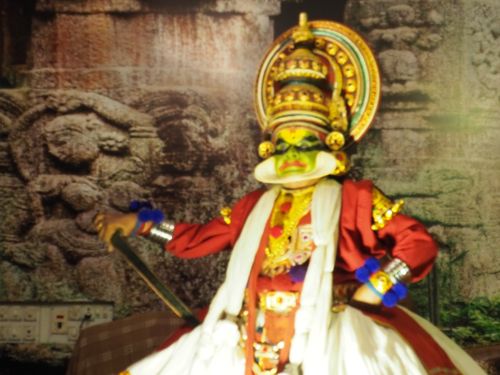
Kochi • Kathakali Dance

Kochi • Kathakali Dance

Kochi • Kathakali Dance
Tradition profile
Kathakali Dance
Tradition category: Kathakali dance
Tradition family: Traditional dance
Tradition genre: Performing arts
Cultural heritage: Hindu
Geographic location: Kochi • Kerala • India
• Links to •
• List of videos about Kochi on this site •
Kochi • Kathakali, Dhobi Khana and Jewish Quarter • Kerala
The Historical Development of the Kathakali Dance Tradition in Kochi, India
Kathakali, a classical dance-drama originating from Kerala, particularly associated with Kochi, represents one of the most distinctive cultural traditions of South India. More than a form of entertainment, it embodies political, social, and religious dynamics that shaped the region from the early modern period to the present. Its long history reflects complex intersections between power, devotion, community, and art.
Political and Social Context of Emergence
Kathakali developed during the late 16th and early 17th centuries in Kerala, a period marked by intense competition between local kingdoms such as the Zamorin of Calicut, the Raja of Kochi, and later the rulers of Travancore. In this environment, cultural patronage became a way to assert authority, legitimacy, and prestige. Courtly support for elaborate performance traditions served both to entertain elites and to project royal power in front of subjects.
The social framework of Kerala also favored the growth of Kathakali. A rigid caste system structured cultural expression, with Brahmins often supervising the ritual aspects, while Nair and other warrior communities played a central role in the performance tradition. Religious influences, particularly linked to Hindu epics such as the Ramayana and Mahabharata, provided the thematic foundation. Kathakali was not only art but also a didactic tool, transmitting moral and ethical lessons to a largely illiterate population.
The emergence of Kathakali was also shaped by rivalry with older traditions like Krishnattam, a temple-based art form patronized by the Zamorin of Calicut. Kochi’s rulers encouraged Kathakali as a parallel form that reflected their distinct identity, thus making the art both a cultural and political instrument.
Major Historical Events Influencing the Tradition
Over the centuries, Kathakali was deeply affected by regional and global historical changes. The shift of political dominance from small kingdoms to larger powers, such as Travancore, influenced the distribution and patronage of performances. Colonial encounters with the Portuguese, Dutch, and British introduced new cultural dynamics, often leading to restrictions on temple-based performances but also stimulating the presentation of Kathakali to foreign audiences.
During British rule, Kathakali faced challenges due to changing social priorities and reduced royal patronage. However, it was never banned outright; rather, it adapted by moving from temple courtyards and royal courts to public stages and cultural associations. After Indian independence, Kathakali benefited from state-sponsored cultural policies. Institutions such as Kerala Kalamandalam, founded in 1930, became central in formalizing training, preserving codification, and promoting Kathakali nationally and internationally.
The modern era also brought reinvention. Performances, once lasting entire nights, were shortened to suit new audiences. Political leaders used Kathakali as a symbol of Kerala’s cultural distinctiveness, and later as a component of India’s national cultural identity.
Global Context at the Time of Emergence
Kathakali’s development coincided with broader global trends in performance traditions. In East Asia, the Japanese Noh and Kabuki theatres were flourishing, combining music, dance, and codified gestures. In China, Peking Opera developed as an elaborate synthesis of costume, acrobatics, and symbolic movement. In Europe, the late Renaissance and early Baroque periods witnessed the rise of opera, another fusion of music, drama, and spectacle.
Although these traditions arose independently, they shared common features: performance as both entertainment and moral instruction, codified symbolism, and strong links to elite or religious patronage. Kathakali thus fits into a larger pattern of early modern global cultural expressions that sought to integrate ritual, narrative, and political legitimacy through art.
Transformations Through the Centuries
Kathakali has not remained static. In the pre-modern period, it retained its ritualistic dimension, with performances connected to temple festivals and community gatherings. With colonial transformations, the art form gradually adapted to secular and public stages.
Key changes included modifications to costume design, the introduction of standardized makeup techniques, and innovations in music to accommodate different audiences. Training methods, once restricted to hereditary lineages, expanded through formal institutions.
The 20th century brought both decline and revival. Decline occurred as urbanization, cinema, and new entertainment media diverted audiences. Revival came through deliberate preservation efforts, with schools, research centers, and tourism giving Kathakali renewed relevance.
Technological change has also influenced transmission. Video recordings, digital archiving, and stage adaptations for international tours have ensured Kathakali’s visibility beyond Kerala. Yet such adaptations raise questions about authenticity, as condensed performances risk simplifying the original depth of narrative and ritual context.
Role of the Tradition Today and Cultural Importance
In contemporary Kerala, Kathakali is both a living tradition and a cultural emblem. It continues to be performed during temple festivals, community events, and official cultural programs. Its association with Hindu epics maintains its religious significance, while its codified gestures and symbolic makeup make it a recognizable icon of Kerala’s identity.
At the regional level, Kathakali strengthens community bonds by gathering audiences across generations. Nationally, it is celebrated as one of India’s classical art forms, representing the country in festivals and diplomatic contexts. Internationally, it attracts tourists and researchers, functioning as a bridge between Indian culture and global appreciation.
The values expressed in Kathakali—heroism, justice, devotion, and the triumph of order over chaos—remain relevant in shaping cultural memory and identity.
Current State of Preservation and Modern Challenges
Today, Kathakali enjoys institutional recognition and government support. It has been included in India’s intangible cultural heritage lists and is considered for broader recognition at UNESCO. Schools and academies ensure transmission, while festivals in Kochi and other cities highlight its continued vibrancy.
However, challenges remain. Urbanization reduces the space for long temple festivals, while modernization competes with traditional storytelling. The younger generation often hesitates to commit to the demanding training, which requires years of discipline. Global tourism provides financial support but risks commodifying the art into shorter, less authentic performances.
Preservation initiatives attempt to balance tradition and innovation. Local associations organize workshops for youth, while universities collaborate with performers for documentation and research. International cultural exchanges help sustain global interest, while policy initiatives promote Kathakali as a vital element of Kerala’s cultural diplomacy.
Conclusion
The history of Kathakali in Kochi illustrates the complex interplay of politics, religion, and society in shaping cultural traditions. Emerging from princely rivalries and devotional needs, it adapted through colonialism, independence, and globalization, continually reinventing itself while retaining its core symbolism. Today, it stands as both a regional treasure and a global cultural reference point. Its future depends on sustaining intergenerational transmission, negotiating the pressures of modernization, and preserving the balance between authenticity and accessibility.
The Characteristics of the Kathakali Dance Tradition in Kochi, India
Kathakali, a classical dance-drama form from Kerala, has developed into one of the most recognizable cultural practices of South India. It is closely associated with Kochi, where royal patronage, community involvement, and religious traditions enabled its development into a refined performance art. Beyond its visual spectacle, Kathakali embodies a structured system of movement, music, and symbolism that reflects both the cultural history and the social structures of Kerala.
Origin and Context of Emergence
Kathakali emerged in the late 16th and early 17th centuries against a backdrop of political rivalry among Kerala’s small principalities. Kings and feudal lords encouraged the cultivation of art forms as a means of consolidating power and fostering identity. The temple-centered religious life of the region also created a demand for artistic practices that could narrate epic stories, deliver moral instruction, and reinforce Hindu traditions.
The function of Kathakali in its early stages was therefore dual: entertainment for royal courts and a form of collective religious education for the wider population. It was performed during temple festivals, community gatherings, and royal celebrations, embedding it into the broader cultural and ritual framework of Kerala.
Constituent Elements and Practices
Kathakali is distinguished by a precise codification of elements. The performance combines gestures (mudras), facial expressions, rhythmic body movements, elaborate costumes, and percussion-based music. Each character type is marked by specific makeup styles that signify moral qualities or mythological roles: green for noble heroes, red for aggressive or demonic figures, and black for forest dwellers or hunters.
The structure of a Kathakali performance follows a defined sequence, beginning with ritual preparations and musical introductions before progressing to the enactment of episodes from Hindu epics. The roles are divided among actors, singers, and percussionists. Traditionally, only men performed, even for female characters, though in recent decades women have also participated.
Transmission of Kathakali requires years of disciplined training. Students learn not only dance movements but also vocal modulation, breathing techniques, and the symbolic language of mudras. Training often begins in childhood within specialized schools or through hereditary teaching lineages.
Symbolism and Meanings
Every element of Kathakali carries symbolic weight. The colors of the makeup represent ethical values and spiritual states, while the exaggerated gestures communicate narrative and emotional content to the audience. The accompanying drumming and chanting set the tempo, creating an immersive atmosphere that transcends mere performance and connects with devotional practice.
The symbolic system of Kathakali reflects the social and religious worldview of Kerala. It emphasizes the eternal struggle between order and chaos, the responsibilities of rulers, and the importance of moral discipline. Variants of Kathakali across Kerala also adapt symbols to local contexts, adjusting the emphasis on particular deities or mythological cycles.
Evolution and External Influences
Over centuries, Kathakali evolved from a temple-bound ritual art to a staged performance recognized worldwide. Colonial encounters in Kerala brought restrictions on temple-based cultural life but also introduced new audiences, as missionaries, administrators, and later tourists encountered the form. The decline of royal patronage in the 19th century forced Kathakali to adapt, supported instead by local communities and cultural societies.
In the 20th century, Kathakali underwent a phase of formalization. Institutions such as Kerala Kalamandalam codified training methods and repertories, standardizing costume, makeup, and musical accompaniment. The influence of global performance traditions also led to shorter performances adapted to new audiences. In comparison with other world traditions—such as Japanese Kabuki or Chinese Peking Opera—Kathakali demonstrates both shared traits of elaborate visual storytelling and a distinctive emphasis on hand gestures as a narrative medium.
Social Organization and Community Impact
Kathakali has historically reflected Kerala’s social organization. It was supported by warrior castes and overseen by Brahmin ritual authorities, while performers often came from specialized communities. The practice structured relationships across castes, generations, and localities, serving as a social event as much as an artistic one.
Its role in community life remains significant. Temple festivals featuring Kathakali performances reinforce shared identity, while urban cultural centers bring together diverse audiences. For many, Kathakali remains a marker of Kerala’s distinctiveness, both regionally and nationally.
Statistics, Anecdotes, and Notable Narratives
A full Kathakali performance traditionally lasted from dusk to dawn, sometimes exceeding eight hours. Although modern performances are often shortened to one or two hours, the complexity of training remains. Students typically devote over a decade to mastering the art, with daily physical exercises, rigorous memorization of gestures, and training in rhythm.
Numerous anecdotes are attached to the tradition, including accounts of royal patrons commissioning specific plays to celebrate victories or religious events. Figures such as Vallathol Narayana Menon, the poet who co-founded Kerala Kalamandalam, are celebrated for ensuring Kathakali’s survival in the 20th century.
Recognition and Preservation Challenges
Kathakali is recognized at regional, national, and international levels as a cultural treasure of India. It is included among the country’s classical art forms and has been presented on global stages, from cultural festivals in Europe to academic demonstrations in the United States.
Preservation, however, faces challenges. Urbanization reduces the number of temple-based festivals, while modern entertainment media draw younger audiences away from traditional arts. The intense discipline required for training can discourage new performers. Tourism sustains financial support but risks encouraging superficial adaptations that compress the tradition into digestible formats.
Efforts to safeguard Kathakali include state subsidies, institutional teaching, and international recognition as part of India’s intangible heritage. Local cultural groups also organize workshops, school programs, and annual festivals to maintain interest. These initiatives demonstrate the continuing relevance of Kathakali as both a traditional art form and a symbol of cultural identity.
Conclusion
The Kathakali tradition of Kochi exemplifies the layered cultural history of Kerala. Emerging from a context of political rivalry and religious devotion, it evolved into a structured art form combining ritual, narrative, and spectacle. Its symbolic codes transmit values deeply embedded in the region’s worldview, while its transformations reflect historical shifts in power, society, and globalization. Today, Kathakali stands as both a living tradition and a heritage in need of careful preservation, balancing continuity with adaptation.
 Links to the main sections of the site