Français (France)
  Nederlands (nl-NL)
 Kathakali makeup is a central element of one of the most renowned performing arts traditions of Kerala, India. In Kochi, it is especially noted for its vivid colors and intricate patterns that turn the actors’ faces into expressive masks. Each shade and design is used to define mythological figures, heroes, demons, or deities. The application follows established methods that require precision and long preparation before each performance. Beyond its visual impact, Kathakali makeup highlights the importance of appearance in classical Indian theatre and stands as a cultural emblem of Kerala, carefully maintained and taught in specialized art institutions.
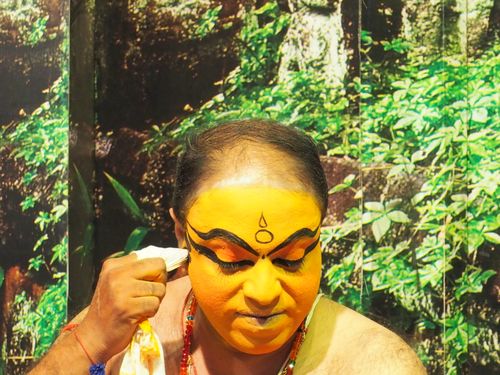
Kochi • Kathakali Makeup
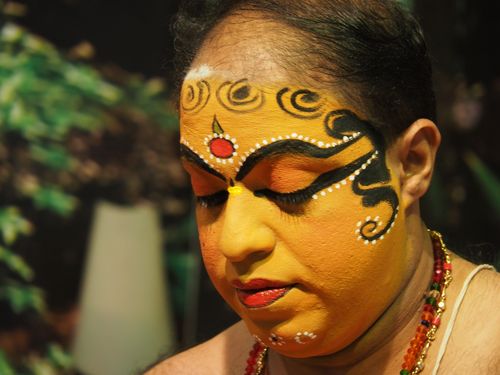
Kochi • Kathakali Makeup
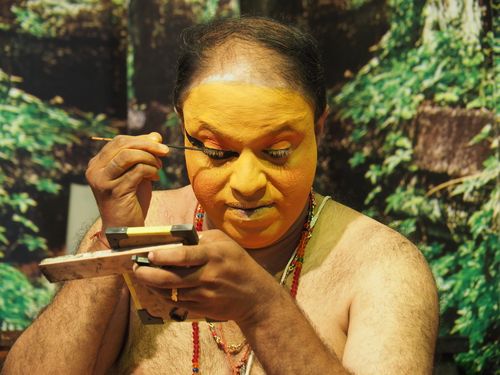
Kochi • Kathakali Makeup
Tradition profile
Kathakali Makeup
Tradition category: Makeup for Kathakali dance
Tradition family: Traditional dance
Tradition genre: Performing arts
Cultural heritage: Hindu
Geographic location: Kochi • Kerala • India
• Links to •
• List of videos about Kochi on this site •
Kochi • Kathakali, Dhobi Khana and Jewish Quarter • Kerala
History of the Kathakali Makeup Tradition in Kochi, India
Kathakali makeup is one of the most distinctive and recognizable aspects of Kerala’s classical dance-drama tradition. More than an artistic embellishment, it functions as a codified system of symbols, embedded in a historical context shaped by politics, religion, and society. Its history reveals how a ritualized practice evolved into a cultural emblem of Kerala and how it has endured through centuries of transformation, colonization, and globalization.
Political and Social Context of Emergence
The origins of Kathakali can be traced back to the late sixteenth and early seventeenth centuries, when the Kerala region was fragmented into competing principalities. These local courts used patronage of the arts to consolidate their prestige, affirm their authority, and reinforce their cultural legitimacy. Dance-drama offered a medium to embody religious values drawn from epics such as the Ramayana and the Mahabharata, while also asserting political influence.
The makeup tradition emerged within this setting as a crucial element of the performance. It allowed performers to transcend their personal identity, embodying gods, demons, and heroes through visual transformation. The codification of color and form provided an immediately legible system for audiences, ensuring that moral and religious lessons were communicated effectively.
Brahmin communities and upper-caste elites played a central role in structuring and transmitting this tradition. They oversaw its ritual significance and artistic standards, while royal patrons provided the resources for its development. Rivalries among regional rulers also stimulated innovation, as each court sought to distinguish its cultural output. The synthesis of older forms such as Koodiyattam (Sanskrit theatre) and Krishnattam (ritual drama dedicated to Krishna) also shaped the early evolution of Kathakali.
Major Historical Events Shaping the Tradition
Over the centuries, Kathakali makeup has been directly influenced by the broader historical shifts affecting Kerala. Dynastic changes altered the level of royal sponsorship, with some rulers expanding patronage and others limiting performances. During Portuguese and later British colonial rule, Western cultural imports challenged traditional forms, and local practices sometimes suffered marginalization.
Despite these pressures, the tradition survived, partly because of its strong roots in temple practices and community festivals. In the nineteenth and early twentieth centuries, Kathakali experienced a partial decline as new forms of entertainment gained popularity. However, the nationalist movement of the twentieth century revitalized it, promoting Kathakali as a symbol of regional and national identity. After India’s independence in 1947, formal institutions and academies were established to preserve, codify, and teach Kathakali, including the art of its elaborate makeup.
Global Context at the Time of Emergence
When Kathakali makeup emerged in the seventeenth century, other parts of the world were also witnessing the rise or codification of theatrical traditions characterized by strong visual symbolism. In Japan, Noh theatre and the emerging Kabuki used stylized makeup and costumes to convey character traits and moral categories. In China, Peking opera employed elaborate facial designs where each color and line symbolized a specific personality type. In Europe, the Baroque theatre developed grandiose scenography and costuming to magnify the power of church and monarchy.
These parallels underline a global tendency to invest performance traditions with visual systems that extend beyond entertainment, functioning instead as tools of cultural education and political expression.
Transformations of the Tradition
The Kathakali makeup tradition has undergone several phases of adaptation. Initially restricted to temple courtyards and royal courts, it gradually reached wider audiences. Performances that once lasted an entire night have often been condensed for contemporary viewers, including tourists. While this adaptation made the tradition more accessible, it raised concerns about preserving its authenticity.
Social transformations also altered the practice. Once dominated by specific castes, Kathakali training is now accessible to broader groups, reflecting shifts in caste relations and democratization of education. The introduction of synthetic materials and new pigments has sometimes replaced traditional natural preparations, streamlining the application process while raising debates about authenticity.
The broader cultural and economic changes of the twentieth and twenty-first centuries have forced Kathakali to redefine itself, balancing continuity with modern adaptation.
Role of the Tradition Today and Cultural Importance
Today, Kathakali makeup remains a defining feature of Kerala’s cultural identity. It is a centerpiece of religious festivals, community celebrations, and cultural showcases. For local communities, it symbolizes continuity with tradition and collective belonging. For India as a whole, it serves as a marker of regional diversity and a source of international cultural prestige.
Beyond Kerala, Kathakali performances have been presented worldwide, contributing to cultural diplomacy and enhancing India’s soft power. The visual impact of the makeup, combined with the rigor of performance, makes it one of the most recognizable traditions of Indian theatre.
Current State of Preservation and Modern Challenges
Despite its prominence, Kathakali makeup faces multiple challenges. Urbanization and globalization reduce the role of long, ritualized traditions in everyday life. The younger generation is sometimes reluctant to engage in years of demanding training required to master the art, particularly in a modern economy where alternative careers are more lucrative. Tourism provides financial support but risks transforming the tradition into a folkloric spectacle, detaching it from its ritual and educational roots.
Preservation efforts are underway at several levels. Cultural institutions in Kerala provide formal training and promote full-length performances. National cultural policies recognize Kathakali as a key component of India’s intangible heritage. Internationally, it has been cited as an example of performance heritage that could benefit from recognition under UNESCO’s frameworks, although it is not yet inscribed.
Festivals, academic research, and cultural diplomacy also contribute to its safeguarding. Nevertheless, maintaining the delicate balance between authenticity and adaptation remains a core challenge for the survival of the tradition.
Conclusion
The history of Kathakali makeup illustrates how a ritual and artistic practice can emerge from specific political and social conditions, adapt to centuries of upheaval, and remain relevant in modern contexts. From its royal and temple origins to its current role as a cultural emblem of Kerala, it embodies both resilience and transformation. Its survival depends on continued efforts to transmit its rigorous techniques, protect its symbolic codes, and adapt responsibly to the demands of contemporary society.
Characteristics of the Kathakali Makeup Tradition in Kochi, India
The makeup used in Kathakali performances is one of the most recognizable and defining features of Kerala’s classical dance-drama. Far from being a mere artistic decoration, it constitutes a complex system of codes, techniques, and meanings that has developed over centuries. It reflects the political and religious history of the region, embodies social values, and provides a visual language through which mythological narratives are made intelligible to audiences.
Origin and Context of Emergence
The Kathakali tradition took shape between the late sixteenth and early seventeenth centuries, when the political landscape of Kerala was marked by competing principalities. Local rulers sought to strengthen their legitimacy by sponsoring artistic forms that combined ritual and spectacle. In this context, makeup became an integral part of the performance, functioning as a tool to embody gods, demons, and heroes and to transmit values derived from Hindu epics such as the Ramayana and Mahabharata.
Initially, the function of the makeup went beyond aesthetics. It helped performers transcend their human identity and transform into archetypal figures, while allowing the audience to immediately distinguish moral qualities such as virtue, cruelty, or divinity. It was supported by elite groups, especially upper castes and temple institutions, who controlled the framework of its use. This support positioned the tradition as both a marker of cultural continuity and a medium for social education.
Constituent Elements and Practices
Kathakali makeup is highly codified and is applied through a precise ritual process. Colors and patterns correspond to distinct character types. Green indicates nobility and virtue, red is linked to aggression or violence, black is associated with demonic figures, and yellow or white often signify spiritual or feminine roles.
The preparation of makeup is a demanding task, often taking several hours before a performance. Traditionally, pigments were derived from natural sources such as rice paste, lime, or plant extracts, requiring both skill and patience. This process is complemented by elaborate costumes, heavy headdresses, and ornate jewelry.
Performances are structured through sequences that combine makeup, costume, music, and acting. Percussions and vocalists provide the musical foundation, while actors use codified gestures (mudras) and facial expressions (rasas) to convey narrative and emotion. Training begins in childhood and requires many years of discipline. Makeup artists, often trained within families or institutions, are responsible for transmitting this specialized craft across generations.
Symbolism and Meanings
Kathakali makeup is a language of symbols. Each color, line, and motif communicates information about the nature of the character portrayed. The design extends the actor’s facial expressions, amplifying emotional impact and transforming the stage into a space of mythic storytelling.
This system reflects religious and social values deeply embedded in Kerala’s culture. By presenting figures of gods, demons, or heroes in recognizable forms, the makeup reinforces collective understanding of moral categories and spiritual ideals. Combined with music and gesture, it provides a multi-sensory framework through which complex narratives are communicated without reliance on spoken dialogue.
Regional variants exist, introducing minor differences in the details of patterns and applications, but the overall codification remains remarkably consistent, ensuring the stability of the tradition.
Evolution and External Influences
Over time, the practice of Kathakali makeup has adapted to changing contexts. Initially reserved for temple courtyards and royal courts, it gradually expanded into community settings and public performances. During colonial rule, Western cultural forms challenged its prominence, but the tradition survived thanks to its strong roots in religious festivals and popular support.
The twentieth century brought further transformation. As nationalist movements emphasized indigenous cultural identity, Kathakali was promoted as a symbol of Kerala’s heritage. Institutions formalized training and standardized practices, ensuring its continuity. In contemporary times, tourism has shaped the way performances are staged, often shortening their length to suit modern audiences. Although this adaptation increases accessibility, it sometimes raises concerns about the preservation of authenticity.
Comparisons can be drawn with other global traditions. Japanese Kabuki and Noh theatre, as well as Chinese Peking opera, use makeup as a codified system of visual communication. European Baroque theatre, although different in religious and political orientation, also emphasized spectacle and costume as a reflection of social hierarchies. These parallels highlight the universality of symbolic makeup in theatre traditions across cultures.
Social Organization and Community Impact
Kathakali makeup plays a central role not only in artistic expression but also in structuring social relations. Historically, access to performance and training was closely tied to caste, with certain communities exercising authority over specific aspects of the art. Over time, this exclusivity has diminished, allowing broader participation and democratization of the practice.
Within the community, Kathakali performances remain integral to religious festivals and cultural gatherings. They serve as moments of collective identity, bringing together generations and reinforcing cultural belonging. Beyond local contexts, the makeup tradition also projects an image of Kerala as a region committed to preserving its heritage, contributing to both national pride and international recognition.
Statistics, Anecdotes, and Notable Accounts
Traditional Kathakali performances often lasted an entire night, involving dozens of participants including actors, musicians, and makeup artists. Even in shorter modern versions, the preparation of makeup alone can require three to four hours. This demanding process reflects the discipline and endurance required of performers.
Legends surrounding Kathakali recount stories of actors who mastered the ability to sustain complex facial expressions for extended periods, embodying the rigor of the art. Institutions in Kochi and Thrissur have been instrumental in preserving and transmitting this tradition, producing generations of acclaimed performers.
Recognition and Preservation Challenges
Kathakali makeup today enjoys recognition as a vital part of India’s intangible cultural heritage. It is supported by national and regional institutions, and cultural academies continue to train students in traditional methods. Internationally, it is regarded as a symbol of Indian theatre, though it is not yet formally inscribed on UNESCO’s lists.
The challenges to its preservation are significant. Urbanization and globalization reduce the time and space devoted to lengthy traditional practices. Younger generations are sometimes reluctant to invest in the years of training required, preferring modern careers. Tourism, while providing financial support, risks reducing Kathakali to a folkloric display.
Efforts to safeguard the tradition include cultural festivals, specialized schools, and outreach programs designed to engage youth and sustain interest. Balancing authenticity with adaptation remains the key to ensuring its long-term survival.
Conclusion
The characteristics of Kathakali makeup reflect a complex interplay between aesthetics, religion, and social organization. From its origins in princely courts and temple rituals to its role as a cultural emblem of Kerala today, it embodies both continuity and transformation. Its codified colors and forms continue to convey timeless moral and spiritual values, while adaptations respond to the realities of modern life. The survival of this tradition depends on ongoing preservation efforts, the dedication of practitioners, and the ability to transmit its meaning to future generations.
 Links to the main sections of the site