

 Français (France)
  Nederlands (nl-NL)
 00:00 • intro | 02:44 • A ceremony at the monastery | 06:37 • Statue of Maitreya Buddha
Personal creation from visual material collected during my trip Unknown India • Ladakh, Karnataka, Telangana (2022)
Map of places or practices in Thiksey on this site
• Use the markers to explore the content •
Thiksey Gompa: Monastic Architecture and Living Buddhist Heritage in Ladakh
A major monastery within a Himalayan landscape
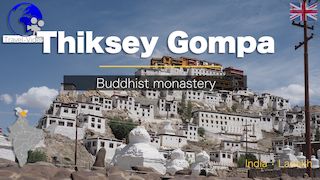
Overlooking the Indus Valley not far from Leh, Thiksey Gompa stands as one of the most significant monastic complexes in Ladakh. Built on a hill and arranged in ascending terraces, it creates a striking silhouette that dominates the surrounding agricultural plains and scattered settlements. This vertical organization is not only a response to the terrain but also an expression of spiritual hierarchy, where architecture reflects both function and symbolism.
The video reveals how the monastery is integrated into its environment, emphasizing the continuity between built forms and the high-altitude landscape. Through carefully composed views, it highlights the coherence of the site, where religious structures, circulation spaces, and ceremonial areas form a unified whole.
Ritual life and key features
At the heart of Thiksey lies an active monastic community whose daily life is structured by rituals and collective ceremonies. These moments, marked by chants, instruments, and codified gestures, give tangible form to Buddhist practice. The video conveys this dimension by focusing on interior spaces and the atmosphere of worship, offering insight into the lived reality of the monastery beyond its architectural presence.
One of the most prominent elements is the large statue of the Maitreya Buddha. Housed within a dedicated hall, this monumental figure represents the future Buddha and embodies key concepts of renewal and continuity within Buddhist thought. Its scale and detailed iconography contribute to both its devotional significance and its didactic role, guiding interpretation through visual symbolism.
Historical and architectural context
Founded in the fifteenth century and associated with the Gelugpa school of Tibetan Buddhism, Thiksey Gompa reflects a period of religious consolidation in Ladakh. Monasteries such as this played a central role not only in spiritual life but also in education, administration, and the organization of local communities.
The architecture demonstrates a refined adaptation to the constraints of altitude and climate. Thick earthen walls provide insulation against extreme temperature variations, while flat roofs and limited openings reduce exposure to harsh weather conditions. The stepped arrangement of buildings, with clearly differentiated zones, reflects both functional needs and institutional hierarchy.
Beyond its structural aspects, the monastery expresses a broader conception of sacred space. Orientation, spatial sequencing, and the presence of religious imagery all contribute to shaping the experience of both practitioners and visitors, reinforcing the connection between physical space and spiritual meaning.
A visual approach that enhances understanding
The videos presented on this site offer a particularly effective way to engage with such a complex environment. By relying largely on carefully selected and animated photographs, they allow for a sustained observation of architectural details, textures, and sculptural elements. This method avoids the fragmentation often associated with fast-moving footage and instead encourages a more attentive reading.
The gradual progression of images also clarifies spatial relationships within the monastery. It becomes easier to understand how different levels connect, how circulation paths are organized, and how the entire complex relates to the surrounding landscape. This structured visual approach enhances both comprehension and appreciation of the site.
A balance between monumentality and living tradition
Thiksey Gompa embodies a balance between architectural grandeur and ongoing religious practice. Its buildings are not static relics but part of a living institution that continues to shape the cultural identity of Ladakh.
Exploring the detailed pages dedicated to the monastery offers an opportunity to deepen this understanding, providing further insight into its history, structure, and enduring significance.
Links to related pages


Audio Commentary Transcript
Founded in the 15th century, the Thiksey Buddhist monastery is one of the largest and most impressive in Ladakh. In Ladakh, the monasteries are called 'Gompa'. This rich gompa is home to treasures of religious art, including a 15-meter-high statue of Maitreya Buddha (the future Buddha). The monastery is an important place of religious learning and meditation and plays a crucial role in preserving Buddhist culture and traditions in the region.
In Tibetan Buddhist monasteries, prayer or assembly rooms are called Dukang. This room is the largest and most ornate in the monastery. There are statues and images of Buddha and important gurus, thangkas (religious paintings on canvas depicting important scenes from Buddhism), wall frescoes, altars decorated with offerings, cabinets and shelves containing sacred texts or musical instruments, such as trumpets and cymbals used during ceremonies.
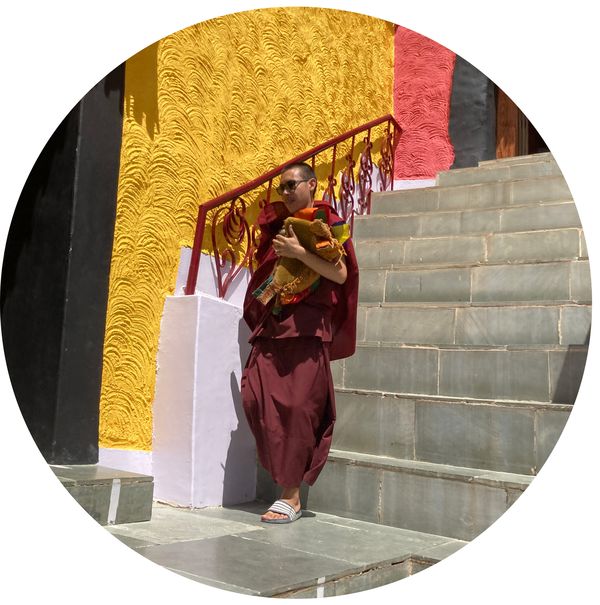
In Buddhism, it is not uncommon to see children, sometimes very young, in monasteries. It is a source of great pride for parents as well as an opportunity for them to receive a good education.
In the ceremonies, these children also play a role. They are in turn musicians and assistants, one of whose tasks may be to bring food and drink to the monks during the ceremonies. They can also participate in ceremonies and processions. All these ceremonial tasks are part of their education at the monastery.
The majestic statue of Maitreya Buddha at Thiksey Monastery, like the one located at Shey, is housed in a structure dedicated to him, extending vertically over two levels. These statues are so tall that their presence is shared between the floors: while the ground floor houses the trunk and legs of the statue, it is on the first floor that visitors can look up at the serene and the bust of the Buddha, creating an imposing and fragmented encounter experience, room by room, as one moves through the building.
Music:
- - - Live Thiksey Gompa 4


