Français (France)
  Nederlands (nl-NL)
 00:00 • intro | 00:33 • in front of and around the temple | 01:44 • the entrance to the temple courtyard | 02:34 • Shiva dancer and frescoes | 03:16 • in the temple courtyard
Personal creation from visual material collected during my trip India • South India • Tamil Nadu and Kerala (2018)
Map of places or practices in Chidambaram on this site
• Use the markers to explore the content •
Chidambaram, the Temple of Shiva as Cosmic Dancer
A major sacred centre of Tamil Nadu
Chidambaram is one of the most important religious cities of South India. Located in Tamil Nadu, it is renowned for the Thillai Nataraja Temple, a prestigious sanctuary dedicated to Shiva in his form as Nataraja, Lord of the Cosmic Dance. Few temples unite architecture, philosophy, ritual practice and artistic symbolism as powerfully as this one.
The site is not simply an ancient monument. It remains an active centre of worship where daily ceremonies, festivals and pilgrimage continue to shape the life of the town. For many devotees, Chidambaram represents a place where divine presence is linked to movement, rhythm and the hidden order of the universe.
This video explores the temple through its outer approaches, monumental entrances, sacred courtyards and visual references to Shiva as dancer.
Around the temple and its urban setting
The opening scenes show the surroundings of the sanctuary, dominated by its towering gateway structures known as gopurams. Rising above the streets, these gateways announce the sacred precinct long before one reaches it. Their sculpted surfaces, filled with deities and mythological imagery, transform the skyline into a theological statement.
As in many historic towns of Tamil Nadu, the temple and the city are closely connected. Streets, markets, pilgrim movement and local daily life continue to revolve around the sacred centre. Chidambaram therefore illustrates a traditional South Indian urban model in which religious architecture plays a central civic role.
The exterior views also help reveal the scale of the enclosure. Rather than a single building, the temple is a large ceremonial complex composed of successive spaces and multiple functions.
Entering the courtyards
The transition from outer streets to inner courtyards is one of the defining experiences of the site. South Indian temple architecture often uses a progressive spatial sequence: gateways lead to enclosures, halls, pillared spaces and increasingly sacred zones. Each threshold carries both architectural and symbolic meaning.
At Chidambaram, the courtyards provide openness within the monumental enclosure. They allow circulation, ritual gathering and visual pauses between built masses. Colonnades, subsidiary shrines and mandapas structure these open areas while preserving a sense of ordered movement.
Walking through such spaces reveals that the temple was designed not only for worship at a central shrine, but also for festivals, processions and the coordinated movement of large numbers of devotees.
Shiva as dancer and sacred imagery
One of Chidambaram’s greatest distinctions is its association with Nataraja, the dancing form of Shiva. This image expresses creation, destruction, cosmic rhythm and spiritual liberation through movement. It is among the most influential religious images in Indian art.
The sequences devoted to Shiva as dancer and to painted or sculpted imagery inside the complex highlight how sacred architecture functions as more than structure. Walls, halls and sanctuaries also serve as settings for mythological narratives, theological symbols and visual devotion.
Chidambaram is especially significant because dance itself is central to the identity of the shrine. The temple has long-standing associations with classical performing traditions of Tamil culture, particularly music and Bharatanatyam.
Historical and architectural background
The present temple reflects many centuries of development. The Chola dynasty played a major role in its expansion and prestige, while later contributions came under Pandya, Vijayanagara and Nayak patronage. This layered history explains the richness and variety visible today.
Architecturally, the complex belongs to the Dravidian tradition of South India, characterised by monumental gateways, axial layouts, enclosure walls and pillared halls. Yet Chidambaram possesses a distinctive theological identity linked to the worship of Nataraja and to concepts of sacred space associated with emptiness, presence and cosmic order.
Unlike many historic monuments preserved mainly as heritage sites, this temple remains fully active. Its continuing ritual use is essential to understanding both its architecture and atmosphere.
What the videos on this site make especially clear
A complex of this scale is difficult to understand through a single still image. Videos built from carefully selected and animated photographs allow viewers to follow the natural sequence of approach: from the streets to the gateways, from gateways to courtyards, and from courtyards toward the most sacred zones.
This method makes architectural relationships clearer. The height of towers, rhythm of columns, proportions of open courts and density of sculptural detail become easier to perceive through gradual visual progression.
It also captures an important theme of Chidambaram: movement. Pilgrims move through gateways, ceremonies move through the courtyards, and at the symbolic centre stands Shiva, whose dance gives rhythm to the cosmos.
A temple of enduring significance
Chidambaram brings together living worship, monumental architecture and profound symbolism in a rare and compelling way. It remains one of the great sacred sites of India and a key monument of Tamil culture. Visitors wishing to explore further can continue with the detailed page dedicated to the Thillai Nataraja Temple, where its history, art and structure are examined in greater depth.
Links to related pages
• Main dynasties that ruled the region • •









Audio Commentary Transcript
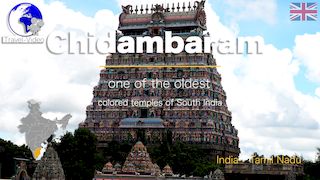
Chidambaram is a small town in Tamil Nadu in the south of India which has just under 70,000 inhabitants. The most important monument in the city is the Thillai Nataraja Temple. The current temple was built during the 10th century making it one of the oldest in South India. The Nataraja temple of Chidambaram is dedicated to Shiva, and in particular to Shiva dancer.

Music:
- - YouTube video library - Her Owl Ring
- - YouTube video library - Spying in the 60's
Disclaimer: Despite its appropriateness, copyright issues prevent the use of indian traditional music in "Chidambaram, dancing Shiva temple • Tamil Nadu,India", hence the use of royalty-free music. Despite our careful selection, some might regret this decision, which is necessary to avoid potential lawsuits. Although difficult, this decision is the only viable solution.