

 Français (France)
  Nederlands (nl-NL)
 00:00 • intro | 00:21 • various residences in the village | 02:23 • visit to the interior of one of these residences
Personal creation from visual material collected during my trip India • South India • Tamil Nadu and Kerala (2018)
Map of places or practices in Chettinad on this site
• Use the markers to explore the content •
Chettinad and the Grand Chettiar Mansions
A distinctive cultural landscape in Tamil Nadu
Chettinad is one of the most remarkable heritage regions of southern India. Located in Tamil Nadu, it is known for its impressive residential architecture created by the Nagarathar community, often called the Chettiars. Renowned as merchants, financiers and traders, they built extensive commercial networks across South and Southeast Asia during the nineteenth and early twentieth centuries. Their prosperity was expressed not through royal palaces, but through extraordinary private homes in their native towns and villages.
This video introduces that unique world. Streets lined with imposing facades lead to interiors of surprising scale and refinement. Chettinad is therefore more than a geographical region: it is a built record of economic success, family prestige and cultural continuity.
The sequences shown here focus on two essential aspects: the village streets where many mansions still stand, and the interior visit of one of these residences, where the true richness of the architecture becomes visible.
Mansion streets and village identity
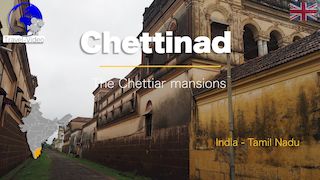
The exterior views reveal a settlement pattern unlike that of most rural regions. Instead of modest houses, many streets are lined with large mansions featuring monumental entrances, decorated pediments, columns and carefully proportioned facades. Some details reflect local Tamil traditions, while others show European or colonial influences adapted to Indian conditions.
These houses were designed to impress, but also to organise family life on a large scale. Many extend deep behind the street front, occupying substantial plots. From outside, only a fraction of the property can be seen. This gives Chettinad villages a distinctive rhythm: formal public fronts concealing complex domestic worlds.
The repetition of such residences across several towns creates an unusual urban landscape where domestic architecture becomes the principal heritage feature.
Inside a Chettiar residence
The interior visit reveals why these houses are so highly regarded. Most are organised around a sequence of courtyards, reception halls, galleries, private rooms and service areas. Natural light enters through open courts, while long axial views connect one zone to another. Ventilation and shade were carefully considered, allowing comfort in the hot climate.
Materials often came from far beyond India. Burmese teak, European ceramic tiles, marble, Belgian glass, cast-iron elements and imported decorative fittings can all appear in Chettinad houses. These materials were integrated into a local architectural language rather than simply copied from abroad.
Polished columns, carved woodwork, painted ceilings and patterned floors demonstrate the attention given to craftsmanship. Such residences were intended not only for everyday life, but also for weddings, festivals, business hospitality and major family gatherings.
Historical and cultural background
The great age of Chettinad architecture corresponds largely to the colonial period, when trade and finance expanded across the Bay of Bengal. Nagarathar entrepreneurs established themselves in Burma, Ceylon, Malaya and Singapore, among other places. Wealth earned overseas was frequently invested back home through temples, philanthropy and above all domestic architecture.
Building a mansion carried several meanings. It signalled prosperity, reinforced family status and maintained links with ancestral villages even when business activity took place abroad. The house functioned as a social centre for an extended family network and as a visible statement of permanence.
During the twentieth century, changing economic conditions, migration, new lifestyles and the high cost of maintenance altered this model. Some houses declined or were partially abandoned. Others have been restored, converted into heritage stays or adapted for new uses. Today they remain central to the identity of the region.
What the videos on this site make especially clear
Chettinad mansions are ideal subjects for videos built from carefully selected and animated photographs. These buildings are difficult to understand through a single static image because their value lies in progression from one space to another.
Slow transitions can reveal the depth of corridors, the sequence of courtyards, the changing scale of rooms and the contrast between shadowed interiors and bright open courts. Architectural details that might be missed during a quick visit become easier to observe when presented in close succession.
This visual method also clarifies one of Chettinad’s defining characteristics: restrained or formal street facades opening onto unexpectedly rich and expansive interiors. The viewer gradually understands how public appearance and private splendour were intentionally balanced.
A rare residential heritage
Chettinad occupies a special place in India’s architectural history. Here, monumental domestic buildings rather than royal monuments dominate the heritage landscape. They tell the story of a trading community connected to the wider world while remaining deeply rooted in Tamil society. For visitors wishing to explore further, the detailed pages linked to these Chettiar mansions offer additional insight into their architecture, history and cultural significance.
Links to related pages
• Main dynasties that ruled the region • •





Audio Commentary Transcript
The history of the Chettiars is very old. Traveling traders for millennia, members of the Nagarathar tribe have grown rich over the centuries and had magnificent palaces built in the 19th century, mixing Indian and Western architecture in the villages of the Chettinad region in southern Tami Nadu where they settled.
More information is available on the travel-video website (see link in comments).

Music:
- - Suresh Prajapati (Inde) - Indian Classical Instrumental - Flute Tabla Raga 1, Suresh Prajapati
- - YouTube video library - Keith
Disclaimer: Despite its appropriateness, copyright issues prevent the use of indian traditional music in "Chettinad, the Chettiar mansions • Tamil Nadu, India", hence the use of royalty-free music. Despite our careful selection, some might regret this decision, which is necessary to avoid potential lawsuits. Although difficult, this decision is the only viable solution.


