Français (France)
  Nederlands (nl-NL)
 Of Hindu tradition, (with additional Buddhist influence), the Vakataka dynasty ruled for approximately 250 years, ± between 250 and 500 over all or part of Central India and West India, during the Ancient Period.
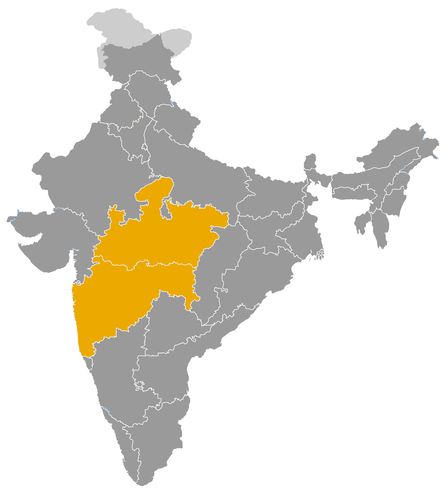
This map illustrates the maximum territory that the Vakataka Dynasty had reached at its height, covering the current regions of Madhya Pradesh and Maharashtra in India. Its main purpose is to provide a visual aid to understand the geographical extent of this dynasty. However, it's important to note that the contemporary borders of these regions may not necessarily coincide with the historical territories.
The Vakataka dynasty and its role in the history of ancient India
A central Deccan power after the Satavahanas
The Vakataka dynasty played a major role in the political and cultural history of ancient India between the third and early sixth centuries. Its main centres lay in the central Deccan and Vidarbha, especially in regions corresponding to parts of present day Maharashtra, Madhya Pradesh, Telangana and the interior Deccan. The dynasty emerged after the decline of the Satavahanas, when the Deccan was divided among several regional powers seeking to control land, routes and political legitimacy.
The Vakatakas were important because they linked northern India with the Deccan. They were not simply a local dynasty ruling an isolated region. Through alliances, marriage connections, political expansion and cultural patronage, they became one of the principal powers of post Satavahana India. Their history also overlaps with the classical age of the Gupta Empire, with which they maintained close and influential relations.
The formation of a regional kingdom in the central Deccan
The traditional founder of the dynasty was Vindhyashakti, who established the first Vakataka power in the central Deccan. His successor, Pravarasena I, greatly expanded the kingdom and gave the dynasty a wider political stature. He appears to have controlled a substantial part of the Deccan and is often regarded as the most powerful ruler of the early Vakataka line.
After Pravarasena I, the dynasty divided into several branches. The two best documented were the Pravarapura Nandivardhana branch, centred in Vidarbha, and the Vatsagulma branch, located further south west. This division did not immediately destroy Vakataka power. Instead, it allowed different branches of the family to dominate several parts of the Deccan at the same time.
The branch of Pravarapura Nandivardhana became especially significant because of its connection with the Gupta Empire. Rudrasena II married Prabhavatigupta, daughter of the Gupta emperor Chandragupta II. After Rudrasena’s death, Prabhavatigupta acted as regent for her minor sons, creating a period of strong Gupta influence at the Vakataka court.
A political bridge between the Gupta north and the Deccan
The Vakatakas occupied a strategic position between the Gangetic world of northern India and the Deccan plateau. This geography gave them a major role in the political balance of ancient India. They could cooperate with the Guptas while maintaining their own regional authority.
The marriage alliance between the Guptas and the Vakatakas was one of the most important political links of the period. It helped stabilise relations between northern and central India and gave the Vakatakas enhanced prestige. For the Guptas, the alliance provided a reliable partner in the Deccan. For the Vakatakas, it strengthened dynastic legitimacy and connected them with one of the most powerful imperial houses of ancient India.
The Vakatakas also interacted with other Deccan powers, local chiefs and regional lineages. Their influence was not always based on direct rule alone. It could also depend on land grants, alliances, religious patronage and the authority of local elites.
Agrarian resources and the economy of royal donations
The economic foundation of Vakataka power was agrarian. Their inscriptions show the importance of land grants to Brahmins, religious institutions and officials. These donations were not merely acts of piety. They were also political instruments that helped integrate local society into the royal order.
Control of villages, fields, irrigation resources and rural revenues allowed the dynasty to support courts, military structures and religious establishments. The Vidarbha and central Deccan regions offered agricultural resources sufficient to sustain regional kingdoms, although the economy remained closely tied to local elites and landed networks.
The Vakataka period also benefited from inland routes connecting northern India, the western Deccan, the eastern regions and the south. These routes allowed the circulation of goods, officials, religious specialists and artistic traditions. The dynasty therefore contributed to the economic and cultural integration of central India.
Religious plurality and the cultural world of the Vakatakas
The Vakatakas are often associated with Brahmanical royal culture. They supported Brahmins, used Sanskrit in political and cultural expression, and participated in the wider classical culture shared with the Gupta world. This Sanskritic environment contributed to the development of elite literary and administrative traditions in the Deccan.
At the same time, Vakataka society was religiously plural. Buddhist institutions continued to flourish, and this plurality is most visible at Ajanta. The major artistic phase of the Ajanta Caves is closely connected with the Vatsagulma branch, especially the reign of Harishena and the patronage of his ministers and aristocratic supporters.
The paintings, sculptures and monastic complexes of Ajanta represent one of the great achievements of ancient Indian art. They show the refinement of courtly culture, the vitality of Buddhist patronage and the circulation of artistic models across the Deccan. The Vakataka cultural impact therefore extended beyond royal inscriptions and political authority.
Ajanta and the prestige of Vakataka patronage
The association with Ajanta is central to the long term importance of the dynasty. The caves were not built by kings alone, but by a network of patrons connected with the Vakataka court. Ministers, local elites and religious donors participated in the creation of a complex artistic environment.
This patronage reflects the political sophistication of the period. Art, religion and royal authority were closely connected. By supporting or enabling major religious foundations, the Vakataka elite displayed wealth, legitimacy and cultural prestige. Ajanta also shows how a Deccan court could participate in the broader artistic world of ancient India while developing local forms of expression.
A lasting legacy in the history of India
The Vakataka dynasty declined in the early sixth century, after the weakening of its major branches and the disappearance of strong rulers such as Harishena. Its territories were eventually absorbed or replaced by new powers in the Deccan, including dynasties that would shape the early medieval period.
Its historical significance remained substantial. The Vakatakas continued the political legacy of the post Satavahana Deccan, created close links with the Gupta world, supported the spread of Sanskritic culture, and helped produce one of the finest artistic achievements of ancient India at Ajanta. Their role in Indian history lies in this combination of political mediation, regional state formation, agrarian economy and cultural patronage.
The Geographic Expansion of the Vakataka Dynasty in India
A Deccan Power Rooted in Vidarbha
The Vakataka dynasty was one of the most important ruling houses of early historic and early medieval India, governing large parts of the Deccan between the third and fifth centuries CE. Its original power base lay in Vidarbha, a region corresponding broadly to eastern Maharashtra, with important extensions into parts of Madhya Pradesh, Telangana, Andhra Pradesh and possibly Chhattisgarh. From this central position, the Vakatakas became a major political force between northern India and the southern Deccan.
Their rise followed the decline of the Satavahanas, whose former territories had fragmented into several regional powers. The Vakatakas benefited from this political vacuum and gradually established control over strategic inland routes, fertile river valleys and zones of cultural exchange. Their expansion was not a single continuous conquest, but a gradual process shaped by military campaigns, dynastic marriages, administrative consolidation and the formation of regional branches.
Expansion from Vidarbha toward Central India
The earliest Vakataka rulers appear to have consolidated their authority in Vidarbha, an area strategically placed between the northern Deccan and the Narmada valley. Pravarasena I, one of the most prominent early rulers, greatly enlarged the kingdom and assumed imperial titles, suggesting that the dynasty had achieved a level of power beyond a purely regional monarchy.
Under his rule, Vakataka authority likely extended northward into parts of present day Madhya Pradesh. This expansion placed the dynasty in contact with the political world of central India and brought it closer to the sphere of the Guptas, who were emerging as the dominant power in northern India. Control over central Indian corridors was especially important because these regions connected the Gangetic plain with the Deccan plateau.
The Vakataka presence in this zone helped them act as an intermediary between northern and southern India. It also made their kingdom a valuable ally or rival for other dynasties seeking influence across the subcontinent.
Division into Branches and Regional Control
After Pravarasena I, the dynasty appears to have divided into branches, the most important being the Nandivardhana or Pravarapura branch and the Vatsagulma branch. This division did not necessarily indicate immediate weakness. Rather, it reflected the complexity of governing a wide and diverse territory.
The Nandivardhana branch ruled from the northern part of Vidarbha, with capitals associated with Nandivardhana and later Pravarapura. This branch controlled the core territories of the dynasty and maintained close relations with the Gupta Empire. Its lands were strategically positioned near the routes leading toward Malwa, the upper Narmada basin and the northern Deccan.
The Vatsagulma branch, based in the region of present day Washim in Maharashtra, controlled areas farther south and west. This branch helped extend Vakataka influence toward the Godavari basin and the western Deccan. Its position placed it in contact with regional powers of the Deccan and with trade routes leading toward the western coast.
Together, these branches gave the Vakatakas influence across a broad arc of the Deccan, although the exact boundaries of their authority changed over time.
Influence over the Godavari and Deccan Interior
The Vakatakas were especially important in the interior Deccan. Their control over parts of the Godavari basin allowed them to dominate agricultural zones and overland communication routes. These areas linked Vidarbha with the Deccan plateau and with regions farther south.
Their influence likely reached into parts of present day Telangana and Andhra Pradesh, although the degree of direct control varied. In some areas, Vakataka authority may have been exercised through feudatories, subordinate chiefs or allied local elites rather than direct administration from the royal capital. This pattern was common in early Indian kingdoms, where political influence often depended on layered authority rather than fixed territorial borders.
The dynasty’s expansion into the Deccan interior also brought it into contact with powers such as the early Kadambas, the Vishnukundins and other regional lineages. These contacts could involve rivalry, diplomacy or shifting alliances depending on the political situation.
Relations with the Gupta Empire
One of the most significant consequences of Vakataka expansion was their relationship with the Gupta Empire. The Vakatakas and Guptas controlled adjoining zones of influence, with the Guptas dominant in northern India and the Vakatakas powerful in the Deccan and central India.
The relationship between the two dynasties was strengthened by marriage. Prabhavatigupta, daughter of the Gupta emperor Chandragupta II, married the Vakataka ruler Rudrasena II. After his death, she acted as regent for her sons and maintained strong Gupta cultural and political connections. This alliance helped stabilize the northern frontier of the Vakataka realm and gave the Guptas a friendly power in the Deccan.
The alliance was mutually useful. For the Guptas, the Vakatakas provided access to Deccan politics without requiring direct conquest. For the Vakatakas, Gupta connections enhanced royal prestige and reinforced their legitimacy. This relationship also encouraged cultural exchange, especially in religion, Sanskrit literary culture and administrative models.
Competition and Diplomacy with Deccan Dynasties
The Vakatakas’ southern and western expansion shaped their relations with other Deccan powers. The Vatsagulma branch, in particular, occupied a position that brought it into the political orbit of western and southern India. This placed the dynasty near the territories of the Kadambas of Banavasi, who were rising in Karnataka, and other regional powers competing for control of the plateau.
The Vakatakas had to manage these relationships carefully. Military rivalry was likely in frontier zones, especially where influence over trade routes, fertile lands and subordinate chiefs was at stake. At the same time, diplomacy and marriage alliances were important tools for maintaining stability. The Deccan was not a single unified political space, but a mosaic of kingdoms whose borders were often fluid.
The Vakatakas’ ability to maintain influence across this region shows the strength of their political organization, but also the limits of their power. Their expansion created opportunities for wealth and prestige, yet it also exposed them to pressure from multiple directions.
Territorial Reach and Historical Legacy
At their height, the Vakatakas controlled a major portion of the central Deccan, with Vidarbha as their core and influence extending into central India, the Godavari region and parts of the western Deccan. Their territory was not always continuous in the modern sense, but it formed a powerful political network linking northern and southern India.
This geographic position explains much of their historical importance. They served as a bridge between the Gupta north and the Deccan south, influenced regional politics after the Satavahanas, and contributed to the cultural development of central India. Their patronage is especially associated with the artistic and religious environment that helped produce some of the later phases of the Ajanta caves.
The Vakataka dynasty’s expansion was therefore not only territorial. It reshaped diplomatic relations, strengthened cultural exchanges and helped define the political geography of early medieval India.
The Vakataka dynasty ruled mainly in the central Deccan and Vidarbha between the third and early sixth centuries. After Pravarasena I, the dynasty split into several branches, of which two are well documented: the Pravarapura-Nandivardhana branch and the Vatsagulma branch. The early dates are approximate, and the two branches ruled partly in parallel.
Early rulers before the dynastic division
- Vindhyashakti (c. 250–270) • Traditional founder of the dynasty, he established the first Vakataka power in the central Deccan.
- Pravarasena I (c. 270–330) • He transformed the dynasty into a major regional power and appears to have extended his authority over a large part of the Deccan.
Pravarapura-Nandivardhana branch
- Rudrasena I (c. 330–355) • Grandson of Pravarasena I, he ruled the main branch from Nandivardhana.
- Prithivishena I (c. 355–380) • He consolidated the authority of the main branch in Vidarbha and neighbouring regions.
- Rudrasena II (c. 380–385) • He married Prabhavatigupta, a Gupta princess, strengthening political links with the Gupta Empire.
- Prabhavatigupta (c. 385–405, regency) • Widow of Rudrasena II, she acted as regent for her minor sons and strengthened Gupta influence at the Vakataka court.
- Divakarasena (c. 385–400, nominal rule under regency) • Son of Rudrasena II, he was heir under Prabhavatigupta’s regency but died before exercising full authority.
- Pravarasena II (c. 400–440) • Also known as Damodarasena, he founded or developed Pravarapura and was an important literary ruler and donor.
- Narendrasena (c. 440–460) • He maintained the authority of the main branch during a period of tension with neighbouring powers.
- Prithivishena II (c. 460–480) • The last known ruler of this branch, he ruled before the weakening or absorption of his kingdom.
Vatsagulma branch
- Sarvasena (c. 330–355) • Son of Pravarasena I, he founded the Vatsagulma branch and was associated with a Prakrit literary tradition.
- Vindhyasena (c. 355–400) • Also called Vindhyashakti II, he strengthened the Vatsagulma kingdom and campaigned against southern neighbours.
- Pravarasena II of Vatsagulma (c. 400–415) • He ruled briefly and is known mainly from traditions linked to the Ajanta inscriptions.
- Unnamed ruler (c. 415–450) • A minor son of Pravarasena II of Vatsagulma, he appears to have ruled during a poorly documented period.
- Devasena (c. 450–475) • He ruled with the support of his minister Hastibhoja and preceded the great artistic phase of Ajanta.
- Harishena (c. 475–500) • The last great Vakataka ruler, he patronised the Ajanta Caves and greatly expanded the influence of the Vatsagulma branch.
 Links to the main sections of the site