Français (France)
  Nederlands (nl-NL)
 Of Hindu tradition, (with additional Jain influence), the Tuluva dynasty ruled for approximately 65 years, ± between 1505 and 1570 over all or part of East India, South India and West India, during the Medieval Period.
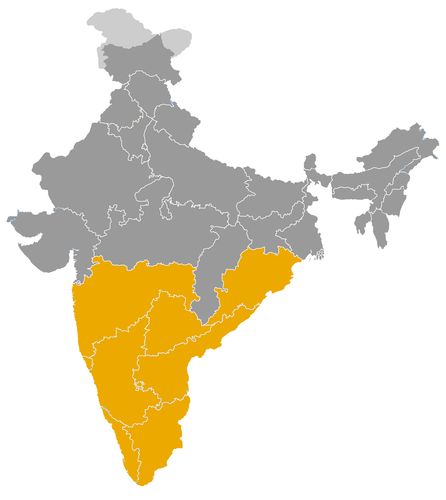
This map illustrates the maximum territory that the Tuluva Dynasty had reached at its height, covering the current regions of Andhra Pradesh, Goa, Karnataka, Kerala, Maharashtra, Odisha, Tamil Nadu and Telangana in India. Its main purpose is to provide a visual aid to understand the geographical extent of this dynasty. However, it's important to note that the contemporary borders of these regions may not necessarily coincide with the historical territories.
The Tuluva Dynasty and the Zenith of the Vijayanagara Empire
A ruling house at the centre of South Indian power
The Tuluva dynasty occupies a central position in the history of medieval India because it corresponds to one of the most powerful and visible phases of the Vijayanagara Empire. It ruled from about 1505 to 1570, after the transitional Saluva period and before the Aravidu dynasty. Its importance lies in the restoration of imperial authority, the expansion of military power, the prosperity of commercial networks and the exceptional cultural development associated above all with the reign of Krishnadevaraya.
The name Tuluva refers to a regional background connected with the Tulu-speaking coastal area of south-western India, within the wider cultural sphere of coastal Karnataka. Before the dynasty formally came to power, Tuluva Narasa Nayaka had already become a dominant political figure as general and regent. His son Vira Narasimha Raya became the first crowned ruler of the Tuluva dynasty in 1505. The dynasty reached its highest point under Krishnadevaraya, who ruled from 1509 to 1529.
The reconsolidation of imperial authority after political instability
The rise of the Tuluvas followed a period of weakness in the Vijayanagara state. In the late Sangama and Saluva periods, the empire had preserved much of its territorial framework, but central authority had been weakened by succession disputes, regional autonomy and pressure from neighbouring powers. The Tuluvas restored a stronger imperial structure and reasserted the authority of the capital over many provinces.
The political system still depended on military governors, local chiefs and regional elites, but under the stronger Tuluva rulers these intermediaries were more effectively integrated into the imperial order. The ruler controlled major campaigns, fiscal resources, diplomatic decisions and symbolic kingship. This renewed cohesion allowed Vijayanagara to project power across Karnataka, Andhra, the Tamil regions and the southern Deccan.
Krishnadevaraya and the political height of Vijayanagara
The reign of Krishnadevaraya is generally regarded as the high point of the Vijayanagara Empire. He led successful campaigns against several neighbouring powers, including the Deccan sultanates and the Gajapati rulers of Odisha. These victories strengthened imperial control over strategic regions, especially in Karnataka, Andhra and the contested zones near the Krishna and Tungabhadra rivers.
The military strength of the Tuluva state rested on a large army, fortified centres, war elephants, cavalry and a network of commanders. The import of horses from Arabia and Persia remained essential, making control of coastal trade routes strategically important. Krishnadevaraya’s victories were not only military achievements. They also reinforced royal prestige, secured agricultural lands, protected commercial routes and confirmed Vijayanagara’s position as the dominant power in much of South India.
A major centre of literary and artistic patronage
The Tuluva dynasty played an exceptional cultural role. Krishnadevaraya was both a ruler and a literary patron, and his court became one of the most celebrated cultural centres of South India. Telugu literature flourished especially strongly during his reign, although Kannada, Tamil and Sanskrit also remained important in courtly, religious and scholarly contexts.
This cultural vitality reflected the multilingual and multi-regional character of the empire. Poets, scholars, administrators, artists and religious figures moved through the imperial court and temple networks. Royal patronage helped to connect political authority with literary prestige, religious merit and artistic production. The Tuluva period therefore represents one of the great cultural phases of the Vijayanagara world.
Monumental architecture and the imperial landscape of Hampi
The architectural legacy of the Tuluva dynasty is particularly visible at Hampi, the former capital of Vijayanagara. Several major monuments or important building phases are associated with this period. The Vittala temple complex, the stone chariot, additions to the Virupaksha temple, the Mahanavami Dibba and parts of the royal enclosure are among the elements commonly linked to the mature Vijayanagara style.
These monuments were not isolated works of architecture. They formed part of a wider imperial landscape in which temples, processional routes, markets, ceremonial platforms, water systems and royal spaces were closely connected. Architecture expressed royal legitimacy, ritual order and economic power. Temples functioned not only as religious centres, but also as landholding institutions, employers of artisans and organisers of festivals and redistribution.
Economic strength through agriculture, trade and taxation
The Tuluva dynasty inherited and strengthened the economic foundations of Vijayanagara. Agriculture remained essential, supported by reservoirs, canals and irrigation works. Agricultural surplus sustained the capital, temples, armies and administrative institutions. The state drew revenue from land, trade, tribute and regional production.
Commerce was equally important. Inland routes linked Karnataka with Andhra, Tamil regions and the coasts. Maritime connections brought horses, luxury goods and commercial opportunities through the Arabian Sea and the Bay of Bengal. Textiles, spices, metals, precious stones and agricultural goods circulated through imperial markets. This economic strength helped finance military campaigns, temple patronage and the monumental development of Hampi.
The road from imperial splendour to the crisis of Talikota
After Krishnadevaraya, the dynasty remained powerful under Achyuta Deva Raya, but internal tensions gradually increased. During the reign of Sadasiva Raya, royal authority became largely nominal, while Aliya Rama Raya exercised effective political power. This situation revealed the fragility of the imperial system when court politics, military leadership and regional loyalties became difficult to balance.
The Battle of Talikota in 1565 marked a decisive turning point. Vijayanagara was defeated by a coalition of Deccan sultanates, and the capital was devastated. The empire did not disappear immediately, but the symbolic and political dominance associated with the Tuluva age was broken. The Tuluva dynasty therefore holds a dual place in Indian history: it represents the zenith of Vijayanagara’s political, cultural, economic and architectural power, but also the period immediately preceding the empire’s decisive decline.
The Geographical Expansion of the Tuluva Dynasty in South India
A restored imperial power after a period of instability
The Tuluva dynasty ruled the Vijayanagara Empire from about 1505 to 1570. Its geographical expansion corresponds to one of the strongest phases in the history of the empire, especially during the reign of Krishnadevaraya from 1509 to 1529. After the political tensions of the late Sangama period and the transitional Saluva rule, the Tuluvas restored imperial authority and reasserted Vijayanagara’s control over much of South India.
The territory of the Tuluva dynasty should not be understood as a uniformly administered state with fixed modern borders. Vijayanagara combined direct rule, military domination, tributary relations, regional alliances and authority exercised through governors and local chiefs. Even so, at its height the Tuluva state controlled or influenced large parts of present-day Karnataka, Andhra Pradesh, southern Telangana, Tamil Nadu, Goa, parts of Kerala and the southern margins of Maharashtra.
Karnataka as the political and symbolic heartland
Karnataka remained the core of Tuluva power. The capital, Vijayanagara, now identified with Hampi, was the centre of royal authority, ceremonial life, administration, trade and monumental architecture. The royal enclosure, major temples, markets, fortifications, water systems and processional routes made the city one of the most important urban centres of medieval South India.
The regions around Hampi, Anegundi, Hospet, Ballari and Raichur were strategically essential. They connected the capital with the northern Deccan, the eastern territories and the routes toward the western coast. Control over this heartland allowed the Tuluvas to mobilise troops, collect revenue, support temple institutions and maintain the military infrastructure required for expansion.
Andhra and the eastern campaigns of Krishnadevaraya
The Andhra region was central to the geographical reach of the Tuluva dynasty. Rayalaseema, inland Andhra and parts of the coastal region were either directly controlled, militarily contested or integrated into the wider imperial structure. Centres such as Chandragiri, Tirupati, Chittoor, Nellore, Udayagiri, Kondavidu, Rajahmundry and Vengi were important in the eastern policy of Vijayanagara.
Krishnadevaraya’s campaigns against the Gajapati rulers of Odisha strengthened Vijayanagara’s position in the Telugu-speaking regions. These victories were not only territorial achievements. They secured fortresses, agricultural zones, river valleys and routes toward the Bay of Bengal. They also increased the role of Telugu elites within the imperial court and helped make Telugu literature especially prominent during the Tuluva period.
Southern Telangana and the contested Deccan frontier
The northern and north-eastern frontier of the Tuluva state was shaped by rivalry with the Deccan sultanates. Southern Telangana and the areas around the Krishna and Tungabhadra rivers formed a frontier zone where military control was frequently contested. The Raichur Doab, located between these two rivers, was one of the most important disputed territories.
This region was valuable because of its fertile land, fortified towns and strategic position between Vijayanagara and the sultanates of the Deccan. Krishnadevaraya achieved notable successes there, particularly against Bijapur. However, the frontier remained unstable. Relations with the Deccan sultanates included warfare, diplomacy, temporary alliances, trade and the movement of soldiers and specialists. The expansion of the Tuluvas therefore intensified both contact and conflict with northern neighbours.
Tamil regions and the authority of imperial governors
To the south, the Tuluva dynasty maintained Vijayanagara influence over large parts of the Tamil country. Centres such as Kanchipuram, Srirangam, Gingee, Madurai and Thanjavur belonged, in varying degrees, to the imperial sphere. These regions were valuable for their agriculture, temples, trade routes and older traditions of royal authority.
The Tuluvas often ruled these territories indirectly through governors, military commanders and local elites. This system allowed the empire to control distant regions without imposing direct administration everywhere. It also created the conditions for later regional autonomy. After the weakening of Vijayanagara, the Nayakas of Madurai, Thanjavur and Gingee emerged as powerful successor states, partly shaped by the administrative and military structures inherited from the imperial period.
Coastal regions and control of commercial routes
The Tuluva dynasty’s geographical strength depended heavily on access to the coasts. On the western side, the Kanara coast, Goa and parts of the Malabar region connected Vijayanagara with the Arabian Sea and the wider Indian Ocean trade. The import of horses from Arabia and Persia was essential for the cavalry, making coastal trade a matter of military strategy.
On the eastern side, the Andhra coast opened routes toward the Bay of Bengal. Textiles, spices, precious stones, metals, agricultural goods and luxury items circulated through these networks. Foreign merchants, including Portuguese traders, became increasingly important in the early sixteenth century. Coastal access strengthened the fiscal resources of the empire and helped support military campaigns, temple patronage and monumental building at Hampi.
Territorial expansion and relations with neighbouring powers
The geographical expansion of the Tuluva dynasty shaped its relations with surrounding states. To the north, competition with the Deccan sultanates centred on the Raichur Doab and other frontier zones. To the east, conflict with the Gajapati rulers focused on control of Andhra and access to the eastern coast. To the south, the integration of Tamil regions required cooperation with local elites and temple institutions.
These relationships were not purely military. Border zones were also spaces of trade, diplomacy, cultural exchange and technical transfer. Vijayanagara interacted with its neighbours through war, negotiation, marriage alliances, mercenary service and commerce. The Tuluva period therefore shows both the power and the complexity of imperial expansion in medieval South India.
A maximum territorial reach before imperial decline
At its height, the Tuluva dynasty controlled or influenced one of the widest territorial spheres in Vijayanagara history. Its authority extended over the central heartland of Karnataka, much of Andhra, southern Telangana, major Tamil regions and strategic coastal zones. This expansion made Vijayanagara one of the dominant powers of the Indian peninsula.
The system, however, depended on strong central leadership and loyal regional commanders. After Krishnadevaraya, internal tensions increased. Under Sadasiva Raya, real power passed largely to Aliya Rama Raya. The defeat at Talikota in 1565 broke the political and symbolic dominance of the Tuluva period. The dynasty thus represents both the greatest geographical strength of Vijayanagara and the phase immediately preceding its decisive decline.
The Tuluva rulers governed the Vijayanagara Empire during its period of greatest power, but some phases must be distinguished between effective rule, nominal kingship and de facto political authority. The rulers generally bore the title raya or maharaya; the designation of emperors is used here for the imperial framework of Vijayanagara. The reign dates are indicative and may vary according to historical chronologies. Tuluva Narasa Nayaka exercised real power as regent before the formal rise of the dynasty.
- Vira Narasimha Raya (1505–1509) • The first crowned ruler of the Tuluva dynasty, he consolidated his family’s seizure of power after the Saluva period.
- Krishnadevaraya (1509–1529) • He brought the Vijayanagara Empire to its political, military, economic and cultural height.
- Achyuta Deva Raya (1529–1542) • He maintained imperial power, despite growing tensions at court and in the provinces.
- Venkata I (1542) • His reign was very brief and belonged to a troubled succession after the death of Achyuta Deva Raya.
- Sadasiva Raya (1542–1570, nominal reign) • He retained the imperial title, but effective power was exercised mainly by Aliya Rama Raya.
- Aliya Rama Raya (1542–1565, de facto power) • The dominant political leader of the empire, he was killed at the Battle of Talikota, which marked the decisive decline of Vijayanagara.
 Links to the main sections of the site