Français (France)
  Nederlands (nl-NL)
 Of Hindu tradition, the Bundela dynasty ruled for approximately 447 years, ± between 1501 and 1948 over all or part of Central India and North India, during the Medieval Period and the Colonial Period.
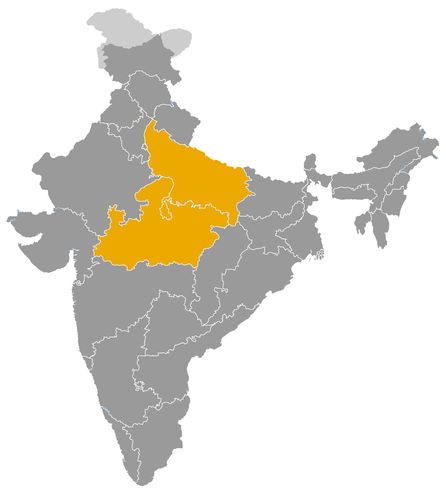
This map illustrates the maximum territory that the Bundela Dynasty had reached at its height, covering the current regions of Madhya Pradesh and Uttar Pradesh in India. Its main purpose is to provide a visual aid to understand the geographical extent of this dynasty. However, it's important to note that the contemporary borders of these regions may not necessarily coincide with the historical territories.
The Bundela Dynasty and the Regional Formation of Power in Central India
A Rajput house rooted in Bundelkhand
The Bundela dynasty was a Rajput ruling house associated with Bundelkhand, a historical region lying across parts of present day Madhya Pradesh and Uttar Pradesh. Unlike the great imperial dynasties of India, the Bundelas did not create a pan Indian empire. Their importance lay instead in the formation of a durable regional power, centred first on Orchha and later extended through related princely branches such as Datia, Panna, Ajaigarh and other Bundelkhand states.
The political rise of the Bundelas is generally associated with Rudra Pratap Singh in the early sixteenth century. Under him and his successors, Orchha became the principal dynastic centre of the house. The Bundelas occupied a strategic zone between the Gangetic plain, Malwa and the routes leading toward the Deccan. This position placed them in contact with major powers, especially the Mughal Empire, the Marathas and later the British. Their history therefore reflects the broader pattern of regional dynasties negotiating survival between larger imperial systems.
Orchha as a centre of dynastic authority
Orchha was the most important early capital of Bundela power. Located near the Betwa River, it combined defensive advantages with access to agricultural land and regional routes. The site allowed the Bundela rulers to develop a fortified and ceremonial capital, where political authority, religious patronage and architectural display were closely connected.
The early rulers of Orchha consolidated Bundela influence in a region of rocky plateaus, river valleys and fortresses. This landscape favoured local powers that could control strongholds and command loyalty from surrounding villages. The Bundelas governed through a combination of martial authority, land revenue, clan prestige and alliances with local elites.
The reign of Bir Singh Deo in the early seventeenth century marked one of the most prominent phases of Bundela history. He strengthened Orchha’s status and became an important figure in the politics of the Mughal court through his association with Prince Salim, later Emperor Jahangir. His rule also left a strong architectural imprint that helped define Bundela identity.
Political relations with the Mughal Empire
The Bundelas had a complex relationship with the Mughal Empire. They were neither permanently rebellious nor consistently submissive. Like many Rajput houses, they adjusted their position according to political opportunity, military pressure and dynastic interest.
Under Bir Singh Deo, the Bundelas benefited from a favourable relationship with Jahangir. This alliance increased their prestige and allowed Orchha to flourish as a regional court. However, the next generation faced a different imperial context. Jhujhar Singh, son of Bir Singh Deo, came into conflict with Emperor Shah Jahan and was defeated after a Mughal campaign. This episode showed both the strength and the vulnerability of Bundela power. Their territory was difficult enough to sustain local autonomy, but too strategically placed to be ignored by imperial authority.
The Bundelas thus illustrate an important feature of early modern Indian politics: regional houses could survive by alternating between service, alliance and resistance. Their autonomy was real, but often negotiated.
Cultural patronage and the architecture of Orchha
The cultural contribution of the Bundelas is most visible in the monuments of Orchha. Their architecture combined Rajput traditions, Mughal influences and local Bundelkhand forms. Palaces, temples, gateways, gardens, cenotaphs and riverside structures created a distinctive princely landscape.
Buildings such as the Raj Mahal, Jahangir Mahal, Chaturbhuj Temple, Ram Raja Temple and the royal chhatris show how Bundela rulers used architecture to express authority and piety. These monuments were not merely decorative. They projected dynastic legitimacy, commemorated rulers, framed ritual life and connected the court to sacred geography.
The religious culture of Orchha was strongly Hindu, with particular importance given to the worship of Rama. The Ram Raja Temple gave the city a distinctive sacred identity, since Rama was venerated there in royal form. This religious association strengthened the symbolic authority of the Bundela rulers and linked kingship with devotion.
Bundela patronage also extended beyond architecture. Courtly culture included painting, music, poetry, genealogical memory and martial traditions. The dynasty contributed to the broader cultural identity of Bundelkhand, a region where heroic memory, sacred landscapes and princely authority remained closely connected.
Economic foundations in land, forts and regional routes
The economic base of the Bundela states rested primarily on land revenue, village control, local taxation and command of fortified centres. Bundelkhand’s geography was challenging, with rocky terrain, uneven rainfall and zones requiring careful management of water resources. Control of reservoirs, rivers, agricultural lands and defensive sites was therefore central to political stability.
The Bundelas also benefited from regional routes linking northern India with Malwa and central India. Fortified towns and princely capitals served as nodes of authority and exchange. In later periods, branches such as Datia and Panna developed their own economic bases. Panna became especially associated with diamond resources, while other states depended more heavily on agrarian revenues and local tribute.
The fragmentation of Bundela power into several principalities limited the creation of a single large kingdom, but it also allowed the lineage to remain present across different parts of Bundelkhand. Each branch adapted to local circumstances while maintaining a wider Bundela identity.
Adaptation under Maratha and British pressure
In the eighteenth century, the weakening of Mughal authority exposed Bundelkhand to Maratha expansion. Bundela states faced demands for tribute, military pressure and shifting alliances. Some rulers sought protection, while others attempted to defend autonomy through diplomacy or local warfare. This period reduced the independence of many regional powers but did not eliminate Bundela rule.
Under British paramountcy, several Bundela states survived as princely states in Central India. Orchha, Datia, Panna and Ajaigarh retained internal administration, courts and ceremonial authority, but their external relations and political freedom were controlled by the colonial system. This arrangement preserved dynastic continuity while ending full sovereignty.
A lasting regional legacy in Indian history
The Bundela dynasty occupies an important place in Indian history as a regional Rajput power that shaped the political and cultural identity of Bundelkhand. Its rulers were builders, warriors, patrons, imperial allies and occasional rebels. Their power never matched the scale of the Mughals or Marathas, but their regional influence endured for centuries.
Their legacy remains visible in Orchha’s monuments, in the former princely states of central India and in the historical memory of Bundelkhand. The Bundelas demonstrate how a regional dynasty could survive through adaptation, symbolic legitimacy and control of a difficult but strategically valuable landscape.
The Geographical Expansion of the Bundela Dynasty in India
A regional Rajput power centred on Bundelkhand
The Bundela dynasty developed as a Rajput ruling house in Bundelkhand, a historical region extending across parts of present day Madhya Pradesh and Uttar Pradesh. Its geographical expansion was not that of a vast imperial state, but of a regional lineage that controlled forts, towns, agricultural districts and princely territories over several centuries. The earliest strong political centre of Bundela power was Orchha, founded and developed under Rudra Pratap Singh in the early sixteenth century.
Bundelkhand’s geography strongly shaped the history of the dynasty. The region consists of rocky plateaus, river valleys, hill forts, forests and semi arid agricultural zones. It lies between the Gangetic plain to the north, Malwa to the west, central India to the south and the routes toward the Deccan. This position gave the Bundelas strategic importance, but also exposed them to pressure from larger powers such as the Mughals, the Marathas and the British.
Orchha as the first territorial nucleus
Orchha was the original and most prestigious centre of Bundela authority. Located near the Betwa River, it offered defensive advantages and access to fertile lands and regional routes. From this base, the Bundelas consolidated control over surrounding parts of Bundelkhand. Their power depended on fortified settlements, village revenues, clan loyalty and alliances with local chiefs.
The territory of Orchha was not always sharply defined. Like many early modern Indian states, it consisted of zones of direct control, tributary areas and contested frontier districts. Forts and strongholds were often more important than fixed borders. Control over a fort meant control over nearby villages, revenue collection and military movement.
Under rulers such as Madhukar Shah and Bir Singh Deo, Orchha became both a political capital and a symbolic centre of Bundela identity. The palaces, temples and cenotaphs built there expressed the dynasty’s claim to authority over the region. The city’s location also allowed the Bundelas to interact with Mughal power while preserving a measure of local autonomy.
Branches at Datia, Panna and neighbouring principalities
Bundela expansion often occurred through dynastic branching rather than through the creation of a single unified kingdom. As members of the ruling house established separate domains, the Bundela presence spread across different parts of Bundelkhand. Datia became one of the most important branches. Its position between Orchha, Gwalior and the northern routes gave it strategic significance.
Panna also became a major Bundela centre. Located farther east in Bundelkhand, it controlled an area associated with forests, agriculture and later diamond resources. Ajaigarh, Charkhari, Samthar and other smaller principalities further extended the Bundela political network. These states were not always subordinate to Orchha in a simple sense. They had their own rulers, courts and interests, but they belonged to the broader Bundela dynastic world.
This fragmentation made Bundela power resilient. Even when one branch declined or came under pressure, others could continue to rule. At the same time, it limited the emergence of a large centralised kingdom. Bundela geography therefore became a mosaic of related princely states rather than a compact territorial empire.
Relations with the Mughal Empire from a strategic frontier
The Bundela territories were close enough to the Mughal heartland to attract imperial attention, but rugged enough to make direct control difficult. This geography shaped relations between the Bundelas and the Mughal emperors. The dynasty alternated between alliance, service, negotiation and revolt.
Bir Singh Deo benefited from his association with Prince Salim, who later became Emperor Jahangir. This relationship enhanced Bundela prestige and allowed Orchha to flourish. Under Shah Jahan, however, Jhujhar Singh’s rebellion led to a major Mughal intervention. The defeat of Jhujhar Singh demonstrated the limits of Bundela independence when imperial authority chose to act decisively.
The Bundelkhand landscape gave the Bundelas defensive strength, but it did not isolate them from imperial politics. Their territories lay on routes connecting northern India with central India and the Deccan. For the Mughals, control or supervision of Bundelkhand helped secure communications and prevent regional disorder. For the Bundelas, the same geography offered opportunities to bargain for recognition and autonomy.
Pressure from Maratha expansion in central India
In the eighteenth century, the decline of Mughal authority transformed the political geography of Bundelkhand. Maratha power expanded northward and into central India, bringing new military and fiscal pressure to the Bundela states. The region became a zone of negotiation, tribute demands, raids and shifting alliances.
The Bundela principalities could no longer rely on the old Mughal framework. Some rulers sought accommodation with Maratha chiefs, while others attempted to preserve autonomy through local resistance or diplomatic balancing. Their fragmented territorial structure sometimes weakened them, because separate branches could be pressured individually. Yet it also allowed different Bundela states to survive by adopting different strategies.
This period linked Bundelkhand more closely to the wider politics of central India. Relations with neighbouring powers such as Gwalior, Malwa, the Maratha houses and other Rajput or local states became increasingly important.
Bundela states under British paramountcy
During the nineteenth century, the Bundela territories were gradually incorporated into the British imperial system as princely states. Orchha, Datia, Panna, Ajaigarh and other Bundela states retained internal rulers, courts and local administration, but their sovereignty was restricted. External relations, military policy and succession questions came under British supervision.
British paramountcy changed the geographical meaning of Bundela rule. The states no longer functioned as independent regional powers, but as protected principalities within the colonial order of central India. Their territories were mapped, classified and administered through political agencies. This system preserved dynastic continuity while reducing real political freedom.
A durable territorial legacy in Bundelkhand
The geographical expansion of the Bundela dynasty was regional rather than imperial. Its power centred on Orchha and spread through related branches across Bundelkhand, especially in present day Madhya Pradesh and Uttar Pradesh. Datia, Panna, Ajaigarh and other principalities show how the dynasty created a network of territories rather than one unified kingdom.
This geography shaped Bundela relations with the Mughals, Marathas, neighbouring Rajput houses and the British. The dynasty’s strength lay in its control of forts, river valleys, villages and strategic routes in a difficult landscape. After independence, the princely states were integrated into the Indian Union, ending Bundela sovereignty. Their territorial legacy remains visible in the monuments of Orchha, the palaces of Datia, the former princely centres of Bundelkhand and the regional identity of central India.
The Bundelas were a Rajput house of Bundelkhand, with several princely branches. The list below mainly follows the Orchha line, the founding state and senior house; other branches, especially Datia and Panna, had their own rulers. The rulers mostly bore the title raja until 1865, and then maharaja under British paramountcy.
- Rudra Pratap Singh (1501–1531) • Founder of the state of Orchha, he established Bundela power in Bundelkhand.
- Bharatichand (1531–1554) • He succeeded Rudra Pratap Singh and maintained the young principality against regional pressures.
- Madhukar Shah (1554–1592) • He ruled during Mughal expansion and was associated with important religious and architectural patronage.
- Ram Shah (1592–1605) • His reign preceded the rise of Bir Singh Deo and was marked by tensions with Mughal authority.
- Bir Singh Deo (1605–1626/1627) • A major ruler of Orchha, he strengthened Bundela prestige and commissioned several important monuments.
- Jhujhar Singh (1626/1627–1635) • He rebelled against the Mughal emperor Shah Jahan and was defeated after imperial intervention.
- Devi Singh (1635–1641) • Ruling in a context of strong Mughal dominance, he governed after the defeat of Jhujhar Singh.
- Pahar Singh (1641–1653) • He partly restored stability in Orchha under Mughal supervision.
- Sujan Singh (1653–1672) • His reign continued dynastic continuity in a Bundelkhand shaped by Mughal political balances.
- Indramani Singh (1672–1675) • He ruled briefly during a phase of dynastic transition.
- Jaswant Singh (1675–1684) • He maintained Orchha’s authority in an unstable regional context.
- Bhagwat Singh (1684–1689) • His short reign belonged to the continued line of the senior house of Orchha.
- Udwat Singh (1689–1735) • He ruled for a long period during the gradual weakening of Mughal power in central India.
- Prithvi Singh (1735–1752) • He reigned during a period marked by Maratha pressure and regional political realignments.
- Sanwant Singh (1752–1765) • He maintained Orchha during rivalries between Bundela, Maratha and neighbouring powers.
- Hati Singh (1765–1768) • His short reign belonged to a phase of rapid succession and political fragility.
- Man Singh (1768–1775) • He ruled amid external pressure and regional reorganisation.
- Bharti Singh (1775–1776) • His very brief reign marked a dynastic transition.
- Vikramajit Mahendra (1776–1817) • He ruled during the rise of British influence and Orchha’s movement into the colonial sphere.
- Dharam Pal (1817–1834) • He governed as raja of Orchha under growing British influence.
- Taj Singh (1834–1842) • His reign continued the integration of the state into the princely system of central India.
- Surjain Singh (1842–1848, regency of Ladai Sarkar) • His reign was associated with the political influence of Queen Ladai Sarkar.
- Hamir Singh (1848–1874) • First raja, he was raised to the rank of maharaja in 1865 under British authority.
- Pratap Singh (1874–1930) • Maharaja of Orchha, he developed public works and irrigation projects in his princely state.
- Vir Singh II (1930–1950 as effective ruler) • The last ruling maharaja of Orchha, he retained princely power until the state’s integration into the Indian Union.
 Links to the main sections of the site