Français (France)
  Nederlands (nl-NL)
 Of Hindu tradition, (with additional Buddhist and Jain influence), the Pandya dynasty ruled for approximately 1645 years, ± between -300 and 1345 over all or part of South India, during the Ancient Period, the Classical Period and the Medieval Period.
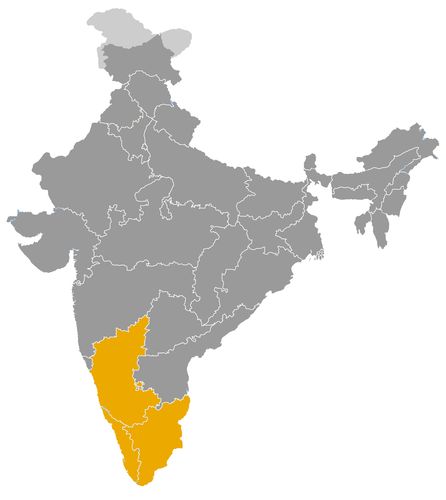
This map illustrates the maximum territory that the Pandya Dynasty had reached at its height, covering the current regions of Karnataka, Kerala and Tamil Nadu in India. Its main purpose is to provide a visual aid to understand the geographical extent of this dynasty. However, it's important to note that the contemporary borders of these regions may not necessarily coincide with the historical territories.
The Pandya Dynasty and Its Political, Cultural and Economic Role in Indian History
An ancient Tamil dynasty rooted in southern India
The Pandya dynasty was one of the most important ruling houses of South India and one of the three great Tamil dynasties traditionally associated with ancient Tamilakam, alongside the Cholas and the Cheras. Its main political centre was Madurai, a city that became closely linked with Tamil literature, royal authority, temple culture and regional identity. The Pandyas are remembered both as an ancient lineage mentioned in early Tamil tradition and as a powerful medieval dynasty that reached a high point in the thirteenth century.
Their history extended across several phases. The early Pandyas are known partly through Sangam literature, while later rulers are better documented through inscriptions, temple records and foreign accounts. This long duration gives the dynasty a special place in Indian history. It represents continuity, restoration and adaptation within the changing political world of South India.
Madurai as a centre of kingship and Tamil culture
Madurai was the symbolic and political heart of Pandya power. In Tamil cultural memory, the city was associated with poetry, learned assemblies, royal patronage and sacred geography. Although the historicity of some early literary traditions must be treated carefully, they clearly show that Madurai occupied an exceptional place in the imagination of Tamil society.
The city also developed as a major religious centre. The cults of Shiva and Meenakshi became central to the sacred identity of Madurai, while other religious traditions, including Jainism and Buddhism, were also present in the wider Tamil region at different times. The Pandyas helped to link kingship with temple patronage, religious legitimacy and urban prestige. Their court became part of a broader Tamil world in which language, ritual, literature and political authority reinforced one another.
A political force among the powers of South India
Politically, the Pandyas played a major role in the balance of power in southern India. Their core territory lay in the far south of the Tamil region, but their influence expanded and contracted according to military strength and dynastic circumstances. They competed with the Cheras to the west, the Pallavas to the north and later the Cholas, who became their most powerful rivals.
After an obscure period often associated with the Kalabhra interregnum, the Pandya kingdom was restored from the sixth century onward. Kadungon is usually credited with reviving Pandya power and re-establishing Madurai as a significant political centre. In the following centuries, the Pandyas fought to maintain their position against the Pallavas and other regional powers.
The rise of the imperial Cholas reduced Pandya autonomy for a time. Madurai and the southern Tamil region came under Chola influence or control during parts of the medieval period. However, the decline of Chola power allowed the Pandyas to re-emerge. In the thirteenth century, rulers such as Jatavarman Sundara Pandya I and Maravarman Kulasekara Pandya I made the Pandya kingdom one of the dominant powers of South India. Their authority extended over much of Tamilakam and influenced Kerala, Sri Lanka and parts of the southern Deccan.
A cultural contribution to Tamil literature and temple civilisation
The cultural importance of the Pandyas is closely connected with the development and preservation of Tamil identity. Their association with Sangam poetry made them central to the literary memory of the Tamil world. Even when the details of early Pandya rulers remain difficult to reconstruct, the dynasty’s link with Tamil literary culture is one of its most enduring legacies.
The Pandyas also contributed to temple development in South India. They patronised shrines, made land grants and supported religious institutions. Their inscriptions record donations, rituals, endowments and the relationship between royal power and sacred spaces. The great temple culture later expanded by the Cholas and Nayaks rested partly on foundations already strengthened by Pandya patronage.
Artistically, the Pandyas contributed to the Dravidian temple tradition through sculpture, architecture, inscriptions and ritual landscapes. Their role was not always as monumental as that of the later Cholas or Nayaks, but it was essential in shaping the sacred geography of southern Tamil Nadu. Madurai, Tirunelveli and other centres of the Pandya region became enduring markers of this religious and artistic world.
An economy supported by agriculture, pearls and maritime trade
The Pandya economy rested on a combination of inland agriculture and coastal exchange. The fertile lands of southern Tamilakam provided revenue through cultivation, village organisation and irrigation. Land grants to temples, Brahmins and religious institutions linked the agrarian economy with royal authority and sacred patronage.
The Pandyas were especially associated with the pearl fisheries of the Gulf of Mannar. Pearls from the southern coast had been valued in long-distance trade since ancient times. Control over these coastal resources gave the dynasty economic importance beyond its inland territory. The fisheries connected the Pandya kingdom with Sri Lanka, the Arabian Sea, Southeast Asia and wider Indian Ocean networks.
Ports on the south-eastern coast enabled trade in pearls, textiles, spices, horses and luxury goods. These exchanges brought wealth to the region and strengthened the position of coastal towns. Maritime commerce also encouraged cultural contact, diplomatic exchange and the movement of religious and artistic influences.
A dynasty shaped by restoration, expansion and decline
The Pandya dynasty reached its greatest medieval power in the thirteenth century, but its expansion was followed by internal conflict. Succession disputes weakened the kingdom at the end of the thirteenth and beginning of the fourteenth century. Rival princes competed for authority, and this instability made the region vulnerable to outside intervention, including campaigns associated with the Delhi Sultanate.
The decline of effective Pandya sovereignty did not erase the dynasty’s historical importance. Pandya rulers or claimants survived in reduced regional roles, while the memory of their rule remained deeply embedded in Tamil history. Their legacy continued through Madurai’s religious status, southern Tamil identity, temple traditions and the memory of a maritime and agrarian kingdom that had once dominated the far south of India.
A lasting place in the history of South India
The Pandyas were central to the political and cultural formation of southern India. They linked ancient Tamil traditions with medieval temple civilisation, combined inland kingship with maritime exchange, and shaped the history of Madurai and the far south. Their role was not limited to regional warfare or dynastic succession. They helped define the cultural geography of Tamilakam and contributed to the wider history of India through literature, religion, trade and political resilience.
The Geographical Extension of the Pandya Dynasty in Southern India
A Tamil kingdom centred on Madurai and the far south
The Pandya dynasty developed its power in the far south of the Indian subcontinent, with Madurai as its main political, cultural and religious centre. Alongside the Cholas and Cheras, the Pandyas formed one of the three great dynastic traditions of ancient Tamilakam. Their most durable territorial base lay in the southern part of present-day Tamil Nadu, especially around Madurai, Tirunelveli and the regions connected with the Gulf of Mannar.
The geographical extent of Pandya authority changed considerably over time. Early Pandya power, known partly through Tamil literary tradition, was probably centred on the inland plains and coastal zones of southern Tamilakam. Later, especially during the medieval period, inscriptions show a more clearly defined kingdom capable of expanding northward, westward, across the sea toward Sri Lanka, and into territories once controlled by the Cholas. The Pandyas therefore ruled a shifting political space rather than a state with fixed modern borders.
Madurai and the agrarian heartland of southern Tamilakam
Madurai was the territorial and symbolic core of Pandya rule. Its importance rested on more than royal residence. The city stood within an agrarian zone that supported villages, irrigation systems, temples, markets and administrative networks. Control of Madurai gave the Pandyas access to both material resources and cultural legitimacy.
The surrounding plains of southern Tamilakam formed the basic economic foundation of the kingdom. Agricultural revenues sustained the court, military activity, temple endowments and local administration. This inland core allowed the dynasty to survive even during periods when wider influence was reduced. Madurai also served as a point from which the Pandyas could project authority toward the coast, the western passes and the northern Tamil regions.
Coastal control and the Gulf of Mannar
One of the most distinctive features of Pandya geography was access to the southern coast and the Gulf of Mannar. This region was famous for pearl fisheries, which gave the kingdom economic importance in both ancient and medieval trade networks. Control over pearl-rich coastal waters strengthened Pandya wealth and connected the kingdom with maritime commerce.
The coast also linked the Pandyas with Sri Lanka. The Palk Strait and the Gulf of Mannar were not barriers but zones of movement. Troops, merchants, religious specialists and diplomatic missions could cross between southern India and the island. The Pandyas intervened several times in Sri Lankan politics, sometimes through military campaigns and sometimes through influence over trade and regional alliances. Their maritime position therefore shaped both their economy and their foreign relations.
Western connections with the Cheras and Kerala
To the west, Pandya territory approached the regions associated with the Cheras and later Kerala. The Western Ghats formed an important natural boundary, but they did not prevent interaction. Passes through the mountains connected the Pandya country with the Malabar coast, where trade in spices, forest products and maritime goods was significant.
Relations with the Cheras were shaped by both rivalry and economic interdependence. The Pandyas sought access to western routes and resources, while the Cheras guarded their own coastal and inland interests. At times, especially during periods of Pandya strength, the dynasty extended influence toward parts of Kerala. However, control over western regions was usually less stable than authority in the Madurai heartland.
This western orientation gave the Pandyas a wider economic horizon. It connected their kingdom not only with the Bay of Bengal and Sri Lanka, but also indirectly with the Arabian Sea trade networks of the Malabar coast.
Northern rivalries with the Pallavas and Cholas
The northern frontier of Pandya power was shaped by long rivalry with the Pallavas and Cholas. The Pallavas, centred on Kanchipuram, controlled northern Tamilakam and often opposed Pandya expansion. For several centuries, the political geography of Tamilakam was marked by a balance between Pallava power in the north and Pandya strength in the south.
The Cholas later became the most important rivals of the Pandyas. When the imperial Cholas rose from the ninth century onward, Pandya autonomy was reduced. Madurai and the southern Tamil region came under Chola pressure or control during parts of the medieval period. Yet the decline of Chola power created an opportunity for Pandya recovery. In the thirteenth century, the Pandyas expanded into former Chola territories and became the dominant power in much of Tamilakam.
This northern expansion was politically decisive. It transformed the Pandyas from a southern kingdom into a broader South Indian power capable of challenging or replacing earlier hegemonies.
The thirteenth-century height of Pandya expansion
The greatest territorial reach of the medieval Pandyas came in the thirteenth century under rulers such as Jatavarman Sundara Pandya I and Maravarman Kulasekara Pandya I. During this period, Pandya influence extended over much of Tamilakam, parts of Kerala, Sri Lanka and some areas connected with the southern Deccan.
This expansion rested on the combination of military strength, control of trade routes, temple patronage and maritime wealth. The Pandyas dominated important sacred centres, agricultural regions and coastal zones. Their authority was not always direct in every area, but their political influence was widely recognised. The kingdom became one of the leading powers of South India at a time when Chola authority was weakening.
Fragmentation and the impact of external intervention
The wide extension of Pandya power did not last. At the end of the thirteenth and beginning of the fourteenth century, succession disputes weakened the dynasty. Rival princes competed for authority, sometimes ruling in overlapping or contested territories. This internal fragmentation reduced the ability of the Pandyas to defend their realm.
The crisis also opened the way for northern intervention. Campaigns associated with the Delhi Sultanate reached the far south and disrupted the political order of Madurai. The former Pandya territory then fragmented among competing regional powers. Later rulers and claimants preserved the Pandya name in more limited contexts, but the period of major territorial expansion had ended.
A southern territory with maritime and regional influence
The geographical importance of the Pandya dynasty lay in its dual foundation: an inland core around Madurai and a maritime opening toward the Gulf of Mannar and Sri Lanka. From this base, the Pandyas interacted with the Cheras, Pallavas, Cholas, Sri Lanka and powers from the Deccan and northern India.
Their territory expanded and contracted over many centuries, but the dynasty remained one of the defining powers of Tamilakam. Its geography allowed it to combine agriculture, temple networks, pearl fisheries, coastal trade and military ambition. The Pandyas therefore shaped the political and economic landscape of southern India far beyond the limits of their original Madurai heartland.
The Pandyas were an ancient Tamil dynasty whose history covers several phases, from the rulers of the Sangam age to the medieval kings of Madurai. The earliest reigns are known from Tamil literary traditions and fragmentary inscriptions; their dates are therefore highly approximate. In the thirteenth and fourteenth centuries, several Pandya princes sometimes ruled simultaneously or in competing territories, making the chronology particularly complex.
- Mudukudumi Peruvazhuthi (c. 1st century BCE–1st century CE) • An early king mentioned in Tamil tradition, he is associated with the ritual and military authority of the early Pandyas.
- Nedunjeliyan I (c. 1st–2nd century) • A ruler of the Sangam age, he is linked to early accounts of Madurai and rivalries with other Tamil powers.
- Nanmaran (c. 2nd century) • An early Pandya king known from Tamil literature, in a context where historical data remain fragmentary.
- Nedunjeliyan II (c. 2nd–3rd century) • A celebrated ruler in Sangam tradition, he is often associated with the victory of Talaiyalanganam.
- Ukkiraperuvaluti (c. 3rd century) • He appears among the last great Pandya rulers of the early tradition before a long obscure period.
- Kadungon (c. 560–590) • He restored Pandya power after the Kalabhra period and re-established Madurai as a major political centre.
- Maravarman Avanisulamani (c. 590–620) • He continued the consolidation of the Pandya kingdom in southern Tamilakam.
- Jayantavarman (c. 620–645) • His reign belongs to the phase of dynastic strengthening after Kadungon’s restoration.
- Arikesari Maravarman (c. 645–670) • He is associated with Pandya expansion and the religious traditions of Madurai.
- Kochadaiyan Ranadhiran (c. 670–710) • He strengthened Pandya authority against neighbouring powers of Tamilakam and the southern Deccan.
- Maravarman Rajasimha I (c. 710–765) • His reign marked a phase of Pandya power in rivalries with the Pallavas and Chalukyas.
- Nedunjadaiyan Parantaka (c. 765–815) • He consolidated Pandya expansion and strengthened royal prestige through grants and inscriptions.
- Rajasimha II (c. 815–862) • He maintained Pandya influence during a period of increasing regional competition.
- Varaguna II (c. 862–880) • He faced the Pallavas and the rising Cholas in northern Tamilakam.
- Parantaka Viranarayana (c. 880–900) • He ruled during a period of growing Chola pressure.
- Maravarman Rajasimha III (c. 900–920) • He was one of the last Pandya rulers before Chola domination over Madurai.
- Jatavarman Kulasekara I (c. 1190–1216) • He took part in the restoration of Pandya power after the weakening of Chola hegemony.
- Maravarman Sundara Pandya I (c. 1216–1238) • He strengthened Pandya independence and campaigned against the Cholas.
- Jatavarman Sundara Pandya I (c. 1251–1268) • He brought the Pandya empire to its height, extending influence over Tamilakam, Kerala, Sri Lanka and parts of the southern Deccan.
- Maravarman Kulasekara Pandya I (c. 1268–1310) • His long reign maintained Pandya power, but his succession triggered a major dynastic crisis.
- Sundara Pandya IV (c. 1308–1323, disputed reign) • He contested power with other Pandya princes during a period of civil war and intervention by the Delhi Sultanate.
- Vira Pandya IV (c. 1309–1345, disputed reign) • He was one of the last Pandya rulers of Madurai before the kingdom fragmented and new regional powers prevailed.
 Links to the main sections of the site