

 Français (France)
  Nederlands (nl-NL)
 The Brihadishwara Temple in Thanjavur is one of the most important religious monuments in southern India and a major symbol of the power of the Chola dynasty. Dedicated to Shiva, the complex occupies a central place in the religious, cultural, and political history of Tamil Nadu. The site continues to function as an active Hindu temple while also attracting researchers, pilgrims, and visitors interested in Indian history. The monument forms part of the UNESCO property “Great Living Chola Temples,” inscribed on the World Heritage List in 1987. Its significance extends far beyond the regional context through its lasting influence on Tamil culture and traditions.
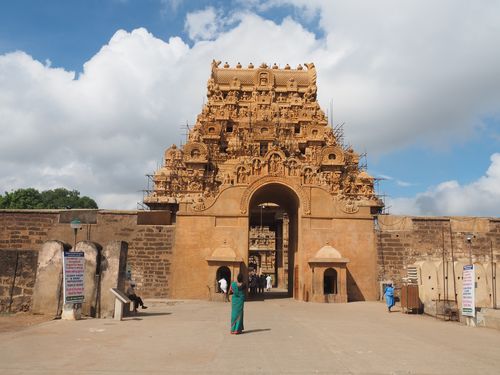
Thanjavur • Brihadishwara Temple
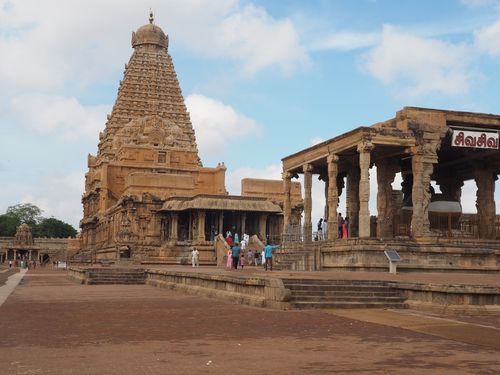
Thanjavur • Brihadishwara Temple
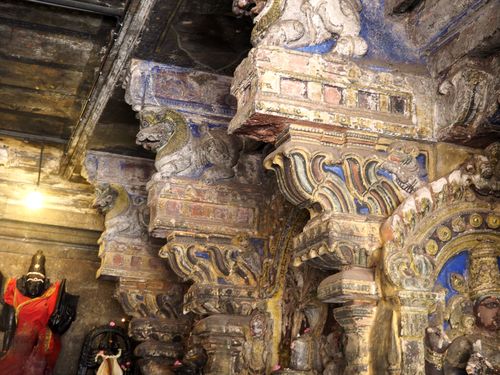
Thanjavur • Brihadishwara Temple
Monument profile
Brihadishwara Temple
Monument categories: Hindu Temple, Dravidian temple
Monument family: Temple
Monument genre: Religious
Cultural heritage: Hindu
Geographic location: Thanjavur • Tamil Nadu • India
Construction period: 11th century AD
This monument in Thanjavur is inscribed on the UNESCO World Heritage List since 1987 and is part of the serial property "Great Living Chola Temples".See the UNESCO monuments featured on this site
• Links to •
• Dynasties that contributed to the construction of the monument •


• List of videos about Thanjavur on this site •
Thanjavur • Chola temples • Tamil Nadu, India
• References •
Wikipedia EN: Brihadisvara Temple
UNESCO: Great Living Chola Temples
The Brihadishwara Temple and the Imperial Ambitions of the Chola Dynasty
Foundation of the Temple Under Rajaraja I
The Brihadishwara Temple was constructed in the early eleventh century during the reign of the Chola ruler Rajaraja I, one of the most influential monarchs in the history of southern India. Dedicated to Shiva, the temple was completed around 1010 at a time when the Chola Empire was expanding its political and military influence across large parts of the Indian subcontinent and the Indian Ocean region. Thanjavur served as the imperial capital, and the temple was intended to embody both royal authority and religious legitimacy.
Numerous inscriptions carved into the walls of the complex provide exceptionally detailed historical information regarding the foundation of the monument. These records describe donations of land, agricultural revenues, ritual objects, and administrative responsibilities connected with the functioning of the temple. The inscriptions also mention priests, musicians, dancers, accountants, guards, and temple officials attached to the institution. The monument therefore operated not only as a religious sanctuary but also as a major administrative and economic center directly linked to the Chola state.
The scale of the project required the mobilization of extensive financial and technical resources. Artisans, sculptors, engineers, and administrators participated in the construction of a monument designed to express the stability and prestige of imperial rule. The temple also reinforced the political role of Shaivism within the Chola kingdom by associating royal power closely with the worship of Shiva.
Religious and Administrative Functions During the Chola Period
Throughout the Chola period, the Brihadishwara Temple played a central role in the organization of religious, social, and economic life in the region. The institution controlled extensive agricultural lands and received revenues dedicated to the maintenance of rituals, festivals, and temple personnel. These resources supported a large permanent staff responsible for religious ceremonies and daily management.
The temple hosted major religious celebrations associated with the Hindu calendar as well as ceremonies connected with royal authority. Processions and public rituals strengthened the symbolic relationship between the Chola rulers and divine protection. Certain ceremonies also served to display imperial wealth and reinforce political authority before local elites and visiting delegations.
The monument maintained its religious importance even after the gradual decline of Chola political dominance from the thirteenth century onward. Successive ruling powers, including the Pandyas, the Vijayanagara Empire, the Nayaks, and later the Maratha rulers of Thanjavur, continued to support the sanctuary and preserve its ritual functions. Although administrative systems evolved over time, the temple remained an active religious institution throughout these political transitions.
Transformations, Restorations, and Historical Continuity
The Brihadishwara Temple underwent several phases of restoration and modification during its long history. Certain subsidiary shrines, mandapas, and decorative elements were added during the Nayak and Maratha periods. Despite these later interventions, the principal Chola structure retained its original architectural identity and ceremonial organization.
During the British colonial period, the temple increasingly attracted scholarly attention because of its inscriptions and monumental architecture. Archaeologists, historians, and epigraphists began documenting the complex during the nineteenth and twentieth centuries. The inscriptions proved particularly valuable for reconstructing the political administration of the Chola Empire and understanding the organization of medieval temple institutions in southern India.
In 1987, the monument was inscribed on the UNESCO World Heritage List as part of the property known as the “Great Living Chola Temples.” This designation recognized both the historical significance of the monument and the continuity of its religious use. The temple remains an active center of Shaivite worship while simultaneously functioning as one of the major historical monuments of India.
Modern conservation efforts focus primarily on the preservation of granite structures, sculptures, mural paintings, and inscriptions. The increasing number of visitors and the continuation of ritual practices require careful management in order to balance religious activities with long-term preservation objectives.
The Temple Within the Global Context of the Eleventh Century
The construction of the Brihadishwara Temple took place during a period marked by the expansion of major regional states across Asia and by the growth of maritime trade networks in the Indian Ocean. In the early eleventh century, the Chola Empire maintained commercial and diplomatic contacts with Southeast Asia and conducted naval expeditions across maritime routes. During the same period, the Song dynasty governed much of China, while the Islamic world was influenced by the Abbasid and Fatimid dynasties. In western Europe, feudal political structures were consolidating before the major transformations of the later medieval period.
Architectural Composition of the Brihadishwara Temple in Thanjavur
Monumental Layout and Spatial Organization of the Complex
The Brihadishwara Temple occupies a large rectangular enclosure within the historic urban core of Thanjavur. The complex follows a highly organized axial plan characteristic of major Dravidian temple architecture, with the principal entrance aligned toward the central sanctuary dedicated to Shiva. The progression through gateways, open courtyards, and ceremonial spaces creates a carefully controlled visual and ritual sequence leading toward the sacred core of the monument.
The main structure stands on an elevated platform that reinforces its monumental appearance and distinguishes it from surrounding buildings within the enclosure. The complex includes gateways, subsidiary shrines, pillared halls, circumambulatory passages, and open ritual courts. Despite its scale, the arrangement remains coherent because most of the principal structures were constructed during a relatively concentrated campaign under Rajaraja I.
Unlike later South Indian temple complexes where entrance towers dominate visually, the Brihadishwara Temple places architectural emphasis on the central sanctuary tower, or vimana. This hierarchy gives the monument a distinctive position within the evolution of Tamil temple architecture.
The broad courtyards surrounding the shrine also intensify the perception of scale. The limited presence of later additions preserves clear visual perspectives toward the towering central structure from multiple areas within the enclosure.
The Vimana and Structural Engineering
The vimana of the Brihadishwara Temple represents one of the major achievements of Chola architectural engineering. Rising to approximately sixty meters, the pyramidal tower dominates the complex and remains among the tallest stone temple towers built in premodern India. Its composition relies on progressively diminishing tiers that create vertical emphasis while preserving structural stability.
The summit is crowned by a massive monolithic stone block topped with a metal finial. Positioning such a heavy element at great height required advanced engineering coordination and carefully planned construction techniques. The structure depends on substantial granite foundations and a balanced distribution of weight throughout the ascending levels of the tower.
The sanctum beneath the vimana houses a monumental lingam dedicated to Shiva. In contrast with the immense exterior mass of the temple, the inner sanctuary remains enclosed and dimly illuminated. This opposition between external monumentality and concentrated sacred interior space forms a defining feature of South Indian temple architecture.
The temple axis also includes a large pavilion dedicated to Nandi, the sacred bull associated with Shiva. The pavilion shelters an enormous monolithic sculpture aligned directly with the sanctum, reinforcing the ceremonial orientation of the complex and strengthening the visual relationship between the entrance sequence and the principal shrine.
Construction Materials, Sculpture, and Decorative Programs
The Brihadishwara Temple was constructed primarily from granite, although this material is not naturally abundant in the plains surrounding Thanjavur. The transport and assembly of large quantities of stone therefore represented a major logistical operation. Many structural blocks display exceptional dimensions, particularly in the upper sections of the vimana and the elevated platform.
Stone-cutting and assembly techniques reveal considerable technical precision. The joints between blocks remain highly accurate, contributing both to structural stability and to the monument’s long-term preservation. Large wall surfaces alternate between relatively restrained architectural masses and sculpted sections containing niches, pilasters, and ornamental moldings.
The sculptural program occupies extensive portions of the façades and recesses. Sculptures represent forms of Shiva, associated Hindu deities, guardians, celestial figures, dancers, and symbolic motifs linked with Shaivite cosmology. Several niches contain elaborate sculptural compositions integrated directly into the structural rhythm of the walls.
Pillared halls and mandapas include additional decorative treatment through carved capitals, ceiling panels, floral motifs, and geometric patterns. Ornamentation remains subordinate to the architectural framework rather than visually overwhelming the structure. This balance contributes significantly to the monument’s coherence.
The temple also preserves mural paintings dating from both the Chola and later Nayak periods. These paintings provide valuable evidence concerning medieval South Indian artistic traditions and extend the decorative program beyond sculpture alone.
Ritual Circulation and Functional Organization
The architectural organization of the Brihadishwara Temple was designed to support large-scale ritual activity associated with royal Shaivite worship. Open courtyards provided space for processions, assemblies, and ceremonial movement linked with the Hindu ritual calendar. Circumambulatory passages surrounding the sanctum enabled controlled devotional circulation around the sacred center of the temple.
Several subsidiary shrines and secondary structures were added or modified during the Nayak and Maratha periods. These interventions altered peripheral sections of the enclosure without fundamentally transforming the original Chola organization of the principal shrine.
Perspective and visual sequencing play an important role throughout the complex. From the principal entrance onward, the arrangement of gates, courtyards, and structures directs attention toward the towering vimana. Variations in scale between gateways, halls, platforms, and towers intensify both the ceremonial and political dimensions of the monument.
The immense scale of the temple also functioned as an architectural expression of imperial Chola authority. Monumental dimensions, elevated structures, and extensive sculptural decoration projected political prestige while reinforcing the sacred importance of the temple within the royal capital.
Architectural Preservation and Conservation Challenges
The Brihadishwara Temple has undergone multiple conservation campaigns intended to preserve granite structures, sculptures, inscriptions, and mural paintings. Modern interventions focus on structural stabilization, surface cleaning, water infiltration control, and the protection of weathered sculptural elements.
The continued religious use of the temple creates additional conservation challenges. Daily rituals, large festival gatherings, smoke deposits, oil applications, and continuous visitor circulation all affect the preservation of architectural surfaces and decorative details. Conservation authorities must therefore balance active worship with long-term heritage protection.
The monument forms part of the UNESCO World Heritage property “Great Living Chola Temples,” inscribed in 1987. Despite periodic restoration campaigns, the temple retains a high degree of architectural authenticity and remains one of the most complete surviving examples of monumental imperial Chola architecture in southern India.