Français (France)
  Nederlands (nl-NL)
 Of Hindu tradition, (with additional Buddhist and Jain influence), the Chalukya of Badami dynasty ruled for approximately 210 years, ± between 543 and 753 over all or part of South India and West India, during the Classical Period.
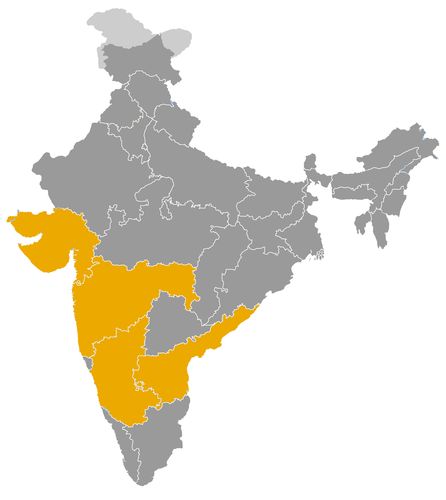
This map illustrates the maximum territory that the Chalukya of Badami Dynasty had reached at its height, covering the current regions of Goa, Karnataka, Maharashtra and Telangana in India. Its main purpose is to provide a visual aid to understand the geographical extent of this dynasty. However, it's important to note that the contemporary borders of these regions may not necessarily coincide with the historical territories.
The Badami Chalukya Dynasty and the Rise of the Deccan in Indian History
A regional dynasty that reshaped the political map of peninsular India
The Badami Chalukya dynasty, ruling mainly from the mid-sixth to the mid-eighth century, occupies a central place in the history of early medieval India. Based at Vatapi, modern Badami in northern Karnataka, the dynasty transformed a regional power in the western Deccan into one of the most influential kingdoms of the Indian peninsula. Its rise marked a decisive stage in the political assertion of the Deccan, a plateau region positioned between northern India and the far south.
The dynasty emerged at a time when the earlier imperial formations of the subcontinent had weakened, allowing regional powers to develop more clearly defined political identities. Under rulers such as Pulakeshin I, Kirtivarman I, Mangalesha and especially Pulakeshin II, the Badami Chalukyas expanded their authority across large parts of the Deccan. Their importance lies not only in territorial conquest, but also in their ability to organize a complex regional kingdom, patronize religious and artistic production, and influence later patterns of rule in southern and western India.
Pulakeshin II and the political assertion of the Deccan
The reign of Pulakeshin II is generally regarded as the high point of Badami Chalukya power. His success against Harsha, the dominant ruler of northern India, gave the dynasty exceptional prestige. By resisting northern expansion, Pulakeshin II helped define the Deccan as an autonomous political zone rather than a mere frontier between north and south.
The Chalukyas also played a major role in shaping the political balance of southern India through their long rivalry with the Pallavas of Kanchipuram. This conflict was one of the defining struggles of the seventh century in peninsular India. It involved control over strategic regions, trade routes, religious centres and zones of cultural influence. The Pallava capture of Vatapi after the defeat of Pulakeshin II temporarily weakened the dynasty, but its later restoration under Vikramaditya I demonstrated the resilience of Chalukya institutions and regional support networks.
The dynasty’s position in the Deccan allowed it to interact with powers in multiple directions: the north Indian world across the Narmada, the Pallavas in the Tamil region, local chiefs in the western Deccan, and emerging powers in Andhra and Karnataka. This made the Badami Chalukyas a major intermediary between different political and cultural spheres of India.
A model of regional kingship and territorial integration
The Badami Chalukya state was not a centralized empire in the modern sense. Its power depended on a combination of royal authority, military control, alliances with local elites and land grants to religious institutions. The dynasty governed a varied territory containing different linguistic, social and religious communities. Its rulers therefore had to integrate local chiefs, Brahmanical groups, temple institutions and military subordinates into a broader political order.
Inscriptions show that land grants played an important role in this process. Donations to Brahmins, temples and religious establishments reinforced the king’s legitimacy while helping to organize agrarian society. These grants also linked the royal court with local economic and ritual networks. Through such mechanisms, the Chalukyas contributed to the development of political patterns characteristic of early medieval India, where royal power was expressed through both military dominance and sacred patronage.
The dynasty’s administration influenced later states in the Deccan. The Rashtrakutas, who eventually overthrew the Badami Chalukyas, and the later Chalukyas of Kalyani inherited aspects of this political environment. The legacy of the Badami Chalukyas therefore extended beyond their own period of rule.
Architectural innovation at Badami, Aihole and Pattadakal
The cultural impact of the Badami Chalukyas is most visible in architecture. Their main centres, Badami, Aihole and Pattadakal, form one of the most important artistic landscapes of early medieval India. These sites show a period of experimentation in temple construction, sculptural form and sacred space.
Badami is especially known for its rock-cut cave temples, which reflect Hindu, Jain and broader religious traditions. Aihole contains a large number of structural temples and is often described as a centre of architectural experimentation. Pattadakal represents a more developed synthesis, where northern and southern temple forms were explored side by side. The coexistence of nagara and dravida features at Pattadakal illustrates the Deccan’s role as a zone of artistic exchange.
This architectural patronage was not merely decorative. Temples served as religious, economic and political institutions. By supporting temple construction, the Chalukya rulers displayed royal authority, reinforced religious legitimacy and shaped the cultural memory of their dynasty. Their monuments later influenced the development of temple architecture in Karnataka and other parts of southern India.
Religious plurality and royal legitimacy
The Badami Chalukyas ruled in a religiously diverse environment. Their inscriptions and monuments show strong connections with Hindu traditions, especially Shaivism and Vaishnavism, but Jainism also received patronage. This plural religious landscape was typical of the Deccan, where royal authority was often expressed through support for several traditions.
The dynasty’s religious policy should not be understood as simple tolerance in a modern sense, but as a practical and symbolic form of kingship. Patronage allowed rulers to build alliances with religious communities, legitimize their authority and embed their power in sacred geography. The temples and cave sanctuaries of the Chalukya period therefore reveal both devotion and political strategy.
Economic foundations of Chalukya power
The economy of the Badami Chalukya kingdom rested on agriculture, regional exchange and control of important routes across the Deccan. Their territories connected interior plateau zones with routes leading toward the western and eastern coasts. This gave the dynasty access to trade networks, tribute, agrarian revenue and military corridors.
Temple patronage also had economic significance. Temples received land, employed artisans, attracted donations and supported local settlements. Monumental construction required sculptors, architects, stonecutters and ritual specialists, linking artistic production with economic activity. The prosperity visible in Chalukya monuments suggests a kingdom capable of mobilizing considerable resources.
A lasting legacy in the history of early medieval India
The Badami Chalukya dynasty declined in the eighth century when the Rashtrakutas rose to power and displaced Kirtivarman II. Yet the dynasty’s historical role remained profound. It helped establish the Deccan as a major political region, created enduring models of regional kingship, and left some of the most important monuments of early medieval Indian architecture.
Their legacy continued through later Chalukya branches, including the Chalukyas of Vengi and the Chalukyas of Kalyani. More broadly, the Badami Chalukyas demonstrated how a Deccan dynasty could compete with northern and southern powers while producing a distinctive political and cultural identity. Their rule stands as one of the formative chapters in the history of medieval India.
The Geographic Expansion of the Badami Chalukya Dynasty in the Indian Deccan
A dynastic centre established at Vatapi in northern Karnataka
The Badami Chalukya dynasty, ruling mainly from the mid-sixth to the mid-eighth century, developed from a regional power in the western Deccan into one of the dominant kingdoms of peninsular India. Its political centre was Vatapi, modern Badami, in northern Karnataka. This location was strategically important because it lay between the plateau zones of Karnataka and Maharashtra and the routes leading toward both the western and eastern coasts.
The earliest Chalukya base was concentrated around Badami, Aihole and Pattadakal. These sites formed the dynastic heartland, combining military, religious and administrative functions. From this core, the dynasty expanded into surrounding regions and gradually built a kingdom that connected large parts of the Deccan. Its territorial growth was not always uniform or permanent, but it gave the Chalukyas a decisive role in the political balance between northern India, the Tamil region and the eastern coast.
Expansion across the western Deccan and Maharashtra
Under Pulakeshin I and Kirtivarman I, Chalukya authority spread beyond the immediate Badami region. The kingdom extended into parts of present-day Karnataka and Maharashtra, bringing important inland territories under royal control. These areas offered agricultural resources, access to local elites and control over routes crossing the Deccan plateau.
The western Deccan was a politically competitive region, where authority often depended on a combination of conquest, tribute, marriage alliances and the submission of local chiefs. The Chalukyas did not necessarily administer every area directly. In many territories, they relied on feudatories and subordinate rulers who recognized Chalukya supremacy while maintaining a degree of local authority.
This flexible structure allowed the dynasty to expand over a wide area without requiring a fully centralized administration. It also made Chalukya power dependent on military success and political prestige. When the dynasty was strong, its influence could reach far beyond its core territory; when it was weakened, local powers could reassert autonomy.
Pulakeshin II and the maximum reach of Chalukya power
The reign of Pulakeshin II marked the height of Badami Chalukya expansion. His authority extended over much of the Deccan, including large parts of modern Karnataka and Maharashtra and areas toward the eastern Deccan. He transformed the dynasty into a major imperial power and made Badami one of the most important political centres of the Indian peninsula.
One of the most significant aspects of his rule was his confrontation with Harsha, the dominant ruler of northern India. Pulakeshin II’s success in stopping Harsha’s advance toward the south gave the Chalukyas great prestige. The Narmada region became a symbolic frontier between the northern power of Harsha and the Deccan sphere dominated by the Chalukyas.
This did not mean that the Badami Chalukyas ruled northern India, but it showed that they controlled enough of the Deccan to prevent northern expansion. Their geographic position allowed them to act as a southern counterweight to the great kingdoms of the Gangetic plain.
The southern frontier and the rivalry with the Pallavas
The southward expansion of the Badami Chalukyas brought them into direct conflict with the Pallavas of Kanchipuram. This rivalry became one of the defining political struggles of seventh-century peninsular India. The contested zone lay between the Deccan interior, the Andhra region and northern Tamil country.
Pulakeshin II campaigned against the Pallavas and initially pushed Chalukya influence deep into the south. However, the Pallava counterattack under Narasimhavarman I led to the capture of Vatapi and a serious disruption of Chalukya power. This event illustrates the risks created by rapid territorial expansion. The Chalukyas had become strong enough to challenge the Pallavas, but their southern campaigns also exposed their capital and heartland to retaliation.
The dynasty later recovered under Vikramaditya I, who restored Chalukya authority at Badami. Subsequent rulers continued to confront the Pallavas, and Vikramaditya II even campaigned successfully against Kanchipuram. The southern frontier therefore remained both a zone of military conflict and a field of prestige for Chalukya kingship.
Eastern expansion and the formation of the Vengi branch
The Chalukya advance toward the eastern Deccan had long-term consequences. By extending influence into the Vengi region, in present-day Andhra Pradesh, the dynasty gained access to the eastern coastal plain and the trade routes of the Bay of Bengal. This region was valuable because it linked inland Deccan politics with maritime and riverine networks.
The establishment of the Eastern Chalukyas of Vengi grew out of this expansion. Although connected to the Badami line, the Vengi branch gradually developed its own political identity. This illustrates a common feature of early medieval Indian expansion: territorial growth could produce regional branches that were initially subordinate but later became independent powers.
The eastern territories also shaped Chalukya relations with the Pallavas and other southern powers. Control over Andhra and Vengi affected access to the coast, military movement and influence over intermediate regions between Karnataka and Tamil Nadu.
Relations with neighbouring dynasties shaped by geography
The geographic position of the Badami Chalukyas placed them at the centre of several political worlds. To the north, they faced the expanding influence of Harsha and other northern powers. To the south, they confronted the Pallavas. To the east, they interacted with the Andhra region and the emerging Chalukyas of Vengi. To the west, they were connected to the Konkan and routes leading toward the Arabian Sea.
This position gave the dynasty both strength and vulnerability. It allowed the Chalukyas to control major routes and influence several regions at once, but it also exposed them to conflicts on multiple fronts. Their territorial policy was therefore inseparable from diplomacy, warfare and the management of subordinate chiefs.
Territorial overextension and the rise of the Rashtrakutas
By the eighth century, the Chalukya kingdom faced growing pressure from within the Deccan itself. The Rashtrakutas, originally connected to the regional political order, rose to prominence and eventually overthrew Kirtivarman II around 753. Their success shows that Chalukya control over the Deccan depended on maintaining the loyalty of powerful subordinate groups.
The geographic expansion of the Badami Chalukyas was therefore both the foundation of their greatness and one of the causes of their instability. Their rule linked Karnataka, Maharashtra, Andhra and parts of the wider Deccan into a major political sphere. It shaped relations with the Pallavas, checked northern ambitions under Harsha, and created the conditions for later Chalukya branches. Although their direct rule ended in the eighth century, their territorial legacy helped define the Deccan as one of the central arenas of medieval Indian history.
This chronology concerns the Badami Chalukyas, also known as the Early Chalukyas or Early Western Chalukyas, and not the later branches of Kalyani or Vengi. The rulers are generally described as kings in modern historiography, although inscriptions also use royal and imperial honorific titles. The dates, especially for the troubled phase after Pulakeshin II, are indicative and may vary between scholars.
- Pulakeshin I (c. 543–566) • He established Chalukya power at Vatapi, modern Badami, and laid the political foundation of the dynasty.
- Kirtivarman I (c. 566–597) • He consolidated the kingdom and campaigned against several powers of the Deccan and South India.
- Mangalesha (c. 597–609) • Brother of Kirtivarman I, he first ruled as protector of the dynasty before coming into conflict with Pulakeshin II.
- Pulakeshin II (c. 609–642) • He brought Chalukya power to its height, resisted Harsha in the north and fought the Pallavas in the south.
- Adityavarman (c. 642–645) • His reign is poorly known and belongs to the period of disorder after the Pallava capture of Vatapi.
- Abhinavaditya (c. 645–646) • He appears in some dynastic lists, but the extent of his effective authority remains uncertain.
- Chandraditya (c. 646–649) • A son of Pulakeshin II, he seems to have held limited power during the gradual restoration of the dynasty.
- Vikramaditya I (c. 655–680) • He restored Chalukya authority at Badami after the interruption caused by the Pallavas.
- Vinayaditya (c. 680–696) • He maintained the strength of the kingdom and continued Chalukya assertion in the Deccan.
- Vijayaditya (c. 696–733) • His long reign corresponds to a phase of political stability and religious and architectural patronage.
- Vikramaditya II (c. 733–746) • He led successful campaigns against the Pallavas and supported temple building at Pattadakal.
- Kirtivarman II (c. 746–753) • The last effective king of Badami, he was overthrown by the Rashtrakutas, ending Early Chalukya dominance.
 Links to the main sections of the site