

 Français (France)
  Nederlands (nl-NL)
 The Bhutanatha temples are located in Badami, in the state of Karnataka, India. Dating back to between the 7th and 11th centuries, these temples are situated near the shores of Agastya Lake and are dedicated to Bhutanatha, a form of the god Shiva. Built from sandstone, the complex blends seamlessly with the surrounding landscape, providing scenic views of the surrounding cliffs. The site is a popular destination for visitors due to its religious significance and distinctive architecture, representing the evolution of Dravidian art.
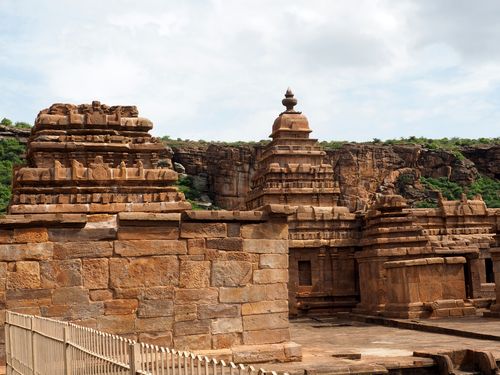
Badami • Bhutanatha Temples: temple
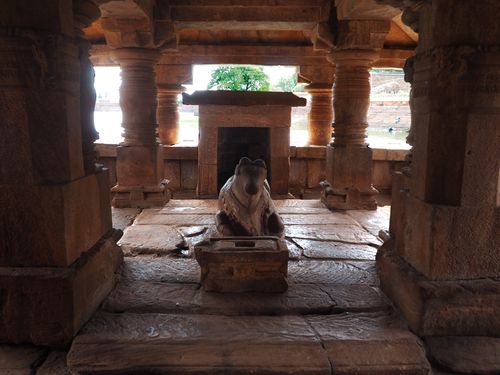
Badami • Bhutanatha Temples: Nandi
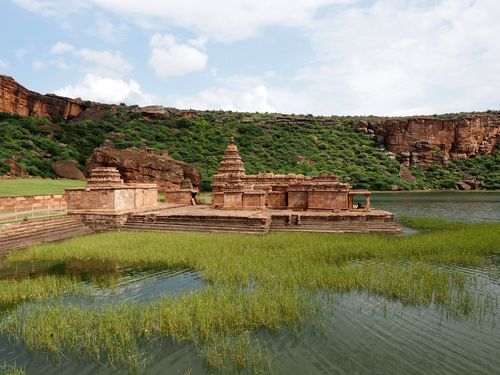
Badami • Bhutanatha Temples: seen from the lake
Bhutanatha Temples

The Bhutanatha Temples in Badami: Political Motivations, Historical Transformations, and Preservation Challenges
Political and Social Motivations Behind the Construction
The Bhutanatha Temples, located in Badami in the state of Karnataka, were constructed primarily during the reign of the Chalukya dynasty between the 7th and 11th centuries. Badami, then known as Vatapi, was the capital of the Chalukya Empire, and the construction of the Bhutanatha Temples was part of a larger effort by the rulers to establish their political authority and religious legitimacy in the region. Dedicated to Bhutanatha, a form of the god Shiva, these temples symbolized the close relationship between religion and political power in ancient India.
The construction of these temples was motivated by the desire of the Chalukyas to consolidate their rule by creating monumental religious structures that would unite the people under a shared cultural and spiritual framework. The temples served as centers for both religious and social activities, thus reinforcing the cohesion of the kingdom through a unified belief system.
Historical Events and Their Impact on the Region
The Bhutanatha Temples have witnessed several significant historical events that shaped the development of the region. After the fall of the Chalukya dynasty, Badami was captured by the Rashtrakutas, and later by the Cholas and Hoysalas. Each ruling dynasty left its mark on the temples, either through architectural additions or by restoring them to reflect their own religious and political ideals.
These shifts in power influenced the political and social dynamics of the region. Badami remained an important religious and cultural center even after the Chalukyas’ decline, as successive dynasties recognized the significance of the Bhutanatha Temples and sought to associate themselves with their religious and cultural heritage.
The Global Context and Comparison with Other Regions
During the period when the Bhutanatha Temples were being constructed, major political and cultural transformations were taking place across the globe. In Europe, this era corresponded to the rise of the early medieval kingdoms following the fall of the Western Roman Empire, such as the Carolingian Empire under Charlemagne. In East Asia, the Tang dynasty in China was expanding its influence, and the Islamic Caliphate was spreading across the Middle East and North Africa.
In this global context, the construction of the Bhutanatha Temples can be seen as part of a broader trend where rulers across the world used monumental architecture to assert their authority and project power. Much like the rulers in Europe or the Middle East, the Chalukyas sought to leave a lasting legacy through the creation of religious structures that symbolized both spiritual and political dominance.
Major Transformations and External Influences
Over the centuries, the Bhutanatha Temples underwent significant transformations, reflecting the changes in political power and external cultural influences. The temples’ architecture, originally in the Dravidian style, was influenced by the Pallava and Rashtrakuta dynasties, who brought their own artistic traditions to the region. This blending of styles is visible in the detailed carvings and sculptures that adorn the temples, which depict scenes from Hindu mythology alongside intricate floral and geometric designs.
The constant changes in political rule also led to periodic modifications in the temples' structure, as each dynasty sought to make their mark on these important religious monuments. These transformations are a testament to the fluid cultural exchanges that took place in the Deccan region, where local traditions blended with external influences from northern India and beyond.
Cultural Significance and Current State of Preservation
Today, the Bhutanatha Temples are recognized for their cultural and religious importance, both within India and internationally. They are part of a larger group of historical monuments in Badami that attract visitors and scholars interested in early Indian temple architecture. Despite their age, the temples have survived in relatively good condition, though they have been affected by natural erosion due to the soft sandstone used in their construction.
Efforts to conserve the temples have been ongoing, with the Indian government and local authorities working to preserve the intricate carvings and architectural features that define the temples. However, the temples face challenges related to weathering and environmental degradation.
Challenges to Preservation and Modern Threats
The Bhutanatha Temples face significant preservation challenges due to their exposure to natural elements, particularly the monsoon rains that affect the soft sandstone used in the temples' construction. Erosion and the growth of vegetation on the temple surfaces have contributed to the deterioration of some of the finer carvings and structural elements. Furthermore, the increasing number of tourists visiting the site poses additional risks to the integrity of the monuments.
Preservation efforts need to balance the desire to maintain public access to these historically significant sites with the need to protect them from further damage. Conservation programs are critical to ensuring the long-term survival of these temples, with a focus on using appropriate restoration techniques that respect the original materials and construction methods.
Conclusion
The Bhutanatha Temples in Badami stand as a testament to the architectural and cultural achievements of the Chalukya dynasty. Built with the dual purpose of reinforcing political power and religious devotion, these temples have evolved over the centuries, reflecting the changing political landscape and the blending of cultural influences. While the temples remain an important symbol of India's rich religious heritage, they face ongoing challenges related to preservation and conservation. Protecting these architectural treasures is essential for ensuring that future generations can continue to appreciate their historical and cultural significance.
Architectural Innovation of the Bhutanatha Temples in Badami: A Testament to Chalukya Technological Advancements
Technological Advancements and Innovation in Chalukya Architecture
The Bhutanatha Temples in Badami, constructed during the 7th to 11th centuries under the rule of the Chalukya dynasty, are a striking example of the technological prowess and architectural innovation of the time. The Chalukyas were known for their mastery of stone construction, particularly using the local soft sandstone. Despite the challenging properties of sandstone, prone to erosion and weathering, the Chalukyas were able to create intricate and durable structures that have withstood centuries.
One of the key innovations of the Chalukyas was their ability to combine functionality with aesthetics, creating temples that were not only places of worship but also marvels of engineering. The precision in the stone carving techniques used in the Bhutanatha Temples demonstrates their advanced knowledge of geometry and structural stability, allowing the creation of complex designs without compromising the integrity of the buildings.
Materials and Construction Techniques Reflecting the Grandeur of the Era
The Bhutanatha Temples were constructed primarily using the local sandstone, a material chosen for its abundance in the region. However, working with sandstone required advanced carving skills due to its susceptibility to erosion. The Chalukya artisans mastered the art of carving the stone in such a way that the intricate details of the sculptures and the structural elements could endure the test of time. This level of craftsmanship is evident in the temples’ pillars, ceilings, and outer walls, where fine carvings of deities, floral motifs, and geometric patterns remain visible even today.
The temples’ construction techniques also reflect the grandeur of the period. The temples were built without the use of mortar, with precisely cut blocks of sandstone fitted together using dry-stone construction methods. This technique, combined with their deep understanding of load distribution, allowed for the creation of towering structures supported by intricately designed pillars.
A Unique Blend of Regional and Foreign Artistic Traditions
The architecture of the Bhutanatha Temples illustrates a unique blend of regional artistic traditions and external influences. While the overall design follows the Dravidian style typical of southern India, there are clear elements that reflect northern Indian Nagara influences. This fusion of styles can be seen in the temple’s vimana (tower) and its mandapa (pillared hall), which show a harmonious combination of southern architectural forms with northern decorative motifs.
The sculptures adorning the temples are also a testament to the Chalukyas’ ability to integrate diverse artistic influences. Depictions of Hindu deities like Shiva, Vishnu, and scenes from Hindu mythology are carved into the temple walls, alongside motifs that were likely influenced by the Gupta and Pallava traditions. This blending of styles and iconography demonstrates the cosmopolitan nature of the Chalukya empire, which was a hub of cultural exchange in the Deccan region.
Notable Structure and Layout of the Bhutanatha Temples
The Bhutanatha Temples are notable for their strategic location on the banks of the Agastya Lake. The temples are built on a raised platform that merges with the surrounding cliffs, creating a sense of harmony between the natural and architectural landscapes. The temple layout includes a sanctum (garbhagriha), a large mandapa, and subsidiary shrines, all arranged symmetrically around the central shrine dedicated to Bhutanatha, a form of Shiva.
One of the most significant features of the Bhutanatha Temples is their integration with the natural surroundings. The temple complex appears to rise organically from the rock, with the lake’s reflection adding to its serene atmosphere. The use of the natural rock as a base for construction is a hallmark of Chalukya architecture, where the temples seem to blend seamlessly with the environment, reinforcing the spiritual connection between nature and divinity.
Notable Anecdotes and Statistics Regarding the Construction
Anecdotally, the Bhutanatha Temples are said to have been built in stages over several centuries, with each ruling dynasty adding to the complex. The Chalukyas began construction in the 7th century, and subsequent rulers, including the Rashtrakutas and the Hoysalas, contributed to its expansion and embellishment. Despite the passage of time and the changing rulers, the temples maintain a cohesive architectural style, showcasing the lasting influence of the Chalukya vision.
It is also noteworthy that the temples, built with sandstone, have survived numerous monsoon seasons, a testament to the advanced engineering techniques employed by the Chalukyas to protect the structure from the elements.
International Recognition and UNESCO World Heritage Consideration
While the Bhutanatha Temples are not yet recognized as a UNESCO World Heritage Site, they have gained increasing recognition for their architectural and cultural significance. Their distinct style and the advanced techniques used in their construction have drawn international attention, particularly from scholars and architects interested in early temple architecture in India. The temples, part of the larger Badami cave and temple complex, are a key focus for those studying the evolution of Dravidian architecture and its intersection with northern styles.
Should the Bhutanatha Temples receive UNESCO status, it would not only boost international recognition but also provide critical funding and support for their preservation. Currently, the temples are managed by local authorities, but UNESCO recognition could lead to a more comprehensive conservation effort, ensuring the site’s protection for future generations.
Challenges in Preserving the Historical Integrity of the Temples
The preservation of the Bhutanatha Temples faces several modern challenges. The soft sandstone from which the temples are built is particularly vulnerable to weathering, especially during the monsoon season. Erosion of the carvings and the structural integrity of the pillars and walls is a persistent issue that requires regular maintenance and restoration.
Additionally, the growing number of tourists visiting Badami places additional strain on the site. While tourism brings awareness and revenue, it also increases the risk of physical damage to the ancient structures. Efforts to balance conservation with public access are ongoing, but more robust measures may be needed to protect the temples in the long term.
Conclusion
The Bhutanatha Temples in Badami are a magnificent example of the technological innovation and architectural brilliance of the Chalukya dynasty. Through their use of advanced construction techniques, carefully selected materials, and a unique blend of regional and external artistic traditions, the temples stand as a testament to the Chalukyas’ legacy. Despite facing challenges from environmental degradation and tourism pressures, these temples remain an essential part of India’s cultural heritage. Their recognition on a global scale, potentially through UNESCO, would further enhance efforts to preserve this historical treasure for generations to come.