Français (France)
  Nederlands (nl-NL)
 Of Hindu tradition, (with additional Buddhist influence), the Khmer dynasty ruled for approximately 629 years, ± between 802 and 1431 over all or part of Cambodia, Laos, Thailand and Vietnam.
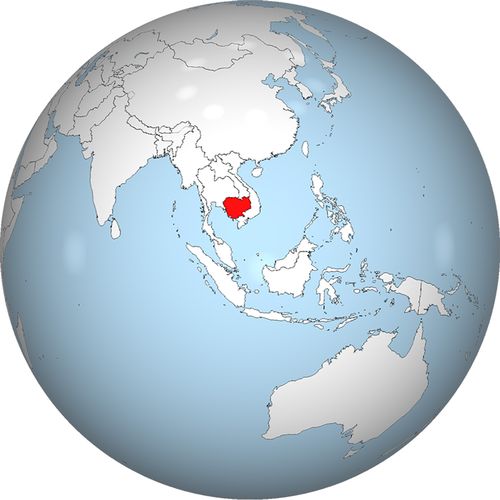
This map illustrates the maximum territory that the Khmer Dynasty had reached at its height, covering the current regions of __ in Cambodia. Its main purpose is to provide a visual aid to understand the geographical extent of this dynasty. However, it's important to note that the contemporary borders of these regions may not necessarily coincide with the historical territories.
The Khmer Dynasty and Its Role in the History of Cambodia
A Royal Power That Shaped Cambodian Historical Identity
The Khmer dynasty, understood here as the succession of rulers of the Khmer Empire centred on Angkor, occupies a foundational place in the history of Cambodia. From the early ninth century onward, the Angkorian kings developed one of the most powerful and enduring states of mainland Southeast Asia. Their authority extended from the Cambodian heartland around the Tonle Sap and the Mekong basin to wider zones of influence in present day Thailand, Laos and southern Vietnam during periods of expansion.
The importance of the Khmer rulers lies not only in their political power, but also in their long term cultural impact. Angkor became the symbolic centre of Cambodian civilisation. Its temples, inscriptions, reservoirs, roads and urban structures formed a political and religious landscape that shaped Cambodian memory for centuries. Even after the decline of Angkor as a royal capital, the legacy of the Khmer Empire remained central to Cambodian identity.
Sacred Kingship and the Organisation of Royal Authority
The political system of Angkor was built around a powerful conception of kingship. The king was not merely a military leader or administrator. He was presented as the guarantor of cosmic order, religious legitimacy and territorial stability. This model drew on Hindu concepts of divine kingship and later incorporated Buddhist forms of royal patronage.
From Jayavarman II onward, the Angkorian rulers developed a monarchy in which political authority was expressed through ritual, architecture and control over land. Royal capitals were designed as sacred spaces, often organised around temple mountains symbolising Mount Meru, the cosmic centre of the universe in Indian religious thought. The king’s authority was therefore made visible in stone, water and ceremonial space.
This sacred dimension did not prevent practical administration. The empire relied on officials, provincial elites, temple estates, taxation, corvée labour and networks of local dependency. The Khmer state was able to mobilise large numbers of workers for construction, agriculture, warfare and religious foundations. Its power depended on the balance between royal command and cooperation with regional elites.
Angkor as a Major Power in Mainland Southeast Asia
Politically, the Khmer Empire became one of the dominant forces of mainland Southeast Asia. Its rulers controlled the Cambodian core and, at different times, extended influence westward toward the Khorat Plateau and central Thailand, northward into parts of the Mekong basin, and eastward toward regions bordering Champa. This expansion brought the Khmer kings into contact and conflict with neighbouring powers.
Relations with Champa were especially important. The two states alternated between diplomacy, rivalry and warfare. Cham attacks on Angkor in the twelfth century caused a major crisis, but the subsequent restoration of Khmer power under Jayavarman VII demonstrated the resilience of the Angkorian state. To the west, Khmer influence affected Mon and later Tai political formations, while the rise of new Tai kingdoms eventually contributed to the weakening of Angkor’s regional dominance.
The Khmer dynasty thus played a major role in shaping the political geography of Southeast Asia. Its power linked the Cambodian plains to broader continental networks of warfare, diplomacy, trade and cultural exchange.
Monumental Architecture as Political and Religious Expression
The cultural impact of the Khmer dynasty is most visible in architecture. Angkor Wat, the Bayon, Preah Khan, Ta Prohm, Banteay Srei, Bakong and many other monuments reveal a civilisation of remarkable artistic and technical sophistication. These structures were not isolated religious buildings. They were instruments of royal representation, territorial control and cultural memory.
Angkor Wat, associated with Suryavarman II, expressed both devotion to Vishnu and the grandeur of royal authority. The Bayon and Angkor Thom, associated with Jayavarman VII, reflected a different religious and political vision, shaped by Mahayana Buddhism and a strong concern with royal protection. Through such monuments, the Khmer rulers connected their reigns to divine order, dynastic legitimacy and the welfare of the kingdom.
Sculpture, bas reliefs, inscriptions and architectural planning also contributed to a distinct Khmer artistic language. Religious themes from India were adapted to local traditions, court ideology and Cambodian landscapes. This ability to transform external influences into a recognisably Khmer civilisation was one of the dynasty’s most enduring achievements.
Agriculture, Water Management and Economic Power
The economic strength of the Khmer Empire was closely linked to agriculture and water management. The Angkor region benefited from the Tonle Sap system, seasonal floods and fertile plains. The rulers supported or controlled large scale hydraulic works, including reservoirs, canals and embankments, which helped organise water storage, irrigation and transport.
Rice production formed the foundation of the empire’s wealth. Agricultural surplus supported the royal court, temple communities, military activity and monumental construction. Temples functioned not only as religious centres, but also as economic institutions. They possessed land, labour, livestock, goods and dependent populations.
The empire also participated in regional exchange. Roads, rivers and trade routes connected Angkor with other parts of mainland Southeast Asia. Although the Khmer economy was primarily agrarian, it was not isolated. It depended on the circulation of goods, people, religious ideas and political influence across a wide region.
Religious Transformation and Social Continuity
The Khmer dynasty presided over major religious transformations. Early Angkorian kings were strongly associated with Hindu traditions, especially the worship of Shiva and Vishnu. Later rulers, most notably Jayavarman VII, promoted Mahayana Buddhism on a grand scale. From the late Angkorian period onward, Theravada Buddhism became increasingly important and eventually shaped Cambodian religious life more deeply than earlier royal cults.
These changes did not erase the past. Instead, they layered new practices over older sacred landscapes. Temples were reused, reinterpreted and sometimes modified. The religious history of Angkor therefore reflects continuity as much as change. It shows how Cambodian society absorbed and transformed multiple religious traditions.
A Foundational Legacy for Cambodia
The Khmer dynasty’s role in Cambodian history is exceptional. It created a powerful state, developed a monumental capital, organised a productive agrarian economy and produced one of the most influential artistic traditions of Southeast Asia. Its rulers shaped the political imagination of Cambodia long after Angkor ceased to be the main royal centre.
The legacy of Angkor remains central to Cambodian historical identity. It represents royal authority, religious creativity, architectural achievement and cultural continuity. The Khmer dynasty was therefore not simply one ruling house among others. It was the political and cultural foundation of a civilisation whose memory continues to define Cambodia’s place in the history of Southeast Asia.
The Geographical Extent of the Khmer Empire in the History of Cambodia
A Cambodian Heartland Around Angkor and the Tonle Sap
The geographical extent of the Khmer dynasty, understood here as the rulers of the Angkorian Khmer Empire, was rooted in the Cambodian heartland around Angkor, the Tonle Sap and the middle Mekong basin. This region provided the political, agricultural and symbolic base from which the Khmer kings expanded their influence across mainland Southeast Asia. The plain surrounding Angkor offered fertile land, access to water, communication routes and a dense population capable of supporting royal administration, temple foundations and military campaigns.
The Tonle Sap was central to this system. Its seasonal flooding created rich agricultural and fishing resources, while its waterways connected the Angkor region to the Mekong and to other parts of Cambodia. Control of this area allowed the Khmer rulers to organise food production, labour mobilisation and transport. The Cambodian core was therefore not only the centre of royal power, but also the economic foundation of imperial expansion.
Expansion From the Angkorian Centre
From the reign of Jayavarman II in the early ninth century, the Khmer rulers progressively consolidated territories in present day Cambodia. Early royal centres such as Hariharalaya and Yasodharapura helped structure authority over the surrounding plains. Over time, the capital region became increasingly monumental, with temples, reservoirs, roads and administrative foundations reinforcing the connection between royal ideology and territorial control.
The Khmer state did not expand as a modern state with fixed borders. Its authority varied according to distance from the capital, military strength, local alliances and the loyalty of provincial elites. In the central regions, the king’s power was more direct. In outer territories, control often depended on tributary relationships, religious foundations, governors and local aristocracies. The empire was therefore organised as a hierarchy of centres and dependencies rather than as a uniformly administered territory.
Western Influence Toward Present Day Thailand
One of the most important directions of Khmer expansion was westward. During periods of strength, Angkorian authority reached into areas that are now part of Thailand, especially the Khorat Plateau, the Mun River basin and parts of the central plains. The presence of Khmer temples, inscriptions, roads and religious foundations in these regions reflects strong political and cultural influence.
This western expansion placed the Khmer rulers in contact with Mon communities, local chiefdoms and later Tai speaking groups. For several centuries, Khmer power shaped the political and religious landscape of these areas. Temples built in Khmer style, often dedicated to Hindu or Buddhist cults, served both as sacred centres and as markers of royal authority.
In the long term, however, these western territories became increasingly difficult to hold. The rise of Tai polities, especially Sukhothai and later Ayutthaya, changed the balance of power. These emerging kingdoms challenged Khmer authority and gradually reduced Angkor’s influence in the western regions. The western frontier therefore became both a zone of expansion and a source of long term vulnerability.
Northern and Northeastern Connections in the Mekong Basin
Khmer influence also extended northward and northeastward into regions corresponding to parts of present day Laos and the upper Mekong basin. These areas were important for movement, trade and political communication between the Cambodian lowlands and the upland zones of mainland Southeast Asia. Control over routes and river corridors allowed the Khmer kings to connect their capital with distant territories and dependent centres.
The degree of Khmer control in these northern regions varied over time. In some places, royal authority may have been expressed through temple foundations, inscriptions or local rulers acknowledging Angkorian supremacy. In others, the relationship was likely more indirect. This flexible pattern was typical of many premodern Southeast Asian states, where influence could extend beyond areas of direct administration.
Eastern Rivalry With Champa
To the east, the Khmer Empire faced Champa, a major power located along the coast of what is now central and southern Vietnam. Relations between the Khmer and Cham worlds were complex. They included trade, diplomacy, cultural exchange, rivalry and war. The Khmer Empire was primarily a continental power, while Champa had strong maritime connections. This difference shaped their strategic interests.
Several Khmer rulers campaigned against Champa, while Cham forces also attacked Khmer territory. The Cham assault on Angkor in the twelfth century was one of the most serious crises in Khmer history. The later restoration of power under Jayavarman VII demonstrated the resilience of the Angkorian state, but also showed that Khmer expansion was never secure. The eastern frontier required constant military and diplomatic attention.
Southern Links Toward the Mekong Delta
Khmer influence extended southward into parts of the lower Mekong region, including zones that later became highly contested between Cambodian and Vietnamese powers. The Mekong delta and its waterways were important for trade, agriculture and communication with maritime routes. In the Angkorian period, Khmer cultural and political influence was present in parts of this wider southern landscape, although the exact degree of direct control varied by period.
This southern orientation connected Angkor with riverine and coastal networks. It also helped place the Khmer Empire within the broader commercial world of Southeast Asia. The empire was fundamentally agrarian, but it was not isolated from regional exchange.
Territorial Control Through Roads, Temples and Water Systems
The geographical reach of the Khmer Empire depended on infrastructure as much as conquest. Roads, bridges, rest houses, reservoirs and temples helped connect the capital to distant territories. Under Jayavarman VII, the construction of roads and religious foundations strengthened the imperial network and linked provincial areas more closely to Angkor.
Temples functioned as political markers, religious centres and economic institutions. They held land, labour and resources, and they helped integrate distant regions into the royal order. This system made Khmer expansion durable, but also dependent on the strength of the central monarchy.
A Regional Empire That Reshaped Mainland Southeast Asia
The geographical extent of the Khmer dynasty made Angkor one of the dominant powers of mainland Southeast Asia. Its rulers controlled the Cambodian core and projected influence into present day Thailand, Laos and southern Vietnam. These territorial ambitions shaped relations with neighbouring dynasties, especially Champa in the east and the rising Tai states in the west.
The decline of Angkor reflected the difficulty of maintaining such a broad continental system. Military pressure, changing trade patterns, religious transformation and the rise of neighbouring powers gradually reduced Khmer dominance. Yet the memory of this territorial reach remained central to Cambodian history. The Khmer Empire gave Cambodia a monumental heartland, a regional political legacy and a historical identity deeply connected to Angkor.
The term “Khmer dynasty” is used here for the rulers of the Khmer Empire of Angkor, not for a single dynasty in the strict genealogical sense. Angkorian chronology varies between reconstructions, especially for the disputed reigns of the eleventh century and for the end of the Angkorian period; the dates below are therefore indicative.
- Jayavarman II (c. 802–850 CE) • He is traditionally regarded as the founder of Angkorian kingship. His reign marks the assertion of independent Khmer power.
- Jayavarman III (c. 850–877 CE) • He succeeded Jayavarman II and maintained the continuity of the young Angkorian state. His reign remains relatively poorly documented.
- Indravarman I (c. 877–889 CE) • He strengthened the Khmer state through hydraulic and religious works. He built Preah Ko and Bakong at Hariharalaya.
- Yasovarman I (c. 889–910 CE) • He founded Yasodharapura, the first great Angkorian capital. His reign was decisive for the monumental and political organisation of Angkor.
- Harshavarman I (c. 910–923 CE) • He continued the work of Yasovarman I in the Angkor region. His reign belongs to a period of dynastic consolidation.
- Ishanavarman II (c. 923–928 CE) • He ruled briefly after Harshavarman I. The surviving information about his government is limited.
- Jayavarman IV (c. 928–941 CE) • He transferred the centre of power to Koh Ker. His reign is associated with an original monumental phase outside the Angkor core.
- Harshavarman II (c. 941–944 CE) • He ruled briefly after Jayavarman IV. His authority belongs to the transition between Koh Ker and the return toward Angkor.
- Rajendravarman II (c. 944–968 CE) • He restored the royal centre at Angkor. His reign is associated with Pre Rup and with renewed political expansion.
- Jayavarman V (c. 968–1001 CE) • He governed a period of cultural and intellectual prosperity. The temple of Ta Keo belongs to the context of his reign.
- Udayadityavarman I (c. 1001–1002 CE) • He ruled very briefly after Jayavarman V. His place in the succession is linked to the troubles of the early eleventh century.
- Jayaviravarman (c. 1002–1011 CE, disputed reign) • He was one of the claimants to power after the death of Jayavarman V. His authority was challenged by Suryavarman I.
- Suryavarman I (c. 1006–1050 CE) • He gradually imposed his power after a period of conflict. His reign greatly extended Khmer influence.
- Udayadityavarman II (c. 1050–1066 CE) • He built the Baphuon and continued the development of Angkor. His reign was marked by regional revolts.
- Harshavarman III (c. 1066–1080 CE) • He succeeded Udayadityavarman II in a fragile political context. His reign preceded the rise of a new royal line.
- Jayavarman VI (c. 1080–1107 CE) • He founded a new line originating from the north-east of the kingdom. His power seems first to have been established outside the traditional Angkorian centre.
- Dharanindravarman I (c. 1107–1113 CE) • He succeeded Jayavarman VI and maintained the authority of this line. His reign was relatively short.
- Suryavarman II (c. 1113–1150 CE) • He reunified the kingdom and led campaigns against Cambodia’s neighbours. He is chiefly associated with the construction of Angkor Wat.
- Dharanindravarman II (c. 1150–1160 CE) • He ruled after Suryavarman II in a less well documented period. He was probably connected with the line that led to Jayavarman VII.
- Yasovarman II (c. 1160–1166 CE) • His reign was marked by internal tensions. He was overthrown by Tribhuvanadityavarman.
- Tribhuvanadityavarman (c. 1166–1177 CE) • An usurper or disputed ruler, he reigned until the Cham attack on Angkor. His fall opened the way for the return of Jayavarman VII.
- Jayavarman VII (c. 1181–1218 CE) • He restored Khmer power after the Cham invasion. His reign was marked by Bayon, Angkor Thom, Ta Prohm, Preah Khan and a vast Buddhist programme.
- Indravarman II (c. 1218–1243 CE) • He succeeded Jayavarman VII and maintained part of his religious and political legacy. The kingdom then entered a phase of reduced expansion.
- Jayavarman VIII (c. 1243–1295 CE) • He favoured a return to Shaivite Hindu worship. His reign is associated with a reaction against some Buddhist monuments of the previous period.
- Srindravarman (c. 1295–1308 CE) • He took power after Jayavarman VIII and favoured Theravada Buddhism. His reign corresponds to a lasting religious transformation of Cambodia.
- Indrajayavarman (c. 1308–1327 CE) • He ruled during a period of gradual decline in Angkorian power. The sources become scarcer for this phase.
- Jayavarmadiparamesvara (c. 1327–mid-fourteenth century CE) • He is one of the last Angkorian rulers mentioned by Sanskrit inscriptions. His reign belongs to the late and poorly documented phase of Angkor.
 Links to the main sections of the site