

 Français (France)
  Nederlands (nl-NL)
 The South Gate of Angkor Thom, located in Angkor, Cambodia, is one of the main entrances to the ancient capital of the Khmer Empire. It is adorned with impressive statues of mythological figures, symbolizing spiritual protection and the city's power. The gate is renowned for the large carved face at its top, representing either King Jayavarman VII or the bodhisattva Avalokiteshvara. This monument, a testament to Khmer artistic refinement, attracts visitors with its majestic presence and its significance in Angkor’s spiritual and architectural heritage.
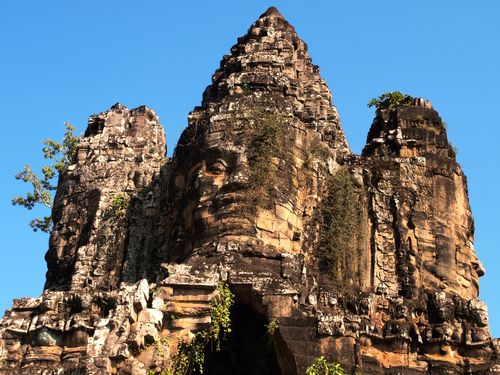
Angkor • South Gate of Angkor Thom: gigantic heads above the door
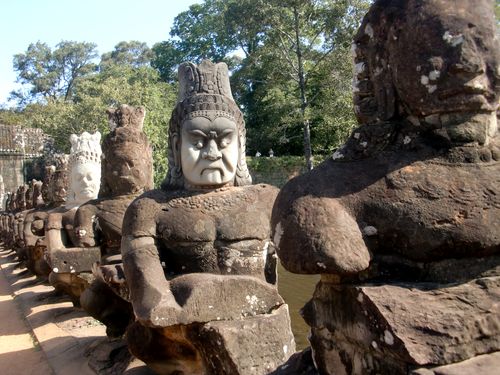
Angkor • South Gate of Angkor Thom: naga-wearing deities
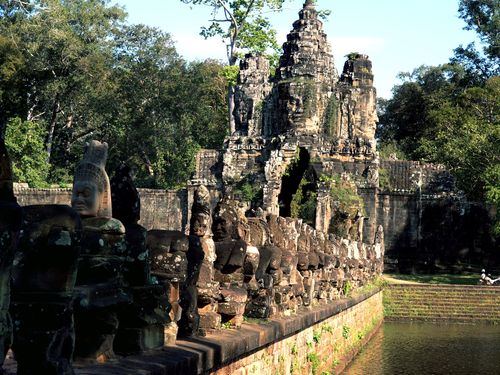
Angkor • South Gate of Angkor Thom: deities wearing a naga and the gate
Monument profile
South Gate of Angkor Thom
Monument categories: Fort, Giant Statues
Monument families: Fort, Fortifications or Citadel • Giant statues or set of statues
Monument genres: Military, Religious
Cultural heritages: Hindu, Buddhist
Geographic location: Angkor • Cambodia
Construction period: 12th century AD
This monument in Angkor is inscribed on the UNESCO World Heritage List since 1992 and is part of the serial property "Angkor".See the UNESCO monuments featured on this site
• Links to •
• Dynasties that contributed to the construction of the monument •

• List of videos about Angkor on this site •
Angkor, the Preah Khan temple • Cambodia
Angkor, Ta Prohm temple • Cambodia
Angkor Thom, the Great City • Cambodia
Angkor Wat, masterpiece of Khmer architecture • Cambodia
• References •
Wikipedia EN: Angkor Thom
UNESCO: Angkor
The South Gate of Angkor Thom: Political Symbolism, Historical Evolution, and Preservation Challenges
Political and Social Motivations Behind the Construction
The South Gate of Angkor Thom, constructed in the late 12th century during the reign of King Jayavarman VII, served as a symbol of the Khmer Empire’s strength and unity. Built at Angkor, the empire’s capital, this gate was one of five monumental entrances to the fortified city of Angkor Thom. Jayavarman VII, a devout follower of Mahayana Buddhism, sought to establish his rule through both spiritual and political authority after a period of conflict with the neighboring kingdom of Champa. By embedding religious and royal symbolism into the South Gate’s architecture, he conveyed a message of divine protection and benevolence. The massive stone faces atop the gate, thought to represent either the bodhisattva Avalokiteshvara or Jayavarman VII himself, reflect the king’s intention to be seen as a benevolent, god-like protector of his people.
Key Historical Events and Regional Influence
Over the centuries, the South Gate of Angkor Thom has witnessed numerous shifts in power and influence in Southeast Asia. The Khmer Empire reached its height under Jayavarman VII but later experienced decline due to internal strife and pressure from neighboring states. By the 15th century, Thai forces from Ayutthaya posed a significant threat, leading to the gradual abandonment of Angkor as a political center. The South Gate, though largely unaffected structurally, became a silent testament to the once-mighty Khmer Empire. The rediscovery of Angkor by French explorers in the 19th century, particularly by Henri Mouhot, rekindled global interest in the site and highlighted its historical importance, eventually giving rise to the field of Khmer studies and archaeological preservation.
Global Context: Comparison with Other Regions
The construction of Angkor Thom and its South Gate took place during an era marked by monumental architecture in various parts of the world. In Europe, cathedrals such as Notre-Dame in Paris were being built, symbolizing the rising power of the Christian Church. Similarly, in Asia, the Song Dynasty in China and the Chola Empire in India were erecting temples and palaces to assert their political and religious influence. However, the South Gate of Angkor Thom stands out for its unique combination of Buddhist and Hindu symbolism, reflecting the integration of diverse spiritual traditions within the Khmer Empire and underscoring its cosmopolitan nature.
Major Transformations and Cultural Influences Over Time
The South Gate of Angkor Thom has undergone significant transformations over the centuries, shaped by both environmental factors and cultural influences. With the decline of the Khmer Empire, the site was gradually reclaimed by the surrounding jungle, which preserved but also partially damaged the monument. In the late 19th century, under French colonial rule, restoration efforts began, inspired by the growing interest in Southeast Asian heritage. French archaeologists employed techniques that were advanced for the time, ensuring that the South Gate and other parts of Angkor Thom could withstand the impact of time and weather.
The influence of various Asian cultures, especially Indian and Javanese, is evident in the artistic details of the South Gate. The alignment of the statues and carvings along the approach to the gate—depicting Hindu mythological scenes like the Churning of the Ocean of Milk—reflects a blend of Khmer, Hindu, and Buddhist elements that contributed to the unique identity of Angkor.
Cultural Significance and Current State of Conservation
Today, the South Gate of Angkor Thom is a prominent symbol of Cambodian cultural identity and a key attraction for global visitors. Its recognition as a UNESCO World Heritage Site in 1992 helped bolster international efforts to preserve the monument, which stands as a lasting symbol of the Khmer Empire’s architectural and artistic achievements. The large, serene faces and intricate sculptures along the approach to the gate capture the imagination of visitors, embodying the spiritual and political legacy of the empire. With continuous conservation efforts, the South Gate remains in remarkable condition, a testament to both ancient and modern preservation techniques.
Modern Preservation Challenges
Despite its good state of preservation, the South Gate of Angkor Thom faces numerous modern challenges. The tropical climate, characterized by high humidity and heavy rainfall, accelerates the erosion of sandstone carvings. Additionally, the steady flow of tourists puts strain on the structure, necessitating strict visitor management and maintenance practices. Cambodian authorities, in collaboration with UNESCO and international conservation teams, have implemented monitoring systems and restoration techniques to safeguard the monument’s integrity for future generations.
Conclusion
The South Gate of Angkor Thom represents the architectural innovation and spiritual vision of Jayavarman VII, blending advanced construction techniques with profound religious symbolism. This monumental gate is a lasting symbol of the Khmer Empire’s glory, and its international recognition as a UNESCO World Heritage Site emphasizes the importance of preserving such cultural treasures. As a site of historical and spiritual significance, the South Gate continues to captivate and inspire, highlighting the ongoing need for dedicated preservation efforts to protect this invaluable piece of human heritage.
The South Gate of Angkor Thom: Architectural Innovation and Cultural Fusion of the Khmer Empire
Technological Advancements and Construction Techniques
The South Gate of Angkor Thom, built in the late 12th century under the reign of King Jayavarman VII, showcases the technological prowess and architectural innovation of the Khmer Empire. Constructed primarily from sandstone, a locally abundant but challenging material, the gate exemplifies the precision and skill of Khmer engineers. The structure, which stands over 20 meters tall, was constructed with interlocking sandstone blocks that fit together without the use of mortar, demonstrating advanced knowledge of structural stability and load distribution.
One of the most remarkable features of the gate is the central tower adorned with four massive faces, each facing a cardinal direction. This feature required careful alignment and balance, as well as highly skilled artisans capable of detailed stone carving on a grand scale. These faces, representing either the bodhisattva Avalokiteshvara or Jayavarman VII himself, embody both spiritual and political symbolism, reinforcing the ruler’s image as a protector and spiritual guide for his people.
Materials and Techniques Reflecting the Grandeur of the Era
Sandstone, chosen for its durability and ability to be finely carved, was the primary material for constructing the South Gate. Artisans used tools made from copper and iron to achieve the intricate details of the massive faces and the surrounding reliefs. Each piece of stone was meticulously carved and then positioned to create a smooth, cohesive surface that has withstood centuries of weathering. The construction techniques reflect the empire's architectural advancements, as the gate remains largely intact despite the region's challenging climate.
The road leading to the gate is flanked by rows of statues representing a scene from Hindu mythology known as the "Churning of the Ocean of Milk," where gods and demons cooperate to obtain the elixir of immortality. This alignment of sculptures and the gate’s imposing entrance create a grand processional route, emphasizing the gate’s role as a transition from the mundane world to the spiritual and political heart of the empire.
Unique Blend of Regional and Foreign Artistic Traditions
The South Gate of Angkor Thom is an extraordinary example of cultural fusion, combining local Khmer artistic traditions with influences from Indian and Javanese art. The bodhisattva faces, with their serene expressions and slight smiles, reflect a unique Khmer interpretation of Buddhist art, possibly inspired by earlier Indian and Javanese depictions. Meanwhile, the Hindu scene along the approach aligns with the Hindu-Buddhist syncretism promoted by Jayavarman VII, who merged elements of both religions to unify the empire’s diverse spiritual beliefs.
The blend of these influences reflects the Khmer Empire’s openness to external cultures and its ability to adapt foreign ideas into its own distinct style. This cultural fusion not only elevated the architectural beauty of the gate but also strengthened Jayavarman VII’s authority by appealing to the varied beliefs of his subjects.
Noteworthy Structure and Architectural Plan
The South Gate, one of the five main entrances to the fortified city of Angkor Thom, was strategically positioned to convey grandeur and authority. The gate’s structure, with a central passage flanked by towers, leads visitors along a wide, 7-meter causeway lined with the statues of gods and demons. The alignment of the colossal faces atop the gate allowed travelers to see the imposing visage of the ruler or bodhisattva from all directions, reinforcing a sense of omnipresence and divine protection.
This design choice created an unforgettable visual impact, projecting the power of the Khmer Empire to both citizens and visitors. The scale and symmetry of the structure, combined with its detailed decorative motifs, demonstrate a mastery of both architectural and symbolic design.
Historical Significance and Recognition as a UNESCO World Heritage Site
The South Gate of Angkor Thom, along with the rest of Angkor, was inscribed as a UNESCO World Heritage Site in 1992. This designation has played a crucial role in bringing international attention to the site and securing resources for its conservation. The UNESCO recognition emphasized the South Gate’s importance as a masterpiece of Khmer architecture and a symbol of Cambodia’s cultural heritage, attracting millions of visitors annually.
The gate’s inscription on the UNESCO list has also fostered global interest in Southeast Asian history and art, contributing to the preservation of Khmer architectural achievements. As part of an iconic World Heritage Site, the South Gate is now protected and monitored, ensuring that its legacy endures for future generations.
Modern Conservation Challenges
Despite its robust construction, the South Gate of Angkor Thom faces several modern preservation challenges. The humid, tropical climate of Cambodia, coupled with heavy monsoon rains, accelerates the deterioration of sandstone. Furthermore, the high volume of visitors has increased the risk of erosion, necessitating strict management practices to control access and protect the stonework. Restoration teams, including Cambodian authorities and international experts, use advanced monitoring and restoration techniques to preserve the monument’s integrity while allowing for sustainable tourism.
Conclusion
The South Gate of Angkor Thom is a testament to the Khmer Empire’s architectural ingenuity and cultural synthesis, combining advanced construction techniques with deep spiritual symbolism. Its monumental design and the fusion of regional and foreign artistic elements contribute to its status as a globally recognized cultural treasure. As a UNESCO World Heritage Site, the South Gate stands as a symbol of Cambodia’s rich history and cultural identity, inspiring both awe and respect while underscoring the importance of continued preservation efforts.