Français (France)
  Nederlands (nl-NL)
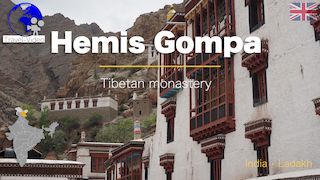
 00:00 • intro | 00:34 • approaching the Hemis monastery | 01:11 • in the courtyard of the monastery
Personal creation from visual material collected during my trip Unknown India • Ladakh, Karnataka, Telangana (2022)
Map of places or practices in Hemis on this site
• Use the markers to explore the content •
Hemis Gompa: A Cultural Landmark in the Himalayan Landscape of Ladakh
A monastery set within a preserved mountain environment
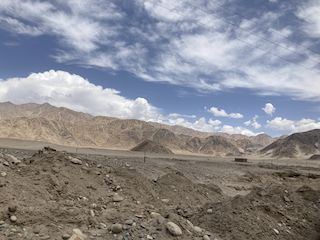
Located southeast of Leh, in a side valley of the Indus River, Hemis Gompa stands out for both its relative isolation and the scale of its monastic complex. Surrounded by rugged mountains and sparse vegetation, the site is revealed gradually, reinforcing the impression of a secluded spiritual center embedded in a demanding natural setting. This relationship between architecture and landscape is essential to understanding the monastery.
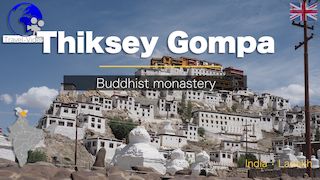
The video highlights this dynamic by first introducing the surrounding terrain before revealing the architectural ensemble itself. The buildings, with their whitewashed walls and layered volumes, form a structured composition that responds to both topographical constraints and religious functions.
Approaching the site and the central courtyard
The approach to the monastery plays a key role in the perception of the site. The path leading to Hemis crosses a stark landscape before opening onto a dense architectural cluster. This transition emphasizes the passage from an open environment to a more defined and symbolic space.
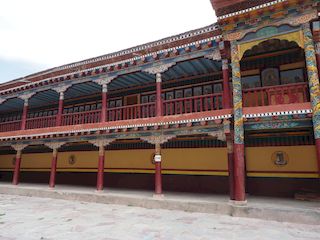
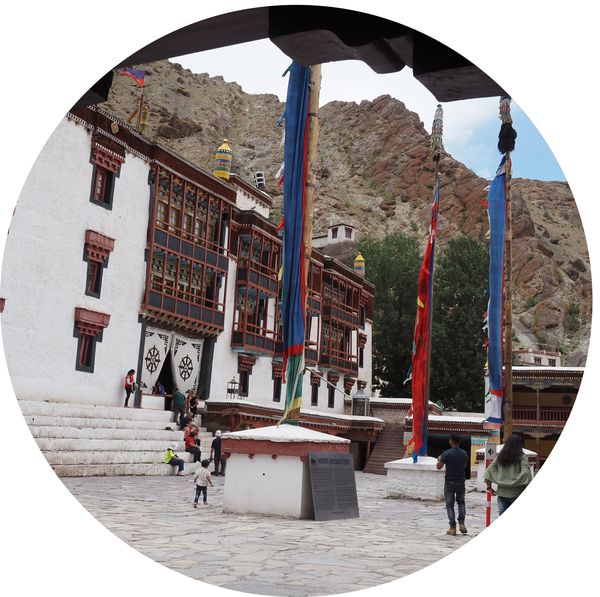
At the heart of the complex, the courtyard of Hemis Gompa serves as a central gathering area. It functions as the main setting for religious ceremonies and communal events, including festivals where ritual dances and processions take place. The spatial organization around this courtyard reflects a clear hierarchy, with open areas designed for collective use and more enclosed structures dedicated to prayer, study, and daily monastic life.
Historical background and religious traditions
Founded in the seventeenth century under the patronage of Ladakhi rulers, Hemis Gompa is affiliated with the Drukpa lineage of Tibetan Buddhism. Over time, it developed into one of the most influential monastic institutions in the region, supported by political authority and endowed with significant resources. This status is reflected in both its architectural scale and the richness of its cultural traditions.
The monastery is particularly known for its annual festival, during which masked dances convey symbolic narratives rooted in Buddhist teachings. These performances illustrate how spiritual concepts are expressed through visual and performative forms, reinforcing the role of the monastery as both a religious and cultural center.
Architecturally, Hemis shares many characteristics with major Himalayan monasteries. The use of stone and earth ensures thermal efficiency in a high-altitude environment marked by strong temperature variations. The exterior remains relatively austere, while interior spaces often display more elaborate decoration, including wall paintings and sculptural elements. The terraced arrangement of buildings follows the natural slope, structuring both circulation and spatial relationships.
A visual method that clarifies complex spaces
The videos presented on this site offer a particularly effective way to understand such a complex environment. By relying largely on carefully selected and animated photographs, they allow for a detailed observation of architectural features, textures, and proportions. This approach slows down the viewing experience and makes it easier to perceive elements that might otherwise go unnoticed.
The progression of images guides the viewer from the initial approach to the interior of the monastery, revealing how spaces are connected and how the overall layout is organized. This structured visual narrative helps clarify the relationship between buildings, open areas, and the surrounding landscape, providing a more comprehensive understanding of the site.
A convergence of architecture, landscape, and spiritual life
Hemis Gompa emerges as a place where historical development, religious practice, and environmental adaptation intersect. The monastery is not only an architectural landmark but also an active center of spiritual life that continues to shape the cultural identity of Ladakh.
For a deeper exploration, the detailed pages dedicated to the monastery offer further insight into its history, architecture, and enduring traditions, extending the perspective introduced by the video.
Links to related pages


Audio Commentary Transcript
In Ladakh, a high plateau located in the heart of the Himalayas, the landscape is dominated by majestic snow-capped peaks, an arid land, and the Indus River which meanders through the valley, feeding the local population. At the edge of this valley stands the magnificent monastery of Hemis with its crisp white walls and red accents. Symbol of immutable spirituality in one of the most isolated and mystical places in the world.
The local name of this monastery is Hemis Gompa. Gompa is a term used in the region to refer to a place of retreat, study and meditation for the monks of Tibetan Buddhism..
Hemis Monastery is one of the largest and also one of the richest in Ladakh. Hemis Gompa has an impressive collection of ancient Buddhist texts and Tibetan paintings on silk (called Thangkas), but these treasures are not directly accessible to tourists. These treasures have been accumulated over the centuries and the location of the monastery, nestled between the hills of the plateau, has greatly contributed to their protection over the centuries.
If the monastery of Hemis is the largest and probably the richest culturally in all of Ladakh, it is also the one that houses the most legends, some of which are eccentric. Thus, some claim that Jesus Christ would have spent some of the years preceding his public life here, probably at the monastery although this was not founded until the 16th century. This theory, known as "Issa" or "Jesus in India" comes from the imagination of a late 19th century Russian journalist named Nicolas Notovitch. He claimed to have discovered ancient texts at the monastery of Hemis describing a journey of Jesus to India during those years. Proof that fake news does not date from today...
Music:
- (Live Music) - - Live music