Français (France)
  Nederlands (nl-NL)
 00:00 • intro | 00:28 • the fort | 01:30 • the life in the village
Personal creation from visual material collected during my trip Cuba (2015)
Map of places or practices in Cojimar on this site
• Use the markers to explore the content •
Cojímar, Fishing Village and Coastal Memory near Havana
A maritime community on the edge of the capital
East of Havana, Cojímar preserves a distinct identity within the wider urban area of the Cuban capital. Facing the sea and centred around a small harbour, it developed as a fishing village whose daily rhythms long depended on boats, tides and coastal work. Its modest scale and open waterfront create a strong contrast with the grand plazas and monumental districts of central Havana.
Cojímar also carries cultural significance beyond its size. It represents a more intimate maritime side of Cuba, where local traditions, neighbourhood life and the relationship with the sea remain central. The village atmosphere gives the area a character very different from the ceremonial image often associated with Havana.
This video explores that setting through the old fort, the shoreline and scenes of everyday village life.
The fort and the defence of the coast
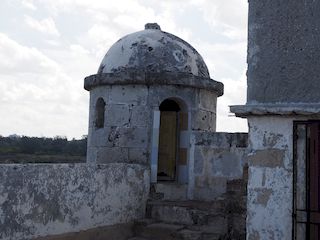
One of the main landmarks shown in the video is the Castillo de Cojímar, the historic fort overlooking the bay. Built during the Spanish colonial period, it formed part of the defensive network designed to protect Havana’s eastern approaches. Caribbean waters were contested for centuries, and coastal watchpoints such as this one played an important strategic role.
Its elevated position was carefully chosen. From the headland, guards could monitor vessels approaching the coast and communicate potential threats. The structure itself reflects military priorities: thick walls, compact forms and practical organisation rather than decorative display.
Today, the fort remains the most visible historic monument in Cojímar. It connects the quiet present-day village with a time when coastal defence shaped the landscape of the region.
Village life and the world of fishing
Beyond the monument, Cojímar is especially interesting because it remains a living settlement. The scenes of village life reveal streets, homes, harbour spaces and informal meeting points where daily activity continues close to the sea.
Fishing long provided the economic foundation of the community. Even as occupations diversified, the image of boats, nets, docks and returning crews remained tied to the identity of the village. This continuity gives Cojímar an authenticity that differs from places shaped mainly by heritage tourism.
The village also became internationally known through its connection with Ernest Hemingway, who frequented the area during his years in Cuba. While that association is only one part of Cojímar’s story, it contributed to its broader cultural visibility.
Historical and architectural context
Cojímar developed in relation to Havana but retained its own function as a secondary harbour and coastal settlement. Its architecture is modest compared with the grand civic buildings of the capital, yet this simplicity is part of its interest. Low-rise houses, practical waterfront spaces and the dominant fort together form a landscape shaped by use rather than ceremony.
The fort dates from the eighteenth century, a period when Spain strengthened Havana’s outer defences after repeated conflicts in the Caribbean. Smaller positions such as Cojímar complemented the major fortresses guarding the main harbour.
Over time, military importance declined, while the village economy and residential life became more central. This shift from strategic outpost to local fishing community is one of the key themes visible in the area today.
What this site’s videos make especially clear
Coastal places are often best understood through the relationship between topography, architecture and everyday movement. Videos created from carefully selected and animated photographs allow viewers to follow that relationship clearly. The eye moves from the fort above the water to the harbour below, then into the streets of the village.
This method also reveals details that may be missed in a quick visit: stone textures, the fort’s commanding position, the scale of the harbour and the coexistence of historic structures with ordinary life.
It helps viewers understand how one place can unite defence history, maritime labour and local identity within a compact landscape.
A quieter face of Havana
Cojímar shows that Havana extends beyond its famous colonial centre. Here, fortifications, fishing traditions and coastal scenery combine in a smaller, more intimate setting. Visitors wishing to continue the discovery can explore the detailed page dedicated to the Castillo de Cojímar and its historical role.
Links to related pages







Music:
- - YouTube video library - Murder Mystery
Disclaimer: Despite its appropriateness, copyright issues prevent the use of cuban traditional music in "Havana, Cojimar - fishing village • Cuba", hence the use of royalty-free music. Despite our careful selection, some might regret this decision, which is necessary to avoid potential lawsuits. Although difficult, this decision is the only viable solution.