Français (France)
  Nederlands (nl-NL)
 00:00 • intro | 00:38 • maneuvering an old steam locomotive | 02:00 • locomotive exhibition | 03:36 • on board the locomotive
Personal creation from visual material collected during my trip Cuba (2015)
• Use the markers to explore the content •
Remedios and the Marcelo Salado Sugar Museum: Cuba’s Railway Heritage
An industrial memory preserved in central Cuba
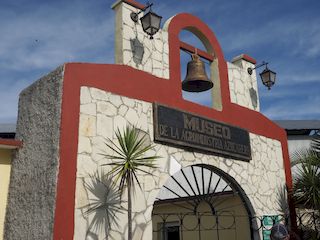
Near Remedios, one of Cuba’s oldest colonial towns, the Marcelo Salado Sugar Museum preserves an important chapter of the island’s economic and technical history. For generations, sugar production shaped Cuban landscapes, labor systems, transport networks and international trade. Railways were at the center of that world, linking plantations, mills and ports with remarkable efficiency.
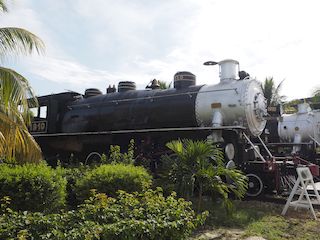
This video focuses on one of the most striking survivals of that period: historic steam locomotives once used in the sugar industry. These machines are more than transport equipment. They represent engineering skills, industrial organization and the daily rhythm of agricultural production. Through locomotive movements, museum displays and scenes filmed from aboard the train, the site offers a vivid encounter with Cuba’s railway past.
Steam locomotives and working machinery
One of the most engaging moments is the manoeuvre of an old steam locomotive. Even at slow speed, such operations reveal the mechanical sophistication of these machines. Wheels, connecting rods, pistons and valves work together in a powerful system that transformed steam pressure into motion. What may seem simple from a distance becomes highly precise when observed closely.
The exhibition area allows visitors to compare several preserved locomotives. Some were designed for hauling loaded wagons of sugar cane from the fields to the processing mills. Others served regional transport or industrial tasks linked to plantation life. Differences in size, wheel arrangement and construction reflect changing technical needs over time.
Travelling aboard the locomotive adds another dimension to the visit. From this perspective, the relationship between machine, railway line and rural landscape becomes easier to understand. The viewer can imagine how these trains once moved through cane-growing regions, carrying raw materials essential to Cuba’s economy.
Sugar, railways and Cuban history
During the nineteenth century, Cuba became one of the world’s leading sugar producers. To move harvested cane quickly before processing, efficient transport was indispensable. Railways therefore developed early on the island, making Cuba one of the pioneers of rail transport in Latin America.
Many lines were built primarily to serve the sugar industry. Private industrial railways connected plantations, workers’ settlements, warehouses and mills, while larger networks linked production zones with export ports. Locomotives were not secondary tools: they formed the logistical backbone of a major economic system.
In the twentieth century, political change, new technologies and shifts in the sugar sector gradually reduced the use of many steam engines. Some disappeared, while others were preserved as historical heritage. Museums such as Marcelo Salado now play an essential role in safeguarding this material memory.
What the videos on this site make especially clear
Videos built largely from carefully selected and animated photographs are particularly effective for railway heritage. They allow viewers to examine technical details with unusual clarity: boilers, cabs, metal fittings, wheel systems and structural proportions become easier to appreciate than during a brief on-site visit.
Slow transitions and controlled visual movement also help explain scale. A locomotive’s length, mass and relationship to the track can be understood progressively. During manoeuvre scenes, viewers can better follow how space is used and how carefully these machines were operated.
This format is equally useful for placing the locomotives within their wider setting. Rather than presenting isolated objects, the video shows them as part of a historical landscape shaped by agriculture, industry and transport.
A living reminder of Cuba’s industrial past
The Marcelo Salado Sugar Museum demonstrates how deeply railways were connected to the development of Cuba. Through preserved steam locomotives, an entire world of labor, engineering and economic exchange becomes visible again. Visitors wishing to explore further can continue with the detailed pages devoted to these historic locomotives and the heritage they represent.










Audio Commentary Transcript
When Cuba was a Spanish colony, the railway was established there more than 10 years before the first train ran on the Iberian Peninsula. It must be said that sugar, the white gold of the time, was extremely profitable. Free labor and high yields on land not yet impoverished by years of monoculture made sugar one of the best investments at that time.
There remained the problem of transport. A train made it possible to transport enormous quantities from all regions of the island to the ports from which the boats departed for Spain. Some locomotives have been restored and are exhibited in the Marcello Salado Sugar Museum.

Music :
- - YouTube video library - AchillesIn Memory of Jean Talon - The Mini Vandals, (© Alchemists Tower - Strings by Kevin MacLeod is licensed under a Creative Commons Attribution 4.0 license. https://creativecommons.org/licenses/by/4.0/
- Source: http://incompetech.com/music/royalty-free/index.html?isrc=USUAN1100632
- Artist: http://incompetech.com/)
- - YouTube video library - Anamalie, (© Anamalie by Kevin MacLeod is licensed under a Creative Commons Attribution 4.0 license. https://creativecommons.org/licenses/by/4.0/
- Source: http://incompetech.com/music/royalty-free/index.html?isrc=USUAN1500007
- Artist: http://incompetech.com/)
Disclaimer: Despite its appropriateness, copyright issues prevent the use of cuban traditional music in "Remedios, Marcelo Salado Sugar Museum • Cuba ", hence the use of royalty-free music. Despite our careful selection, some might regret this decision, which is necessary to avoid potential lawsuits. Although difficult, this decision is the only viable solution.