

 Français (France)
  Nederlands (nl-NL)
 00:00 • intro | 00:35 • the beach | 01:19 • in the alleys of the city | 02:19 • the cathedral of Cefalù | 04:21 • the washouse from 12th century
Personal creation from visual material collected during my trip Italy: Seductive Sicily (2022)
• Use the markers to explore the content •
Cefalù, Where the Sicilian Coast Meets Norman Heritage
A Seaside Town Shaped by History
On the northern coast of Sicily, Cefalù combines the atmosphere of a Mediterranean seaside town with an unusually rich historical legacy. Set between the Tyrrhenian Sea and the steep rocky height known as La Rocca, the town presents a striking urban landscape where medieval streets, religious monuments and coastal life remain closely connected.
This video explores several complementary aspects of Cefalù. The waterfront introduces its maritime identity. The narrow streets reveal the texture of the historic centre. The cathedral recalls the political and artistic ambitions of Norman Sicily, while the twelfth-century wash house offers insight into daily urban life in the Middle Ages.
Cefalù is therefore more than a beach destination. It is a place where natural setting, architecture and centuries of urban continuity can still be read with clarity.
The Seafront and the Historic Streets
The opening views along the coast highlight one of Cefalù’s defining strengths: its relationship with the sea. For centuries, maritime access supported fishing, regional trade and communication with other Sicilian and Mediterranean ports. Even today, the shoreline remains central to the town’s character.
As the video moves inland, the scale changes. Open coastal space gives way to a compact network of lanes, arches and small squares. These streets were shaped by practical needs: shelter from summer heat, efficient use of limited space and close-knit urban organization. Stone facades, balconies and irregular passages preserve the atmosphere of a long-inhabited town rather than a reconstructed historical setting.
This continuity is one of Cefalù’s strengths. The centre is not an isolated monument, but a living urban fabric where residents, visitors and historic buildings still share the same space.
Cefalù Cathedral, Monument of Norman Sicily
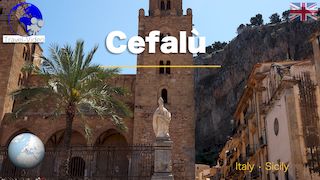
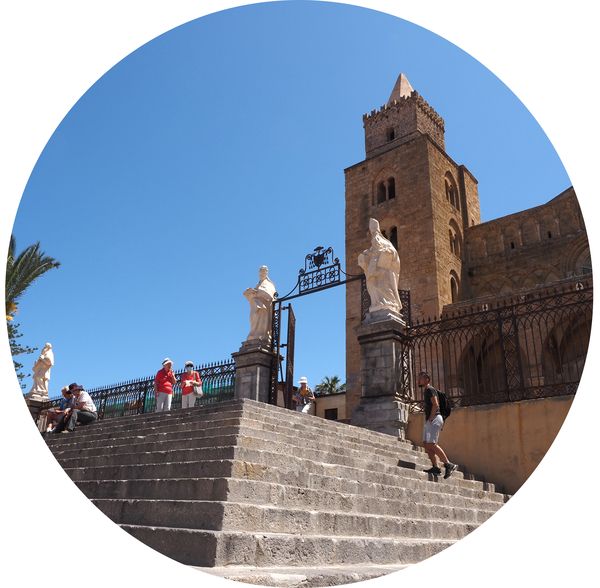
The cathedral is the town’s principal monument and one of the most important medieval churches in Sicily. It was founded in the twelfth century under King Roger II, during the period when the Norman rulers consolidated their power over the island through ambitious architectural patronage.
Its exterior is immediately recognizable: two massive towers frame the facade, while the building occupies a commanding position within the town. The structure reflects the cultural complexity of medieval Sicily, where Norman political authority interacted with Byzantine artistic traditions and technical knowledge inherited from the Islamic Mediterranean world.
Inside, the cathedral is especially renowned for its mosaics, among the finest in Sicily. They demonstrate that Cefalù was not merely a secondary coastal settlement, but a place integrated into the wider political and religious life of the Norman kingdom.
The monument also helps explain the historical importance of Sicily itself, situated between Europe, North Africa and the eastern Mediterranean.
The Medieval Wash House and Everyday Life
The wash house provides a valuable contrast to the grandeur of the cathedral. Often associated with the twelfth century in its medieval phase, although modified later, it represents the practical infrastructure required for urban life.
Water channels and stone basins allowed laundering and domestic tasks to be carried out in a structured communal setting. Such places are essential to understanding historic towns, because they reveal how ordinary life functioned beyond churches, palaces and fortifications.
In Cefalù, the wash house remains one of the most evocative sites in the historic centre. It connects architecture, water management and social memory in a remarkably direct way.
What These Videos Make Especially Clear
Many videos on this site are created from carefully selected and animated photographs rather than relying only on continuous moving footage. This method is particularly effective for a place like Cefalù, where atmosphere depends on relationships between spaces rather than speed of movement.
Slow transitions allow viewers to study details often missed during a brief visit: the texture of stone streets, the scale of the cathedral facade, the contrast between narrow alleys and open squares, and the proximity of the sea to the historic core.
This visual approach also clarifies how the town is organized. The viewer can understand step by step how coastline, streets, monuments and daily-use spaces form a coherent whole shaped over many centuries.
For historic urban environments, this measured rhythm often reveals more than rapid filming alone.
A Distinctive Face of Sicily
Cefalù is admired for its coastal setting, yet its deeper interest lies in the density of history preserved within a compact urban landscape. Between the waterfront, medieval streets, Norman cathedral and surviving civic infrastructure, it offers a vivid introduction to Sicily’s layered past. Those wishing to continue the visit can explore the detailed pages devoted to the cathedral and the wider heritage of the town.




Audio Commentary Transcript
Cefalù is a small town in the province of Palermo in Sicily. It is one of the most popular seaside towns on the island, with a rich historical past. Founded in the 5th century BC by the Greeks, it offers, in addition to its sun and its splendid alleys, a remarkable Norman cathedral dating from the 12th century.
The cathedral of Cefalù, or the cathedral basilica of the Transfiguration was built by Roger II, Norman king of Sicily, following a vow made to the Holy Savior to have saved him from a storm. Its construction dates from 1131 and the building is a fine example of Arab-Norman architecture.
Its Byzantine mosaics, and particularly a Pentocrator Christ, are remarkable.
Deze openbare wasplaatsen van Arabische architectuur, die nog steeds in bedrijf zijn, dateren uit dezelfde periode als de kathedraal, het begin van de 12e eeuw. Ze zijn in de tussentijd duidelijk het onderwerp geweest van restauratiewerkzaamheden.
Music :
- - YouTube video library - Always remember
- - YouTube video library - The Battle of 1066 - Patrick Patrikios
Disclaimer: Despite its appropriateness, copyright issues prevent the use of italian traditional music in "Cefalù, seaside town with a rich historical heritage, Sicily • Italy", hence the use of royalty-free music. Despite our careful selection, some might regret this decision, which is necessary to avoid potential lawsuits. Although difficult, this decision is the only viable solution.


