Français (France)
  Nederlands (nl-NL)
 00:00 • intro | 00:13 • the mosque in the morning sun | 01:00 • the mosque esplanade | 02:43 • towards the interior of the mosque | 03:09 • the women's gallery | 04:23 • the main prayer hall
Personal creation from visual material collected during my trip Morocco 2025 (2025)
• Use the markers to explore the content •
Hassan II Mosque in Casablanca, Monumentality on the Atlantic Shore
A Landmark of Modern Morocco
In Casablanca, the Hassan II Mosque occupies a unique place in the urban and cultural landscape of Morocco. Built directly beside the Atlantic Ocean, it combines monumental scale, traditional craftsmanship and late twentieth-century engineering. Its minaret dominates the coastline and has become one of the most recognizable features of the city.
This video approaches the monument through several complementary viewpoints: the mosque in the early morning light, the vast forecourt, the transition toward the interior, the women’s gallery and the great prayer hall. Together, these scenes reveal not only a religious building, but also a major national project designed to express continuity, prestige and technical ambition.
Casablanca is often associated with commerce, ports and modern growth. The mosque adds another dimension to the city by linking it to the artistic and spiritual traditions of Morocco.
Spaces Revealed by the Visit
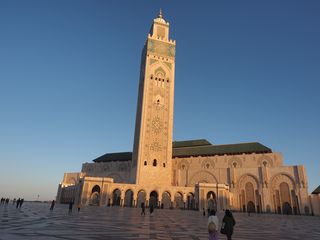
The first views in morning sunlight highlight the exterior surfaces, carved decoration and the relationship between the building and the sea. Light plays an important role here. As shadows move across stone and tilework, the geometry of the structure becomes clearer.
The large esplanade surrounding the mosque is more than an open space. It creates distance and perspective, allowing visitors to grasp the immense size of the complex before entering. It also acts as a threshold between the busy city and the more ordered atmosphere of the sanctuary.
As the video moves inward, scale changes dramatically. Exterior breadth gives way to interior detail: polished materials, repeated arches, carved wood, marble surfaces and carefully organized circulation spaces. The women’s balcony illustrates how the mosque accommodates large congregations through layered spatial planning while preserving visual unity with the main hall below.
The great prayer hall forms the climax of the visit. Its volume, symmetry and decorative richness reflect the ceremonial importance of the building.
Historical and Architectural Context
The Hassan II Mosque was inaugurated in 1993 during the reign of King Hassan II. Its construction belongs to a period when many countries commissioned symbolic public works to project identity and confidence. In Morocco, the project sought to unite religious heritage, artisanal excellence and modern national image.
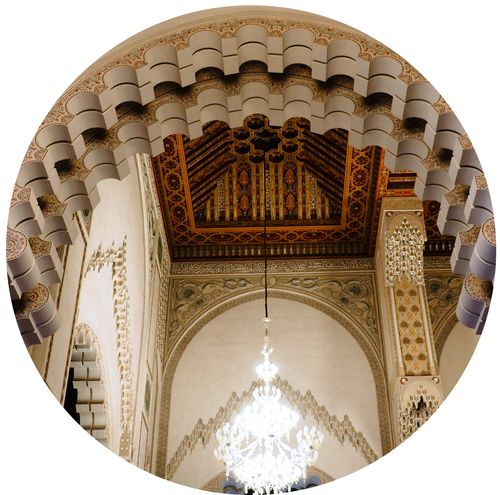
Thousands of craftsmen, engineers and workers contributed to the building. Traditional Moroccan arts were integrated on a monumental scale: zellige mosaic tilework, carved stucco, cedar wood ceilings, marble cladding and calligraphic decoration. These elements root the mosque in long-established artistic traditions while the structural systems, large spans and technical installations reflect contemporary construction methods.
Its position on the Atlantic shore is equally significant. The setting gives the monument an open horizon and reinforces Casablanca’s role as Morocco’s principal maritime metropolis. The meeting of architecture and ocean creates one of the most distinctive urban compositions in North Africa.
The minaret, among the tallest in the world, serves both symbolic and practical purposes. It is visible from many parts of the city and establishes the mosque as a constant point of orientation in the urban landscape.
What These Videos Make Especially Clear
Many videos on this site are built from carefully selected and animated photographs rather than relying only on continuous moving footage. This method is particularly effective for a monument such as the Hassan II Mosque.
Slow transitions and stable framing allow viewers to study details that can be missed during a rapid visit: carved surfaces, proportional relationships, depth of arcades and the contrast between intimate decoration and monumental scale. The progression from exterior spaces to interior halls also becomes easier to understand.
Photographic sequences are equally useful for showing how the mosque interacts with its surroundings. The relation between forecourt, sea edge, skyline and minaret can be read step by step. Instead of a hurried impression, the viewer gains a structured understanding of how the complex was conceived.
Because the monument combines craftsmanship with immense dimensions, this careful visual approach helps reveal both aspects at once.
A Symbol Beyond Scale
The Hassan II Mosque is more than a place of worship or an architectural spectacle. It represents a key moment in the cultural history of modern Morocco, where inherited artistic forms were mobilized for a project of national significance. For Casablanca, it remains one of the city’s defining landmarks. Viewers wishing to go further can continue with the detailed pages dedicated to the monument, its history and its architectural features.

Audio Commentary Transcript
The mosque
Casablanca, Morocco’s economic capital, opens onto the Atlantic Ocean. Here rises the Hassan II Mosque, an emblematic monument and a major landmark of the city. Commissioned by King Hassan II and inaugurated in 1993, it stands as a national symbol and a manifesto of modernity. Yet its monumental scale, built partly over the sea, also embodies a sense of excess. Intended to leave its mark on history, it reflects both political ambition and the tensions of a time when the people’s priorities were different. The Hassan II Mosque thus appears both as a source of pride and a subject of controversy, a unique edifice that dominates the Casablanca seafront and projects the image of a Morocco rooted in tradition and open to the wider world.
The esplanade
The esplanade of the Hassan II Mosque is structured by a series of arcaded galleries forming an enclosure around the sanctuary. These porticoes define the central space and organise the transition between the exterior and the building.
Their regular layout follows the Islamic architectural tradition of the riwâq, the covered gallery lined with arches. They guide the circulation of people, provide partially shaded areas for the faithful, and enhance the monumentality of the mosque.
The space thus defined remains deliberately bare and mineral, without vegetation or shelter. This configuration allows very large crowds to gather for collective prayers and emphasises the symbolism of a central place where the community assembles in front of the religious and political authority embodied by the mosque.
The women’s gallery
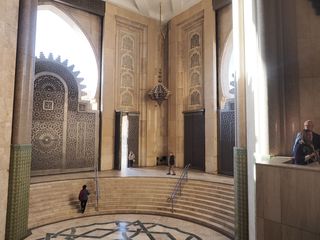
Inside the Hassan II Mosque, a large balcony reserved for women overlooks the main prayer hall. Reached by monumental staircases, it is supported by massive pillars and enclosed by intricately carved wooden railings. This gallery allows women to take part in the prayers while remaining separated from the men, in keeping with traditional practice in many mosques. Its elevated position also provides a unique view of the mosque’s decorative richness, with arches, ornate ceilings, and monumental chandeliers.
The main prayer hall
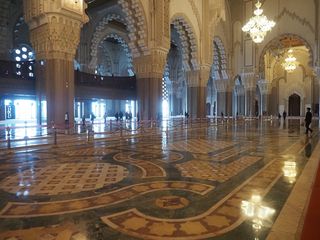
The prayer hall of the Hassan II Mosque covers nearly 20,000 square meters and can accommodate up to 25,000 worshippers. It is structured by massive pillars and illuminated by monumental chandeliers hanging from richly decorated ceilings.
The main section is covered by a continuous carpet, marking the prayer rows and providing comfort for prostration. However, part of the hall is deliberately left in polished marble. This space, designed for circulation and for visitors, can also be used for prayer during major celebrations. The contrast between the carpet and the marble emphasizes both the monumentality of the building and its adaptable function.
The main prayer hall is oriented towards the qibla, the direction of Mecca. The large prayer carpet spread across the floor is marked with parallel lines that indicate each worshipper’s position and help align them in rows. A central red band highlights the axis leading to the mihrab, the niche set into the qibla wall that marks the sacred direction. In addition, during certain ceremonies, a wide red carpet is laid on the marble floor for circulation or processions, separate from the permanent prayer carpet. The entire hall is thus structured to facilitate the arrangement of worshippers and emphasize the unity of collective prayer.
In the center, the mihrab, a niche indicating the direction of Mecca. To its right, the minbar, an elevated pulpit from which the imam delivers the Friday sermon.
The ablution hall
Beneath the mosque, the ablution hall reveals its marble fountains and decorated columns. A place of purification before prayer, and the closing note of our visit.
Music :
- - YouTube video library - Lone Harvest - Kevin MacLeod, (© Lone Harvest by Kevin MacLeod is licensed under a Creative Commons Attribution 4.0 license. https://creativecommons.org/licenses/by/4.0/
- Source: http://incompetech.com/music/royalty-free/index.html?isrc=USUAN1100409
- Artist: http://incompetech.com/
- )
- - YouTube video library - Requiem In Cello - Hanu Dixit
- - YouTube video library - Solo Cello Passion - Doug Maxwell_Media Right Prod
- - YouTube video library - Zombie March
Disclaimer: Despite its appropriateness, copyright issues prevent the use of traditional music in "Casablanca • Hassan II Mosque, Symbol and Excess", hence the use of royalty-free music. Despite our careful selection, some might regret this decision, which is necessary to avoid potential lawsuits. Although difficult, this decision is the only viable solution.