Français (France)
  Nederlands (nl-NL)
 00:00 • intro | 00:20 • the basilic | 02:13 • the Capitol | 02:50 • the forum | 03:35 • The Triumphal Arch of Caracalla and the Monumental Fountain
Personal creation from visual material collected during my trip Morocco 2025 (2025)
• Use the markers to explore the content •
Volubilis and the Roman Heritage of Ancient Morocco
A Roman city in the landscapes of North Africa
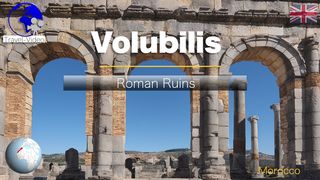
Volubilis is one of the most important archaeological sites in Morocco and one of the best preserved testimonies to Roman presence in the western Maghreb. Located in a fertile agricultural region near the imperial cities of northern Morocco, the ancient settlement still preserves much of its urban organization, including public monuments, administrative spaces, paved streets and residential remains spread across an open plateau overlooking the surrounding countryside.
The video explores several of the major structures that once defined the civic and political life of the city. Standing columns, monumental arches, temple remains and public squares illustrate the importance of Volubilis during the Roman period and reveal the cultural exchanges that connected local Berber populations with the wider Mediterranean world. The site combines architectural remains, archaeological landscapes and traces of imperial urban planning within a setting that remains closely linked to the natural environment of the region.
Monumental spaces at the center of the city
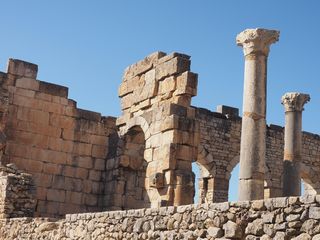
Among the principal monuments visible in the video is the basilica, an imposing administrative and judicial building that once dominated part of the civic center. The surviving columns still convey the scale of the structure and the role it played in the political organization of the Roman city.
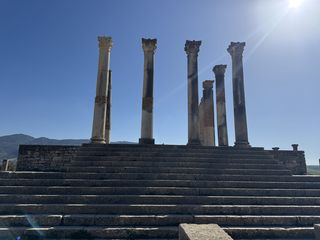
The capitol occupied a prominent position near the forum and formed one of the main religious buildings of Volubilis. Dedicated to the principal deities of the Roman state religion, the temple symbolized imperial authority and the integration of the city into the administrative structure of the Roman Empire. Its elevated position reinforced the monumental character of the civic center.
The forum itself functioned as the central public space of the city. Administrative activities, political gatherings and commercial exchanges were concentrated in this area, whose ruins still make it possible to understand the general organization of the ancient urban layout.
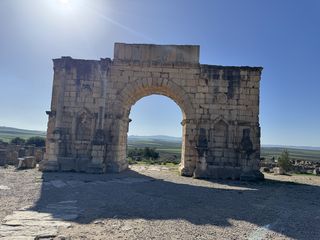
The triumphal arch of Caracalla and the nearby monumental fountain illustrate the representative dimension of Roman urbanism. Built in the early third century, the arch honored the emperor Caracalla and marked one of the ceremonial entrances to the monumental district. Today it remains one of the most recognizable structures of Volubilis.
Between Roman urbanism and regional traditions
Volubilis experienced its principal period of development between the first and third centuries CE, when it served as an important city within the Roman province of Mauretania Tingitana. The surrounding agricultural lands contributed to the prosperity of the settlement, particularly through olive cultivation and regional trade networks connected to other Mediterranean territories.
The organization of the city follows several characteristics typical of Roman urban planning, including structured streets, public squares and monumental civic buildings. At the same time, the site also reflects local influences visible in the adaptation of structures to the terrain, the use of regional materials and certain architectural details that distinguish Volubilis from cities located closer to the central regions of the Roman Empire.
After the gradual withdrawal of Roman administration, parts of the city continued to be occupied during later historical periods before progressive abandonment transformed the site into the archaeological landscape visible today.
What the videos of this site make particularly readable
The videos on this site make the spatial organization of Volubilis especially easy to understand through the use of carefully selected and animated photographs. Progressive transitions allow viewers to follow the alignment of columns, observe the relationships between monuments and perceive the scale of the civic center within the wider landscape.
This approach also highlights architectural textures, surviving stonework and the distribution of urban spaces. The slow visual progression between viewpoints helps reveal details that are often difficult to perceive in rapidly filmed sequences and provides a clearer understanding of how the city functioned as a coherent urban ensemble.
A major archaeological testimony to Roman Morocco
Volubilis remains one of the most significant archaeological sites in Morocco and an essential testimony to the expansion of Roman civilization in North Africa. Through its basilica, forum, capitol and triumphal monuments, the site preserves a remarkably detailed image of ancient urban life at the western edge of the Roman world. The detailed pages linked to the video provide additional historical and architectural information about several of the monuments visible throughout the visit.

Audio Commentary Transcript
Volubilis, one of the most remarkable ancient cities of North Africa, was founded in the 3rd century BCE on a site first occupied by Berber tribes. Later the capital of the Kingdom of Mauretania under Juba II, it experienced exceptional political and economic growth before being incorporated into the Roman Empire in 44 CE. Its monuments – basilica, forum, triumphal arch and mosaic-decorated houses – reflect the fusion of African traditions with imperial culture. Listed as a UNESCO World Heritage Site, Volubilis stands today as a unique testimony to the Romanization of the Maghreb and to the continuity of civilizations in Moroccan history.
The basilica
The basilica of Volubilis reminds us that before becoming a Christian building, the word basilica referred in Roman times to a civil structure.
It was a public hall dedicated to the city’s political, administrative, and judicial life.
Justice was administered there, commercial matters were discussed, and it was where the city’s dignitaries gathered.
In Volubilis, the basilica overlooked the forum — the heart of urban life and a symbol of Roman order rather than religion.
The Capitol
The Capitol was the main temple of a Roman city.
Dedicated to the triad of Jupiter, Juno, and Minerva, it symbolized the presence and authority of Rome throughout its provinces.
Official religious ceremonies and oaths of loyalty to the emperor were held there.
Located near the forum, the Capitol formed, together with the basilica and the administrative buildings, the political and spiritual heart of the city.
The forum
At the heart of Volubilis lay the forum, a vast public square that gathered the city’s political, religious, and commercial life. Surrounded by colonnades and overlooked by the basilica and the Capitol, this open space hosted assemblies, trade, and official ceremonies. A symbol of Roman order, the forum reflected both civic authority and the integration of Volubilis into the Empire.
The Triumphal Arch of Caracalla and the Monumental Fountain
Near the forum stand two of Volubilis’s most emblematic monuments: the triumphal arch and the monumental fountain. Erected in honour of Emperor Caracalla, the arch marked the grand entrance to the Roman city. Close by, the fountain, supplied by an aqueduct, reflected the engineering skills and urban refinement of the time. Together, they illustrate the prosperity and prestige of Volubilis during the imperial era.
The House of the Columns and the Mosaics
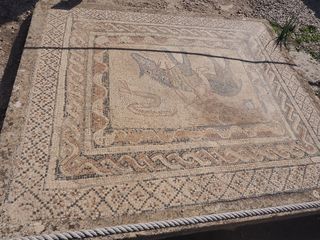
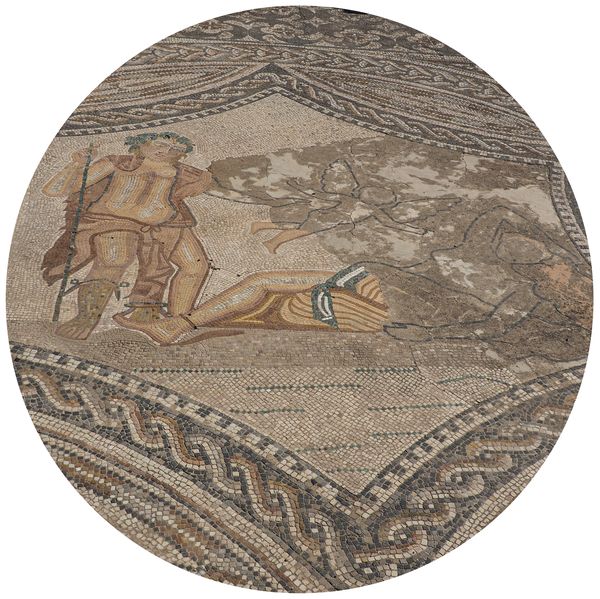
Beyond its official monuments, Volubilis also reveals the private world of its inhabitants. The wealthier homes, such as the House of the Columns, reflect the comfort and refined taste of the local elite. Their mosaics, inspired by Mediterranean models, adorn the floors with mythological scenes, geometric designs, and floral patterns. Through their elegance and technical mastery, they show that Volubilis was far from a remote provincial town — it fully shared in the culture and art of living of the Roman world.
Music :
- - YouTube video library - Forest Lullabye - Asher Fulero
- - YouTube video library - Natasha's Fall
Disclaimer: Despite its appropriateness, copyright issues prevent the use of traditional music in "Volubilis • Roman Ruins at the Heart of Ancient Morocco", hence the use of royalty-free music. Despite our careful selection, some might regret this decision, which is necessary to avoid potential lawsuits. Although difficult, this decision is the only viable solution.