

 Français (France)
  Nederlands (nl-NL)
 The archaeological site of Volubilis, located near the city of Meknes in Morocco, is one of the most significant ancient complexes in North Africa. Initially a Mauretanian settlement and later part of the Roman Empire, it reflects the cultural and economic vitality of the region during antiquity. Excavations conducted since the 19th century have uncovered a well-organized urban layout and remarkably preserved remains, offering valuable insights into Roman urban life in Africa. Listed as a UNESCO World Heritage Site since 1997, Volubilis stands as a key example of the interaction between local and Mediterranean civilizations and remains an essential reference for the study of the Roman world in Africa.

Morocco • Archaeological Site of Volubilis
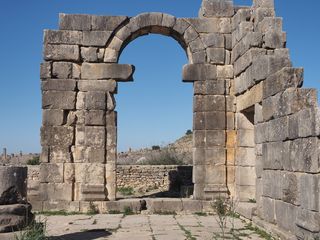
Morocco • Archaeological Site of Volubilis
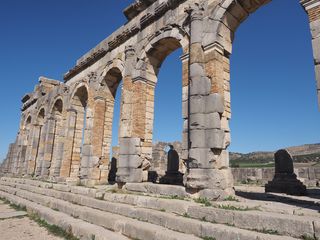
Morocco • Archaeological Site of Volubilis
Monument profile
Archaeological Site of Volubilis
Monument category: Archaelogic site
Monument family: Archaeological
Monument genre: Archaeological site
Cultural heritage: Roman antiquity
Geographic location: Volubilis • Morocco
Construction period: 3rd century BC
This monument in Volubilis is inscribed on the UNESCO World Heritage List since 1997 and is part of the serial property "Archaeological Site of Volubilis".See the UNESCO monuments featured on this site
• Links to •
• List of videos about Volubilis on this site •
Volubilis • Roman Ruins at the Heart of Ancient Morocco
History of the Archaeological Site of Volubilis
The archaeological site of Volubilis, located near Meknes in northern Morocco, stands as one of the most significant vestiges of ancient civilization in North Africa. Once a flourishing Roman provincial city, it bears witness to the complex interplay of local Berber traditions and imperial power, as well as to the evolution of a multicultural society that developed on the fringes of the Mediterranean world. Its ruins encapsulate over a millennium of history, from its pre-Roman origins to its rediscovery in the modern era.
Political and Social Context of Its Foundation
Long before Roman rule, the fertile plains surrounding Volubilis were inhabited by Berber communities who maintained commercial and cultural ties with Phoenician and later Carthaginian traders. In the late 1st century BCE, the region became part of the Kingdom of Mauretania, ruled by the Berber prince Juba II. Educated in Rome and married to Cleopatra Selene, daughter of Mark Antony and Cleopatra VII, Juba II represented a rare synthesis of African leadership and Roman influence.
It was under his reign that Volubilis emerged as an administrative and cultural center. The construction of monumental buildings and the adoption of Roman urban models reflected the king’s political ambitions: to consolidate his authority over a diverse population, to integrate Mauretania into the Roman sphere, and to demonstrate loyalty to Augustus. These projects also served to promote economic prosperity through agriculture and trade, particularly the production of olive oil, which became a cornerstone of the city’s wealth.
At the same time, Volubilis symbolized a delicate balance between independence and allegiance. While the city was firmly tied to Roman administration, it retained local administrative customs and a population composed largely of Berbers, freedmen, and descendants of Punic settlers. The urban landscape that developed during this period combined the pragmatic efficiency of Roman planning with regional adaptations suited to local conditions.
Incorporation into the Roman Empire
In 44 CE, following the assassination of King Ptolemy, son of Juba II, the Kingdom of Mauretania was annexed by Emperor Claudius and divided into two provinces. Volubilis was integrated into Mauretania Tingitana, becoming one of its principal cities. This transition marked the beginning of the most prosperous era in its history.
The city adopted the full trappings of Roman civilization: a forum, basilica, capitolium, and triumphal arch formed the civic core, while an extensive network of streets, baths, and aqueducts structured the urban fabric. The Roman administration encouraged the settlement of veterans and merchants, who contributed to a mixed and cosmopolitan population. Local elites, often of Berber origin, gained Roman citizenship and assumed magistracies, integrating the city into the empire’s political hierarchy.
Volubilis prospered thanks to its agricultural hinterland, which supplied olive oil, grain, and wild animals to the wider Mediterranean markets. The archaeological remains of oil presses and storage facilities attest to the city’s economic vitality. By the 2nd century CE, Volubilis had reached its peak, with an estimated population of around 20,000 inhabitants—an impressive number for a provincial settlement on the empire’s southern edge.
Major Historical Events and Transformations
The city’s remote location on the empire’s frontier exposed it to both opportunity and danger. During the 3rd century crisis, when internal instability weakened Rome’s control, Volubilis was effectively left to its own fate. The Roman army withdrew from the region around 285 CE, but the local population remained. The continuity of habitation after the official end of imperial administration is one of Volubilis’s most distinctive features.
In the centuries that followed, the city adapted to new circumstances. A Christian community flourished during the late antique period, as evidenced by funerary inscriptions and the remains of ecclesiastical buildings. With the Arab conquest of North Africa in the 7th century, Volubilis—known then as Walīlī—became part of the emerging Islamic world. It maintained a regional importance due to its fertile lands and strategic position.
A decisive historical episode occurred at the end of the 8th century when Idris I, a descendant of the Prophet Muhammad fleeing the Abbasids, found refuge in the region. He was welcomed by the local Berber tribes and established what became the first Moroccan Islamic dynasty, the Idrissids. Volubilis, temporarily serving as their base, thus bridged two civilizations—the Romanized and the Islamic. However, as the new capital developed at Fez, the site gradually declined and was largely abandoned by the 11th century.
In later centuries, the site suffered extensive spoliation. Under the rule of Sultan Moulay Isma’il in the 17th century, stones from Volubilis were reused in the construction of the imperial city of Meknes. The earthquake of 1755 further devastated what remained of the ancient structures, leaving the ruins buried and forgotten until their rediscovery in the 19th century.
Global Context and Architectural Parallels
The development of Volubilis paralleled a broader phenomenon across the Roman world: the establishment of urban centers in newly integrated territories. From Hispania to Syria, the empire built cities that served as instruments of control and cultural assimilation. Like Pompeii, Timgad, or Palmyra, Volubilis reflected the Roman ideal of civic life, adapted to local geographies and traditions.
In this global context, Volubilis stands out for its peripheral position and remarkable resilience. It represents the southernmost manifestation of Roman urbanism, a frontier outpost where imperial architecture met African landscape. The site encapsulates both the diffusion of Roman architectural models and the adaptability of these forms to non-Italian settings. Its longevity demonstrates the enduring influence of Roman civic planning long after the empire’s retreat.
Decline, Rediscovery, and Modern Restoration
Rediscovered in the late 19th century, Volubilis soon became a focus of archaeological exploration. The first systematic excavations took place under the French protectorate in the early 20th century. Archaeologists cleared the basilica, capitol, and forum, while uncovering numerous mosaics that revealed the city’s artistic sophistication. Restoration campaigns in the mid-20th century aimed to stabilize the ruins and reconstruct key monuments, though some interventions later drew criticism for their excessive reconstruction.
Following Moroccan independence, preservation efforts became more scientifically guided. Collaboration between Moroccan and international institutions led to renewed excavations and a comprehensive management plan. In 1997, Volubilis was inscribed on the UNESCO World Heritage List for its exceptional testimony to the interaction between local and Roman cultures and for the integrity of its urban fabric.
Cultural Role and Modern Significance
Today, Volubilis occupies a central position in Morocco’s cultural identity. It embodies the depth of the nation’s historical roots and its connection to the Mediterranean world. As one of the most visited archaeological sites in the country, it serves both educational and touristic purposes. The site’s presentation to the public has evolved to balance accessibility with preservation: pathways and interpretative materials guide visitors through the remains without compromising the integrity of the ruins.
Volubilis also holds symbolic value as a bridge between civilizations. Its continuity—from Berber to Roman to Islamic contexts—illustrates the layers of Moroccan history and the resilience of its cultural landscapes. Occasionally, the site hosts cultural or artistic events, though such activities are carefully regulated to protect the fragile monuments.
Conservation Challenges and Heritage Management
Preserving Volubilis poses ongoing challenges. The calcareous stone used in construction is vulnerable to erosion, while mosaics face deterioration from exposure to sunlight and rain. Vegetation, tourism, and urban encroachment from nearby Moulay Idriss Zerhoun add further pressure. Conservation policies now emphasize preventive maintenance, vegetation control, and monitoring of structural stability.
The site’s inclusion on the UNESCO World Heritage List has reinforced its protection and provided an international framework for its management. Restoration initiatives aim to safeguard not only the monuments but also the surrounding landscape, ensuring that the archaeological remains continue to convey their historical and aesthetic significance.
Volubilis thus endures as a vital archaeological and cultural landmark—a place where the traces of empire, religion, and local tradition converge. Its ruins, both majestic and fragile, remind us of the dynamic exchanges that shaped the ancient Mediterranean world and continue to influence the identity of Morocco today.
Architecture of the Archaeological Site of Volubilis
The archaeological site of Volubilis in northern Morocco preserves one of the clearest provincial expressions of Roman urbanism in North Africa. Beyond its iconic forum, basilica, and triumphal arch, the city’s fabric—streets, houses, workshops, baths, presses, drains—records how Mediterranean engineering, aesthetics, and planning were adapted to a fertile plateau on the edge of empire. The architecture is notable not only for its formal monuments but also for the everyday infrastructures that made a frontier town durable, ventilated, and economically productive.
Technological and Architectural Innovations
Volubilis was laid out according to the orthogonal logic typical of Roman planning. A paved cardo and decumanus articulated the main traffic axes, while a dense grid of secondary streets organized neighborhoods, markets, and service lanes. This geometric order supported three innovations central to the site’s longevity: water management, load-bearing mastery, and thermal comfort.
First, water: conduits in terracotta and stone, gradient-controlled gutters, and a network of covered drains collected spring water from the surrounding hills, distributed it to fountains, houses, and baths, and evacuated runoff during seasonal rains. The system minimized erosion on sloping streets and reduced stagnant water within the dense urban core.
Second, structure: widespread use of arches and barrel vaults allowed wider spans in bath complexes, storerooms, and porticoes. Builders combined opus quadratum (regular cut-stone courses) with mixed masonry—rubble cores pinned by ashlar chains often described as forms akin to opus africanum—to improve stiffness and energy dissipation under minor seismic shocks. Relieving arches over doorways and windows limited concentrated stresses.
Third, climate: houses and public buildings rely on passive strategies. Peristyle courts and atria promote cross-ventilation; thick stone walls and shaded porticoes buffer diurnal temperature swings; tiled roofs shed sudden winter rains yet allow the attics to vent hot air in summer. In baths, hypocaust floors and flue systems regulated temperature differentials between hot, warm, and cold rooms with remarkable precision.
Materials and Construction Methods
Construction drew on local limestone for walls, columns, and paving. Its workability enabled regular ashlar in civic buildings and durable curb stones along main streets. Harder igneous or metamorphic stones were sometimes used in foundations or for press bases in the olive-oil quarters. Mortars—lime-based with varying aggregate—bound rubble cores and bedding for pavements; in wet areas, waterproof mixes and pot-sherd additives improved performance.
Roofing followed the Mediterranean tegula-and-imbrex system: flat pan tiles overlapped by curved cover tiles to ensure drainage and air circulation under the roof skin. Floors range from beaten earth in modest rooms to mosaics set in multiple bedding layers; thresholds and high-traffic rooms use larger stone slabs. Where prestige demanded, columns, capitals, and statue bases could be imported or reworked from finer stones, but most carving was executed locally, with crisp profiles and practical proportions.
These methods were not merely conservative. The integration of industrial architecture—the olive-oil presses with beam or lever frames, settling basins, and channelled pavements—shows how production was literally built into the urban plan. The concentration of presses near water and transport routes reflects a sophisticated coupling of architecture with the city’s economic engine.
Influences and Artistic Language
Volubilis blends Roman civic typologies with regional sensibilities. The forum-basilica-capitolium triad follows imperial models in massing and axiality, yet elevation details—column spacing, entablature simplification, and the pragmatic use of local stone—betray a frontier aesthetic that values durability and clarity over ornamental excess. Domestic architecture is unequivocally Mediterranean—peristyle courts, triclinia opening to gardens—but the decorative program often mixes classical myth with geometric and floral motifs resonant in North African workshops.
The triumphal arch dedicated to Caracalla demonstrates the circulation of imperial iconography, while its construction in local limestone underscores resourceful adaptation. Inscriptions and sculptural fragments locate Volubilis within Latin administrative culture, whereas the repeated use of vegetal scrolls, meanders, and braided patterns in mosaics reveals an artisanal vocabulary rooted in regional tastes and materials.
Urban Organization and Notable Design Elements
Within an enceinte exceeding 2.5–2.6 km in length, the planned city covers roughly 40–45 hectares. Eight major gates punctuate the walls, funnelling movement along the main streets. The forum anchors the civic center; to one side stands the basilica, a long hall with internal colonnades used for legal and commercial affairs; behind it rises the capitol, raised on a podium and once fronted by a deep portico. The Caracalla Arch frames the principal north–south axis, functioning as both monument and traffic marker.
Residential quarters line the gridded streets, where colonnaded sidewalks, shop fronts, and service alleys form a legible interface between public and private space. The baths repeat a rational sequence—apodyterium, frigidarium, tepidarium, caldarium—organized to minimize heat loss and optimize water flow. Street paving shows careful cambering, with wheel ruts attesting to long-term cart traffic. Throughout, the design fuses clarity of circulation with robust detailing: curb stones to protect façades, threshold steps to manage interior levels, and culverts dropping into larger collectors at intersection points.
Statistics and Anecdotes
Archaeology has recorded hundreds of structures, including several dozen mosaic-floored houses and multiple bath complexes. The basilica measures on the order of 40+ meters in length—an imposing scale for a provincial town—while the triumphal arch rises to several meters above the street line, once accented by marble revetment and bronze statuary. Industrial zones contain numerous presses, settling tanks, and storage rooms, highlighting the architectural footprint of oil production.
Local lore, compiled over centuries of ruin and reuse, tells of colossal stones moved by legendary giants and of ancient columns serving as waymarks across the Zerhoun plain—stories that, while unhistorical, reflect the enduring presence of the architecture in regional memory.
Recognition and Conservation Challenges
The architectural coherence of Volubilis—its intact street grid, legible civic center, and extensive domestic remains—underpins its standing as a world-class reference for Roman provincial urbanism. Its protection status acknowledges both the integrity of materials and the readability of the plan, rare for a city so far from the Italian core.
Conservation faces familiar Mediterranean challenges: calcareous stone susceptible to thermal stress and granular decay; mosaics exposed to ultraviolet radiation, rainfall, and salt crystallization; vegetation undermining joints and drains; and visitor pressure on fragile pavements. Stabilization strategies prioritize preventive maintenance—repointing with compatible mortars, controlling runoff, managing plant growth, and rotating public access in sensitive houses. New visitor facilities are positioned to preserve viewsheds and minimize visual intrusion, maintaining the architectural dialogue between city and landscape.
⸻
In sum, the architecture of Volubilis is a study in adapted classicism: Roman typologies translated into local stone, engineered for climate and slope, and interwoven with productive landscapes. Its streets and structures offer a rare, three-dimensional handbook of provincial design—how a city was planned, built, ventilated, serviced, decorated, and ultimately sustained at the empire’s edge.